Peaceful Coexistence
 Linkedin
 Google +
White paper outlines how Xinjiang has always been an integral part of the nation
China’s State Council Information Office issued a white paper, titled Historical Matters Concerning Xinjiang, on July 21, emphasizing that Xinjiang Uygur Autonomous Region in northwest China has long been an inseparable part of Chinese territory.
Xinjiang has never been known as East Turkistan, and there has never been any state known as East Turkistan, the white paper said.
“The advocacy of this so-called state has become a political tool and program for separatists and anti-China forces attempting to split China,” the document said. History cannot be tampered with and the facts are indisputable.
The region is experiencing its most remarkable period of development and prosperity, which has been closely related to the rest of China’s throughout its long history. While Chinese territory underwent periods of division and unification, unification and development have always been the overall trend. Small kingdoms or separatist regimes existed in the Central Plains in different periods. Xinjiang too had several local regimes. Nevertheless, the region was ultimately united.
In different periods in Xinjiang there were city states, nomadic states, princedoms, kingdoms, khanates, vassal states, tributary states and other forms of local regime. But these were all local regimes within the territory of China; they were never independent countries. Those local regimes had a strong sense of national identity, and acknowledged themselves as branches or vassals of the Central Plains authorities.
Ethnic Cultures
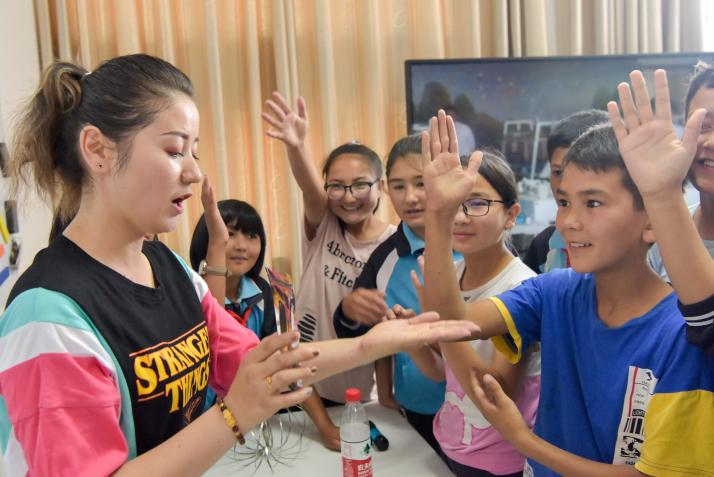
Xinjiang has been a multi-ethnic region since ancient times. Various ethnic groups entering Xinjiang in different periods brought technology, culture and ideas, folk customs and other aspects of their lives, promoting economic and social development through exchanges and integration. They grew and integrated despite periods of isolation and conflict, and shared good fortune and hardship. All of them have made important contributions to exploring, developing and protecting Xinjiang, and they are all masters of Xinjiang, the white paper said.
Xinjiang is one of the provincial-level administrative regions with the most ethnic groups in China, 56 in total. The Uygur, Han, Kazak and Hui have populations of 1 million and above, and the Kirgiz and Mongol have populations exceeding 100,000 each.
The ethnic groups of China, including those in Xinjiang, are economically interdependent and embrace one another’s culture. They are a unified whole that is impossible to separate. They are members of the Chinese nation. The ethnic groups in Xinjiang have guarded against foreign aggression, opposed separatist activities, and safeguarded national unification, the white paper said.
It stressed that the Uygur ethnic group was formed through a long process of migration and integration. The Uygurs are not the descendants of the Turks. Some Pan-Turkism advocates with ulterior motives have described all people speaking languages in the Turkic language family as Turks, confusing a language family with an ethnic group, the white paper said. The key to the prosperity and development of ethnic cultures in Xinjiang is having a stronger sense of identity with the Chinese culture, according to the white paper.
Throughout history, whenever the Central Government exercised effective governance over Xinjiang and society of the region was stable, exchanges and communication between ethnic cultures in Xinjiang and the culture of the Central Plains ran smoothly, and the economy and culture of Xinjiang flourished.
To prosper and develop, Xinjiang’s ethnic cultures must keep pace with the times, be open and inclusive, engage in exchange and integration with other ethnic cultures in China and in mutual learning with other ethnic cultures throughout the world, and play their role in fostering a shared spiritual home for all China’s ethnic groups, the white paper said.

Multiple Religions
Xinjiang now has multiple religions, including Islam, Buddhism, Taoism and Christianity. Its history shows that multiple religions have long coexisted there, with one or two predominant. The region’s religious structure is characterized by blending and coexistence.
China upholds separation of religion from the government. No religious organization is allowed to interfere in political and government affairs. Freedom of religious belief is fully respected and protected as stipulated in the Chinese Constitution.
Citizens’ freedom to believe in, or not to believe in, any religion is respected in Xinjiang. The regional government has zero tolerance for any action that creates disputes between believers and non-believers, between believers of different religions, and between believers of the different sects of a religion.
Xinjiang also upholds equality of all religions and equality for all individuals before the law. Believers and non-believers enjoy equal rights and obligations, and all law violators, whatever their social background, ethnicity, and religious belief, will be punished in accordance with the law, the document said.
To survive and develop, religions must adapt to their social environment. The history of religions in China shows that only by adapting to the Chinese context can they be accommodated within Chinese society.
Islam is neither an indigenous nor the sole belief system of the Uygur. In the process of accepting Islam, the ancestors of the Uygurs and Kazaks integrated it with local faiths and traditions, while absorbing the cultures of other ethnic groups in the region and from inland areas. Some of their original religious concepts, rituals and customs remained as they evolved. Through interaction with these elements, Islam in Xinjiang gradually developed distinct local and ethnic features.
Since the late 1970s and early 1980s, particularly since the end of the Cold War, the surge in religious extremism around the world has caused a rise in religious extremism in Xinjiang. This resulted in an increasing number of incidents of terror and violence that pose a serious danger to the lives and property of the people in the region and to social stability.
Drawing lessons from international experiences and in view of the reality of the region, Xinjiang has taken resolute action to fight terrorism and extremism in accordance with the law, and clamp down on the spread of religious terrorism. Through these efforts Xinjiang has responded to the public’s expectation of security for all ethnic groups, protected the basic human rights, and maintained social harmony and stability.
Xinjiang’s fight against terrorism and extremism is a battle for justice and civilization against evil and barbaric forces. It deserves support, respect and understanding.
Xinjiang Has Long Been Inseparable Part of Chinese Territory
From the Han (206 B.C.-A.D. 220) to the middle and late Qing (1644-1911) dynasties, the vast areas both north and south of the Tianshan Mountains in Xinjiang were called the Western Regions. Xinjiang was formally included in Chinese territory in the Han Dynasty.
In 138 B.C. and 119 B.C., the Western Han (206 B.C.-A.D. 25) Government dispatched an envoy to the Western Regions, who convinced the Rouzhi and Wusun peoples to form an alliance to fight the Xiongnu who lived in north China. They then set up four prefectures in key passageways from the Central Plains to the Western Regions.
In 101 B.C., the Western Han began to send troops to transform wastelands to arable land in Luntai and some other places in Xinjiang, and appointed local officers to command them.
In 60 B.C., the Xiongnu king who ruled the areas north of the eastern Tianshan Mountains surrendered to the Han Government, which thereby incorporated the Western Regions into the Han territory.
The Kingdom of Wei of the Three Kingdoms Period (220-265) adopted the Han system, stationing a garrison commander to rule the Western Regions.
The Western Jin Dynasty (265-420) stationed a garrison commander and a governor to exercise military and political administration over the Western Regions.
The Sui Dynasty (581-618) ended the long-term division of the Central Plains, and expanded the areas in the Western Regions that adopted the system of prefectures and counties.
In the Tang Dynasty (618-907), the Central Government strengthened its rule over the Western Regions by establishing the Grand Anxi Frontier Command and the Grand Beiting Frontier Command to administer the region.
In the Song Dynasty (960-1279), local regimes of the Western Regions paid tribute to the Song.
In the Yuan Dynasty (1206-1368), the Central Government strengthened administration over the Western Regions by establishing the Beiting Command and the Pacification Commissioner’s Office to manage military and political affairs.
In the Ming Dynasty (1368-1644), the imperial court set up the Hami Garrison Command to manage local affairs, and then set up six garrison cities to support local administration.
In the Qing Dynasty, the imperial court quelled a rebellion launched by the Junggar regime, defining the northwestern border of China. It then adopted more systematic policies for governing Xinjiang. In 1884, it established a province and renamed the Western Regions Xinjiang, meaning land newly returned.
In 1912, Xinjiang became a province of the Republic of China.
In 1949, the People’s Republic of China was founded, and Xinjiang was liberated peacefully. In 1955, Xinjiang Uygur Autonomous Region was established.