Development Symphony
 Linkedin
 Google +
Cities in Yangtze delta coordinate their growth strategies to gain international competitiveness
Few people know better than Cao Yi how to live life in the fast lane and literally get the most out of it. In her mid-30s, Cao works in Shanghai but has chosen to live in Suzhou, nearly 110 km away, where the cost of living is much cheaper. Spanning two cities daily has become viable thanks to the high-speed railway system, China’s new shuttle bus for commuters who rush to work every day in a different city.
China’s earlier trains ran at about 60 km per hour, before the high-speed dragons entered, whipping up the speed to some 350 km per hour. They have connected cities, laying a solid foundation for the emergence of clusters, mini galaxies of cities with different levels of development hurtling toward balanced growth by sharing resources and experiences.
Rise of a megalopolis
The concept of pursuing integrated development in the Yangtze River Delta (YRD) and adding more power to the economy originated in the 1990s.
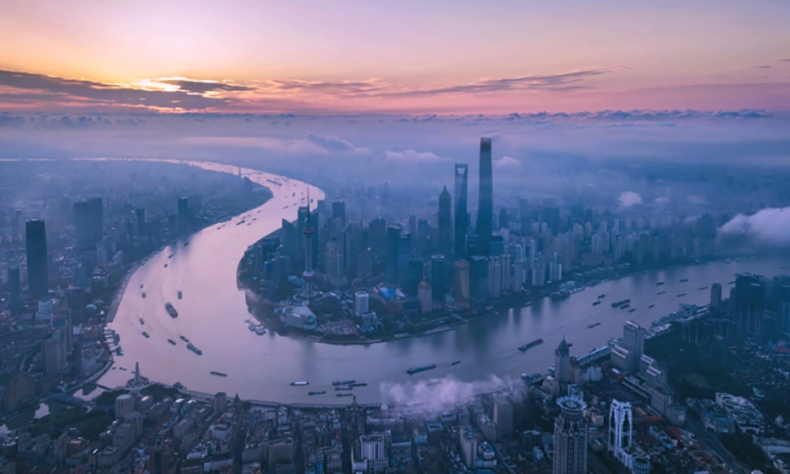
The Yangtze is the longest river in China, flowing all the way from the Qinghai-Tibet Plateau in the west to the East China Sea. The YRD cluster, whose development plan was first unveiled in 2016, initially consisted of Shanghai, China’s financial center, as well as cities in Jiangsu, Zhejiang and Anhui provinces, which have strong manufacturing bases.
The integration drive received a boost when President Xi Jinping announced at the First China International Import Expo in Shanghai in 2018 that the integration of the YRD region would become a new national strategy and that the delta would develop in tandem with key visions like the Belt and Road Initiative.
Subsequently, this year, seven new cities in Anhui were added to the cluster, expanding its membership to 41.
“When we talk about a city cluster, we are not talking about its scale or population, but the large economic entity behind it. The YRD city cluster is the most powerful city cluster economy in China,” Zhang Jie, a researcher with the National Academy of Development and Strategy, Renmin University of China, told Beijing Review.
The bloc’s economic advantages also derive from its link to the Belt and Road Initiative and the Yangtze River Economic Belt, an economic zone comprising nine provinces and two municipalities along the Yangtze with major industries, ports, airports and highways.
It showed its economic clout in the first three quarters of 2019 when its GDP reached 21.1 trillion yuan ($3 trillion), nearly 24 percent of the national GDP though it accounts for only about 4 percent of China’s land area.
In comparison, the GDP of the Beijing-Tianjin-Hebei city cluster, composed of two municipalities and one province in north China, and the Guangdong-Hong Kong-Macao Greater Bay Area encompassing two special administrative regions and nine cities reached 8.51 trillion yuan ($1.21 trillion) and 10.87 trillion yuan ($1.54 trillion), respectively.

Introducing innovations
In history, Jiangnan, which literally means south of the Yangtze, was an area in south China renowned for its advanced economy, education and culture. Called “the hometown of rice and fish,” it was praised by poets for its natural beauty and rich culture and saw thriving trade in silk and tea, using the Yangtze waterway.
The culture of the ancient region is being resurrected with the construction of a model area to demonstrate ecologically friendly development. A plan for the 2,300-sq-km area running through Shanghai, Jiangsu and Zhejiang was approved by the State Council, China’s cabinet, in November.
Ma Chunlei, head of the Shanghai Municipal Development and Reform Commission and the Yangtze River Delta Regional Cooperation Office, explained the demonstration area’s two missions.
In this region, there are many stakeholders and administrative departments. The demonstration area should provide a model for cross-administrative cooperation, showing how different authorities can work together to surmount administrative barriers or differences to promote ecological progress and economic and social development. It should also acquire experience in institutional innovation and project coordination that can be replicated in other areas.
“It is a pioneering move,” Zhou Feixiang, Deputy Director of the Ecological Environment Institute, China Academy of Urban Planning and Design (CAUPD), told Beijing Review. “It starts small [with 660 sq km], then will apply the innovative achievements to a larger area and finally, lead to region-wide implementation, which will create a new model of environmentally friendly high-quality development.”
Zhou said the YRD area was chosen for the project as its cities are geographically close, have cultural affinity and close people-to-people links, and share a common historical background. Also, they have a sound economic foundation.
The G60 Science and Innovation Corridor, a hi-tech manufacturing zone, was launched last year to maximize entrepreneurship in scientific innovation and distribute the fruits of technological and economic development. Named after an expressway in the area, it connects Shanghai and eight other cities in the delta.
“The new technologies and innovation achievements in Shanghai are being transferred to Zhejiang, injecting new vitality into the province’s high-quality development,” Nan Cunhui, Chair of the Chint Group, a leading industrial electrical equipment and new energy company based in Zhejiang, told China Daily. “Since the official launch of the corridor last year, nine industrial cooperation demonstration parks have started construction and more than 80 major collaboration projects have been signed.”
Growth factors
Liu Yanpeng, a senior engineer with the CAUPD’s Water System Planning Research Institute, toldBeijing Review the YRD area faces ecological imbalances, including dramatic changes in the landscape, and air, water and soil pollution.
It is essential to overcome the administrative, geographical and policy barriers to formulate a common code of conduct for the integration of the YRD, Liu said.
Infrastructure integration is another necessity. Zhang advocated further developing the high-speed railway, pointing out how it is aiding industrial linkages and transfers.
For example, in 2012, secondary industries such as manufacturing accounted for 39 percent of all industries in Shanghai, the central city in the cluster, while tertiary industries accounted for 60 percent. But as a result of coordinated development, many manufacturing companies shifted to neighboring cities, leaving finance, research and development, and professional services in Shanghai. Secondary industries now account for 29.7 percent of Shanghai’s industries.
Meanwhile, Shanghai’s tertiary industries like services have grown to 69.9 percent. The high-speed railway has played a big part in this shift.
Zhang said it is a good opportunity to advance the integration of infrastructure, including expressways, subways as well as telecommunications such as 5G. How local governments coordinate and communicate on mapping economic development is also crucial. There has to be coordinated and systematic cooperation for integrated development.
He said market integration is another indispensable part of economic integration though it is often ignored or is hard to achieve due to the varying economic development levels of different cities. For instance, Shanghai has a highly developed open market system and superior talent, but it is not the same in some satellite cities. Therefore, the free and market-oriented flow of elements becomes a key issue in the integration of the YRD.
“Given that global industrial competition is fierce, each city aspires to have sophisticated industries, which leads to homogeneous competition,” Zhang said. But different places have different natural endowments, different incentives for technology innovation and different capacity for attracting high-level elements, and require differentiated development.
Shanghai’s forte is finance, automobile manufacturing and equipment manufacturing; Hangzhou, cradle and home of tech giant Alibaba, has the Internet, information technology and the digital economy in its genes; and Nanjing is famous for its electronics, petrochemical engineering and steel industry.
Global status
From a global perspective, the YRD city cluster currently lags behind major clusters in the U.S, Japan, northwest Europe and the UK. It has a relatively low per-capita GDP and a lower level of economic development and innovation capacity, according to Zhang.
By 2025, the top 600 cities in the world will contribute 60 percent of global GDP growth and the competition will be among the major clusters as they represent the highest production capacity of a region or a nation, said global consultancy McKinsey & Company.
However, Zhang said the YRD city cluster has the latecomer’s advantages, as well as a large population and a solid foundation of industries. To hone its competitive advantages, it should speed up its domestic impetus and innovation-driven development.
He suggested developing an orderly, coordinated and modern industrial chain system for the harmonious growth of industries.
“Whether the YRD city cluster can be on par with major city clusters in the world depends on whether such an industrial system can be developed,” he said. “Moreover, local governments should not fixate on short-term benefits. They should focus on systematic development of the whole region that can bring enormous benefit to all.”
Source: Beijing Review