The Two Sessions Shed Light on China’s Political System
 Facebook
 Twitter
 Linkedin
 Google +
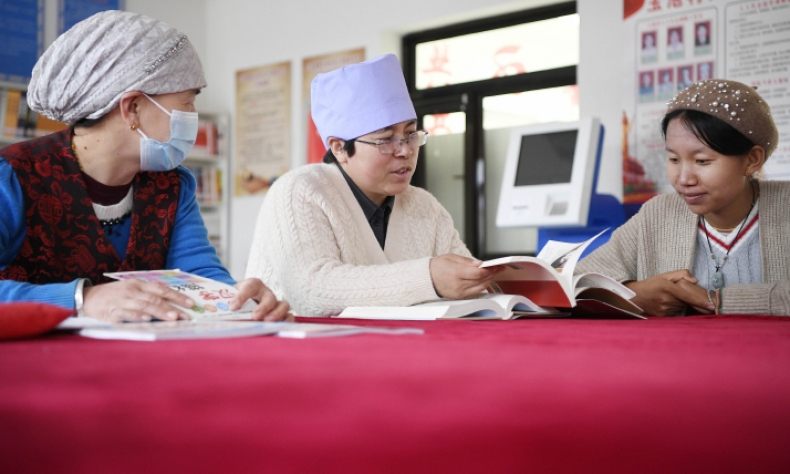
The interests of the people are paramount, this is how democracy goes in China.
The annual sessions of the National People’s Congress (NPC), China’s top legislature, and the National Committee of the Chinese People’s Political Consultative Conference, the top political advisory body, collectively known as the Two Sessions, have long been criticized in the self-proclaimed democratic Western world as putting on a show. However, the prophets of the Western world themselves have different views on democracy.
Renowned U.S. scholar Noam Chomsky said the novel coronavirus epidemic makes it very difficult for the West to return to the past, and so does their declining democracy. According to Francis Fukuyama, the author of The End of History, the state’s capacity and people’s trust in the government are more important than the type of the regime. Author Graham Allison, who coined the term Thucydides trap, called on the United States to “face ugly facts about our own failures” and learn from China.
After all, China has endured all criticism, basically contained the outbreak, won the trust of its people and resumed production. The Two Sessions, postponed for over two months, kicked off recently. So this time, instead of casting doubts on Chinese democracy, why don’t critics have a little patience and try to learn something from it?
I want to point out that one important decision made at the Fourth Plenary Session of the 19th Communist Party of China (CPC) Central Committee in October 2019 was to “vigorously develop the socialist democracy.” Article 3 of the decision is about “upholding and improving the system of institutions through which the people run the country and developing socialist democracy.” Article 1, which is a kind of brief for the whole document, is about “the great significance and overall requirements of upholding and improving the system of socialism with Chinese characteristics and advancing the modernization of China’s system and capacity for governance.” Article 2 is on “upholding and improving the system of institutions for Party leadership and improving the Party’s capacity to practice scientific, democratic and law-based governance.”
Some Western observers would say this further proves that the Chinese democracy is subservient to the CPC and cannot be recognized as a true democracy. But don’t forget about charismatic authority, the kind that was highly spoken of by European thinker Max Weber. Today such types of politicians are rare in the West, as those we’ve seen during the pandemic are more Hollywood politicians. However, Weber didn’t see that a political party may also be charismatic.
In the early days of the epidemic outbreak in China, one of the most widely praised quotes among the Chinese was, “Don’t be afraid; as doctors and CPC members, we will go up first.” It touched and encouraged many. As a matter of fact, CPC members have indeed rushed to the frontlines of the fight against the virus and hundreds of them gave up their lives heroically. What could better exemplify the close relationship between a political party and the people than this quote?
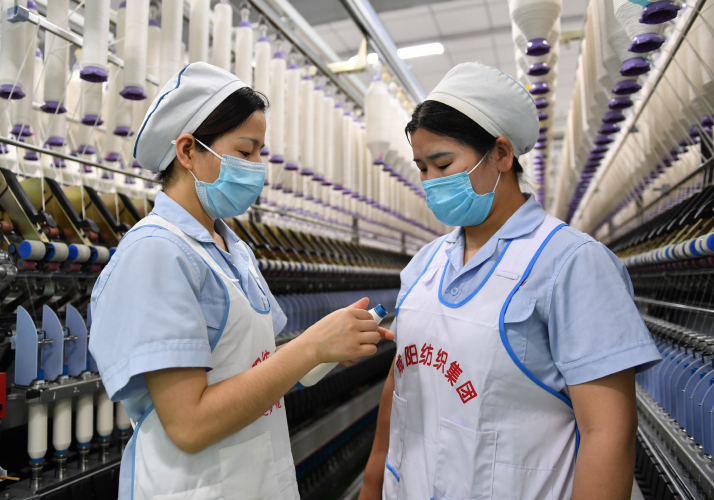
He Fei (left), a deputy to the NPC and a textile worker, interacts with a colleague in her workshop in Xianyang, Shaanxi Province in northwest China, on May 13 (XINHUA)
Democracy explained
China’s leadership is based on democracy and the rule of law. The CPC refers to this as “from the masses, to the masses.” The Constitution states that “all power belongs to the people” and that the People’s Republic of China (PRC) is based on the alliance of workers and farmers. Western politicians tend to criticize China as a communist country and Western scholars believe that China practices state capitalism, the worst form of capitalism. In this way, they try to persuade themselves that there is nothing worth learning from China, even though it is far more efficient than Western countries.
But does China actually practice state capitalism? Now, let’s take a look at the NPC deputies. Who are they?
Of all the 2,987 deputies to the 12th NPC (2013-17), workers and farmers accounted for 13.42 percent, professional and technical personnel 20.42 percent, and cadres from the CPC and the government 34.88 percent. In addition, deputies from the People’s Liberation Army and armed police (including commanders and soldiers) accounted for 9.3 percent, and deputies representing Hong Kong, Macao, and Taiwan 2.1 percent. Deputies who were members of non-Communist parties or personages without party affiliation, religious believers and members of literary and artistic groups accounted for 20.22 percent. Women accounted for 23.4 percent and members of minority ethnic groups 13.69 percent.
Among the 2,980 deputies to the 13th NPC (2018-22), workers and farmers accounted for 15.7 percent, professional and technical personnel 20.57 percent, and cadres from the CPC and the government 33.93 percent. Women accounted for 24.9 percent and members of minority ethnic groups 13.69 percent.
It seems a little bit different from the classical Marxist theory, as the number of intellectuals and members of other political parties exceed workers and farmers. However, intellectuals are also considered as socialist workers in China. Some Chinese scholars hold the view that the CPC is a national party that has inherited the Confucian traditions and does not represent only a particular class or stratum. Other scholars emphasize the neutrality of the Chinese Government—being neutral to all classes.
The CPC calls this “the Three Represents,” which means the CPC should always represent the advanced productive forces, the orientation of China’s advanced culture, and the fundamental interests of the overwhelming majority of the Chinese people. President Xi Jinping himself puts a strong focus on cultivating and maintaining the advanced nature of the CPC. No matter which sector of society you come from, once you become a Party member, you must discipline yourself according to the Party’s ideology and rules.
It is also mentioned in the decision that “the number of grassroots NPC deputies should be increased.” If we compare the composition of the deputies to the 12th and 13th NPC, we can see that cadres from the CPC and the government account for less than 40 percent and have decreased a little bit. Meanwhile, workers from all over the country in different professions and with diverse backgrounds make up the majority and their proportion has increased, not to mention that all 55 ethnic minorities have their own deputies. This makes it possible for representatives from all walks of life to be present when the deputies work together on any bill related to national welfare and the people’s livelihood.
If we look at Western representative democracy, I need not point out how many people come from the top of the pyramid, and how many political leaders come from wealthy families. Plus, in the West, the remarkable revolving door is always there, enabling unimpeded flow between the supreme legislature and the elite power club.
Knowing NPC deputies
Being an NPC deputy is not a profession, and unlike Western parliamentarians, not all NPC deputies are fully equipped with skills in debate or public speech. Even the very few who are good at using the social media are not very well-known. They come to the meeting with their own proposals, which are evaluated and screened through panel discussions. If a proposal is not good enough, it would probably be laughed at by the media and the public. I remember once a deputy put forward a proposal saying that rural students do not need to go to college, which was widely lambasted.
Some people’s attitude toward NPC deputies could be prejudiced and stereotyping. One typical example is Shen Jilan, Deputy Secretary of a Party organization in a county in inland Shanxi Province in north China, the only NPC deputy who has been reelected from the first term to the 13th term. She was criticized by some Chinese because she has never cast an opposing vote. But if you take a closer look, you will find that her proposals are powerful enough to dwarf many professional politicians’.
Early in 1954, she proposed the addition of an equal pay for equal work clause in the first Constitution of the PRC, and her proposal was adopted. She helped to reduce the gender pay gap and won the right for women. Ironically in 2018, BBC News’ China Editor Carrie Gracie resigned after discovering she was paid 50 percent less than her male counterparts.
According to reports by Chinese media, Shen has made many other proposals, most of which were for the welfare of Shanxi, including diverting water from the Yellow River into the province, renovating its old industrial bases, extending railways, and building highways, airports, power stations and centralized heating projects. Her proposals were mostly related to infrastructure, which not only benefited the local people but also helped to vitalize regional economies. As a woman from rural areas, she represents the will of the people in Shanxi. Maybe her critics have fallen into the trap of Western-style democracy.
Many Westerners have a deep understanding of the parliamentary games, but few know how politics run in China. The Chinese way of democracy is not putting everything on the table and everyone fighting for a piece of the cake. Instead, the Chinese prefer harmony to quarrels, and would rather solve conflicts in ways that are more humanistic.
Democracy will not stop functioning because it is always there, in the lives of ordinary people and operating in an effective way.
In normal times, the Chinese Government has also been trying to make democracy visible and effective by promoting consultative democracy that traverses the whole procedure of governance. For the Chinese, the Two Sessions are more like the ultimate form of democracy instead of political posturing. The difference is, while democracy is on a sacred altar in the West, it is one part of the overall governance system in China.
To every country, battling the epidemic is like fighting a war. After the outbreak of the COVID-19 epidemic, nearly 700 officials were held accountable in the hardest-hit city of Wuhan. Meanwhile, dozens of outperforming cadres were promoted. In contrast, while the performance of epidemic prevention and control has been disappointing in Western countries, yet few officials have been held accountable, and their only “democratic” performance was to point fingers and blame everything on China.
Amid the COVID-19 epidemic, Xi stressed that “we must always put the safety and health of the people in the first place.” The interests of the people are paramount, this is how democracy goes in China. In the West, tens of thousands of people died because of the virus, yet the president of the United States said “no ventilator, but this is life.” Some elderly people in the nursing homes in Britain were even asked to sign papers to “voluntarily” give up the right to be rescued, as many doctors and nurses were forced to decide who gets the ventilator.
The author is an honorary research fellow with the Academy of Contemporary China and World Studies and a research fellow with the China Institute, Fudan University.