Australia’s Policy Toward China Should Be Based on Its Own Interests
 Linkedin
 Google +
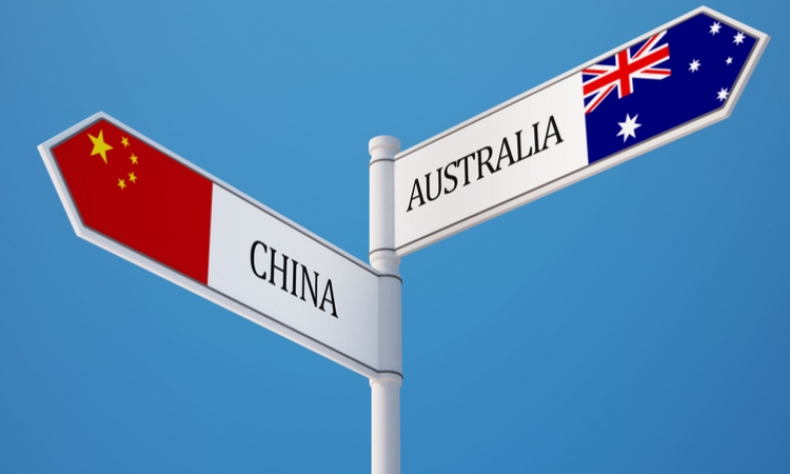
Australia’s policy shift toward China indicates that it will continue to support and coordinate with the U.S. strategic deployment in the Indo-Pacific region.
Intelligence sharing, military alliance, political loyalty, among other areas of cooperation, have tied Australia and the U.S. together, but also made Australia less independent or even fragile.
During an interview in May, U.S. Secretary of State Michael Pompeo threatened to “disconnect” ties with Australia in intelligence and telecommunication if Australia’s Victoria State continued cooperation with China under the framework of the Belt and Road Initiative, which was launched in 2018.
Pompeo’s bossing epitomized the prevailing U.S. influence on Australia’s policy toward China in recent years, which became more hawkish and led to escalated tensions. But it is unwise for Australia to unconditionally follow the U.S. lead rather than developing sound relations with China, its largest trading partner.
Rocky ties
The strained relations can be dated back to 2017, which marked the 45th anniversary of the establishment of China-Australia diplomatic ties. But instead of opening a new chapter of sound bilateral relationship, it initiated a hostile turn of Australia’s policy toward China. Their ties reached the lowest level in recent decades in the second half of the year, influenced by a series of unfriendly gestures from Australia, and no signs of improvement have been observed in the three years since.
The novel coronavirus disease (COVID-19) pandemic adds new uncertainties to bilateral ties. As the virus rages globally, discrimination against China, Chinese and even Asians in Australia has emerged frequently. Moreover, some Australian politicians and media called the virus “China virus.” Though China is the first country to report COVID-19 cases in the world, it doesn’t necessarily make it the source of the virus. Source tracing should be based on science and should be done by scientists and medical experts.
Looking back at China-Australia interactions, it is clear that Australia has overhauled its policies and has taken a more hawkish attitude, leading to turbulence in bilateral relations.
When the U.S. decided to ameliorate ties with China at the beginning of the 1970s, Australia followed suit and officially established diplomatic relationship with China in 1972. It also imitated the U.S. policy of engagement toward China, with a focus on developing trade links and conducting political dialogues. But at the same time, it watched closely and remained guarded in security matters. By doing so, Australia managed to maintain a balance in its relations with the U.S. and China. This policy could be seen as a success by and large and China-Australia ties were strengthened over the ensuing years.

However, Australia seems to have abandoned the policy of engagement and instead sided with the U.S. to contain China.
The change happened amid a great deal of misleading hype of the institutional and ideological differences between the two countries in Australia. It is a fact that the two countries have different political systems and this should not be an obstacle in bilateral ties. But with the rapid growth of China’s global influence, the conservative elements in the Australian leadership have become increasingly concerned.
In the second half of 2017, much was made of China’s so-called infiltration of Australia, which was interpreted as China taking advantage of the loopholes in Australia’s democratic system to interfere in its internal affairs. Such rhetoric is still widely heard. Scott Morrison, the incumbent Australian Prime Minister, said differences between China and Australia should be understood during bilateral exchanges, but he also stressed the differences in political systems and ideologies between the two countries.
Inevitably, routine bilateral economic and trade exchanges with China were impacted, as these exchanges began to be treated as security issues. China is Australia’s largest trading partner, biggest export market and largest import source. Two-way imports and exports reached $160.6 billion in 2018-19, accounting for 26.4 percent of Australia’s overall trade volume. Therefore trade and economic cooperation has long been considered the ballast stone and driving force of bilateral ties.
However, some Australians believe Australia has been too economically dependent on China, giving China leverage to economically coerce Australia. Chinese investments and acquisitions in Australia have been treated unfairly by the authorities, which has led to the continuous decline of Chinese capital inflow. In June, Australia decided to change its foreign investment laws to enhance security checks on foreign investors. It’s likely Chinese investment will face increasingly stringent reviews in the future.
As Australia becomes more anxious and insecure about China’s rapid development, it has coordinated with the U.S. militarily. In August 2019, Andrew Hastie, a member of parliament and Chair of Australia’s Joint Committee on Intelligence and Security, warned that China’s rise might jeopardize Australia’s sovereignty and freedom.
At the Australia-U.S. Ministerial Consultations in July 2018, the two sides decided to increase the number of marines rotating through Australia to 2,500. To accommodate U.S. marine deployment, Australia planned to build new port facilities in Darwin. In November 2018, the U.S. announced that it would partner with Australia and Papua New Guinea to redevelop the Manus Island naval base to balance China’s presence in the South Pacific.
Australia has talked wildly on multiple China-related issues. It misleadingly accused China of undermining security in the South China Sea. As for China’s cooperation with South Pacific island countries, some Australian politicians claimed, without justification, that it was creating “debt traps.” At the same time, they appealed to the Australian Government to invest more in South Pacific nations to balance China’s presence there.
Australia also wantonly interfered in internal affairs of China. After the Chinese Government initiated national security legislation for Hong Kong Special Administrative Region, Australia issued a joint statement with Britain, the U.S. and Canada, making unwarranted comments. Actually, the new law is designed to tackle secession, subversion of state power, terrorist activities and collusion with foreign or external forces, which will ensure the implementation of “one country, two systems” in Hong Kong.
Moreover, Australia has advocated a so-called “independent” review of China’s COVID-19 response and lobbied the leaders of France, Germany and New Zealand, among others, to support the proposal. China is open to joint efforts by the international science community to identify the source of the virus. State Councilor and Foreign Minister Wang Yi said on May 24 that the process must be professional, impartial and constructive.

Pawn of the U.S.
There are many factors at play behind the transformation of Australia’s policy toward China. First, it has been profoundly affected by U.S. strategic adjustments. The alliance with the U.S. has been the cornerstone of Australia’s diplomacy and security policy, and the two countries have cooperated closely in military, intelligence and security affairs.
After U.S. President Donald Trump took office, the U.S. clearly defined China as a strategic competitor, and has taken various measures to contain China’s development, prompting Australia to reevaluate its policy toward China. That is to say, the U.S. Cold War mentality deeply influenced the policymakers in Australian strategic and diplomatic arenas.
Second, Australia’s China policy has been manipulated by hawkish forces within its own government. In recent years, intelligence and security organizations have continuously exaggerated so-called “China threats,” and have pushed the Australian Government to take a hard stance against China. Paul Keating, Australian Prime Minister from 1991 to 1996, recently publicly criticized security agencies for damaging bilateral relations with China. “When the security agencies are running foreign policy, the nutters are in charge,” he said in an interview.
An anti-China faction led by Hastie, known as the Wolverines, has emerged in Australian parliament. Though small in number, their voice has been loud and has influenced the government significantly. Moreover, some people in media and think tank circles are also inventing China threats and pressuring the government to take tough measures against China.
Third, some Australian politicians believe that China’s development is poised to deeply reshape the international and regional power pattern and pose a challenge to the dominant role the U.S. plays in the Asia-Pacific region. Australia has been accustomed to the international order led by the U.S., and is having difficulty adapting to the changes in the international landscape resulting from China’s growth.
Looking forward
The strained relationship between China and Australia has caused losses to both sides. People wonder whether it will take an upward turn. There were attempts to improve relations. For example, then Prime Minister Malcolm Turnbull showed willingness to repair bilateral ties when he delivered a speech at the University of New South Wales in August 2018. His remarks were welcomed by China. But not long after this speech, the Australian Government banned Chinese telecommunication equipment maker Huawei from participating in its 5G deployment, citing security concerns.
As the global and regional order has profoundly changed, and the strategic competition between China and the U.S. has intensified, Australia, as an ally of U.S., will find it increasingly difficult to strike a balance rather than taking sides.
Australia’s policy shift toward China indicates that it will continue to support and coordinate with the U.S. strategic deployment in the Indo-Pacific region. Worse still, the hawkish forces in Australian politics, riding on the U.S. anti-China trend, have made constant provocations on issues of China’s core concerns. Against such a backdrop, the prospect of repairing bilateral ties in a short period is bleak.
The author is an assistant research fellow with the China Institute of International Studies.