Can the World Survive Another Almost Nuclear Moment?
 Facebook
 Twitter
 Linkedin
 Google +
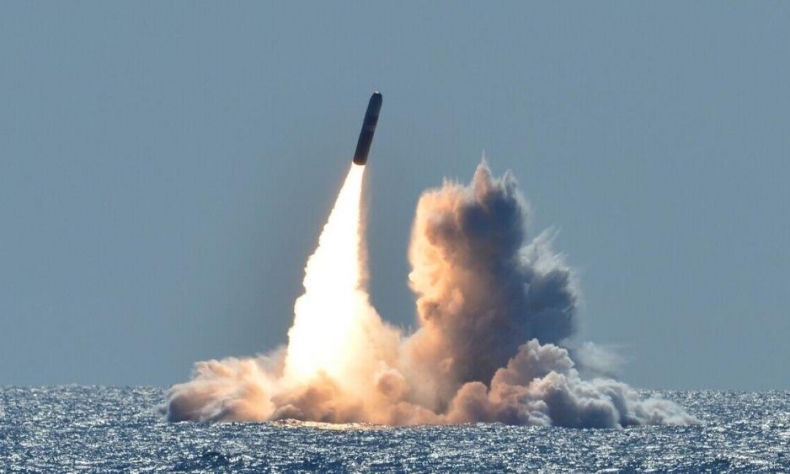
The last time a nuclear arms race occurred, only the bravery and luck of a cautious Soviet flotilla commander saved the world from devastation. If another were to restart, would we be so lucky again?
History is littered with what historians like to call “almost moments” – the what if events that, had it not been for a different decision or action, could have irreplaceably altered the course of history. What if Archduke Franz Ferdinand wasn’t assassinated in 1914? What if Japan hadn’t bombed Pearl Harbour in 1941? What if two planes hadn’t hit the Twin Towers in 2001?
One of the most interesting and dangerous almost moments related to the 1962 Cuban Missile Crisis, when the threat of all-out nuclear war between the world’s two Cold-War superpowers was at its highest and most volatile.
While many are aware of how after days of tense negotiations tensions finally cooled, few are fully aware just how close the world was too almost total obliteration. Had it not been for the cool head of Soviet flotilla commander Vasily Arkhipov, who correctly guessed that the Americans were dropping depth charges rather than bombs on top of his B-59 Soviet patrol submarine, then a nuclear-tipped torpedo from his boat could have been launched, setting off most likely the end of the world as we know it.
One tiny change, one small mistake or a different inference from commander Arkhipov then a global thermonuclear response would likely have occurred. It is what makes nuclear weapons such a dangerous and unpredictable form of defence, and one in an ideal world most would like to see removed.
Since the Cuban Missile Crisis, the world seems to have been moving in that direction, with frameworks established to lessen the possibility of nuclear attacks, and a major reduction in global nuclear stockpiles. Last year, the number of nuclear weapons sank to their lowest number since the 1960s, with the number dropping from a high of approximately 61,662 in 1985 to just 13,400 in 2020, according to The Stockholm International Peace Research Institute.
Beginning of an arms race?
Though that number is still enough to eliminate the world more than ten times over, it highlights the success nuclear nations have had in deescalating their nuclear arsenal, and in turn reducing the possibility of a nuclear confrontation. But there are now worrying signs that such policies are going in a different, more dangerous direction.
Nuclear legislation is now at an all-time low, with the recently signed NEW START treaty the only nuclear arms control agreement in existence between Russia and the US, while more worryingly, there appears to be a significant roll back on efforts to reduce spending on nuclear arsenals.
In the US, Congress is currently debating whether to sanction almost $264 billion in government funding to build a new ground-based strategic deterrent (GBSD) to replace the 400 Minuteman intercontinental ballistic missiles (ICBMs), which makes-up one third of the country’s nuclear deterrent.
In the United Kingdom, one of the US’ closest allies, the recent release of its Integrated Review has revealed plans to increase its nuclear warhead stockpile by 40 percent, while new satellite images published by the International Panel on Fissile Material (IPFM) shows that in Israel, work is in progress to expand the country’s Dimona nuclear facility, a site famous for making the fissile material for its nuclear arsenal.
Their actions come as states in some of the world’s most politically tense areas, such as North Korea, India, Pakistan, Iran, and Saudi Arabia are all also adding or upgrading their nuclear capabilities.
Serhii Plokhy, professor of history at Harvard University and the author of Nuclear Folly: A New History of the Cuban Missile Crisis believes the current nuclear situation is “more unstable and unpredictable than even during the cold war,” especially as the investment in nuclear arsenals, particularly in the US, appears to no longer be in response to an old cold war enemy.
Confronting a rising China
Rather it is China, a nuclear power with capabilities designed to only survive an adversary’s first strike while still maintaining the “minimal means of reprisal”, that is fueling their latest investment.
China is repeatedly being framed as a serious existential and nuclear threat to western powers, especially by senior US military commanders. At a recent congressional hearing regarding the new GBSD system, Admiral. Philip Davidson, commander of US Indo-Pacific Command, stated that the rise in China’s nuclear arsenal over the past two decades raises fears that it could easily attain “nuclear overmatch” against the US in the next decade, if it is to continue with its current trajectory.
His revelation was enough to send Republican Senator for Arkansas Tom Cotton, present at the hearing, into a worried frenzy, making him demand that congress grant Davidson his investment, commenting, it is “much better to win an arms race than to lose a war.”
His fear was only bettered by fellow Republican Liz Cheney, who accused US Representative Ro Khanna’s of being a Chinese stooge at the suggestion of reducing some of its budget.
“I don’t think the Chinese government, frankly, could imagine in their wildest dreams that they would have been able to get a member of the US Congress to propose, in response to the pandemic, that we ought to cut a billion dollars out of our nuclear forces,” said in response to Khanna’s comment that perhaps, during one of the worst economic crises to ever hit the US, some of the money might be better spent on other areas.
Should America be scared?
Such arguments have been made to help on the one hand fuel further suspicion of China’s nuclear ambitions, and on the other help increase pressure on China to sign up to the same nuclear rules that big nuclear powers play by. But while China may have increased the size of its arsenal over the past two decades, in every measure of nuclear strength, China’s numbers are substantially lower than that of Russia or the US.
According to the US Defence Department’s most recent report on Chinese military capabilities, China has a warhead stockpile “currently estimated in the low-200s”, which pales in comparison to the US’ estimated 5,800 nuclear warheads and Russia’s 6,300.
The gulf in nuclear capabilities can be seen further by the number of underground silos – used to launch nuclear weapons from – that each country has. While China is planning to build 16 more silos to go with the 18 to 20 it already uses, Russia has more than 130 active silos, while the US has over 450 available, with 400 reportedly loaded with missiles, according to Washington-based think-tank Federation of American Scientists (FAS).
And while both the US and Russia have enough highly enriched uranium to make tens of thousands of new nuclear warheads, China has just over 1 percent of global stocks, enough for only a couple hundred nuclear warheads – hardly enough to significantly cut the gap between it and the US or Russia.
China’s policy on its nuclear deterrent also differs greatly from that of the US and Russia, having been heavily influenced by former Chinese Chairman Mao Zedong’s comments on nuclear weapons, in which he compared them to “paper tigers”, having been unimpressed with their ability to solve conflicts.
China is still only one of two nuclear nations to conduct a “no first use” nuclear policy, as well one of the few to explicitly state it will not use them against non-nuclear-weapon countries, something the US has emphatically stated it would not follow.
A 2019 White Paper on defence also states that China “advocates the ultimate complete prohibition and thorough destruction of nuclear weapons”, “does not engage in any nuclear arms race with any other country” and “keeps its nuclear capabilities at the minimum level required for national security”, again in contrast to the US and Russia.
Who is the real threat?
Given the policies, facilities and weapons fall increasingly in the US’ favour, it’s difficult to find how the US can see China as such a dangerous nuclear threat, nor reasonable to suggest China sign up to the same rules that govern it and Russia.
There is in fact a strong argument to suggest in terms of their nuclear situation, China is in the one that should feel threatened, and even more so if Congress grants funding for the new GBSD.
China won’t be the only ones looking over their shoulder as countries increase plans to add to their nuclear arsenals, with Iran and North Korea – who launched a “new-type tactical guided projectile” capable of carrying a nuclear warhead last week – even more likely to respond like for like. Setting off a new nuclear arms race is therefore a very dangerous game, and one that history tells us is likely to lead to greater regional tensions and more devastation.
Last time a nuclear arms race occurred, only the bravery and luck of an overly cautious Soviet flotilla commander saved the world from the brink of nuclear war. Who is to say that we would be so lucky the next time?
The article reflects the author’s opinions, and not necessarily the views of China Focus.