A Unique and Joint Publishing Project Shows Why Culture Matters in China-U.S. Relations
 Facebook
 Twitter
 Linkedin
 Google +
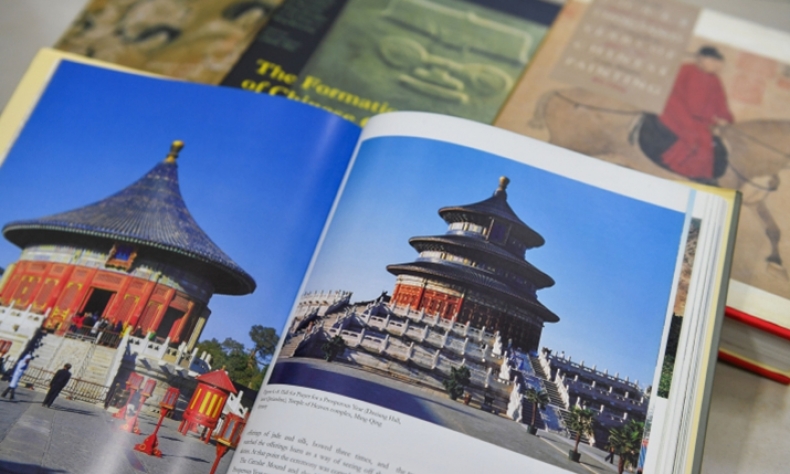
In terms of understanding each other, China’s long history and the relatively short American history both offer sources of study. They will help to see each other’s point of view and become appreciative of each other, instead of growing antagonistic.
One spring day in 1994, an original work by Yuan Dynasty master painter Zhao Mengfu (1254-1322) was brought to the warehouse office of the Palace Museum in Beijing.
Two museum staff wearing white silk gloves gingerly unrolled the 700-year-old piece of art on a long table in front of a group of visitors watching intently. They were Chinese and American scholars working on a book, Three Thousands Years of Chinese Painting, one of the volumes in an unprecedented publishing collaboration series called The Culture and Civilization of China.
This was one of the very rare occasions that the delicate artwork was ever shown under bright light, and the first time ever to visitors from the United States. It marked a typical but at that time very rare activity in exchanges between scholars of the two countries.
The early 1990s were the second decade of normalization of relations between China and the United States and people on both sides realized there was a need to deepen mutual understanding. For that, there was no better way than go into the traditional culture and see what shaped the way of thinking of the people and formed the structure of society.
Initiatives from both sides led to the decision to create a joint publishing project that would present China’s age-old civilization through volumes written by scholars from both countries for readers in both countries.
An innovative first
The project brought together more than 100 scholars at its peak and the volumes were initially published in both Chinese and English with the Yale University Press partnering with the Foreign Languages Press in Beijing. The editors came up with a list of topics on the key aspects of art and philosophy to best represent the 5,000-year-old Chinese civilization.
It was an unprecedented effort in that it was not Chinese scholars writing about China but authors from both countries together deciding what to write. Never before had there been an attempt to produce books between the two countries in such a collaborative spirit. In fact, it still remains the only co-publishing project of its kind.
Such an ambitious project faced plenty of challenges. Authors from different cultural backgrounds had their unique interpretations and their differences had to be respected. To ensure original and illuminating content, the books had to incorporate the latest research findings, which meant the scholars needed access to museum warehouses and archaeological sites not visited by any other international authors.
As the project progressed, the American scholars went to museum warehouses and to the sites of ancient ruins, and had long sessions of open and profound discussion with their Chinese counterparts.
To ensure a high-level scholarship, arrangements had to be made for the most authoritative scholars to work comfortably in a team. As they were the busiest people in their fields, synchronizing their time to fly to different cities in the two countries for the meetings itself was a mammoth task. And like with any cultural undertaking, there was the issue of funding.
Strong support
Luckily, there was strong support in both countries. As the project began, powerful groups of prominent Americans came forward to help. They included Henry Kissinger, former Secretary of State, who served as chair of the U.S. Advisory Council for the project, and former President George H. W. Bush, who not only accepted the invitation to be the honorary chair but also wrote a heart-warming message.
On the Chinese side, then Vice President Rong Yiren was honorary chair and former Vice Premier Huang Hua led the Advisory Council. Such high-level support helped overcome the difficulties.
As the chief coordinator on the Chinese side, I found being part of this unique project both rewarding and thought-provoking. Administratively speaking, I learned a great deal about steering through an international cooperative publishing project, from conceptualization to marketing, from planning to implementation, and from coping with differences to coming to an agreement.
The authors demonstrated a strong cooperative spirit, which was essential to the success of the project. The Chinese authors, who were leading scholars and had their work widely published in their fields, showed a genuinely open attitude while working with foreign colleagues. Though these were subjects they had studied systemically from childhood and on which they were experts, they were receptive to ideas from the American authors.
The American scholars on their part showed excellent scholarship though it was not their native culture. Their hard work and particularly their pioneering spirit earned them the respect of the Chinese scholars. They had an essential role in writing and shaping the books for both experts and the general public. Their persistent in-depth research helped make each piece of art and philosophical idea expressed in the books solidly based on the social changes in the 4,000 years they covered.
Widespread reception
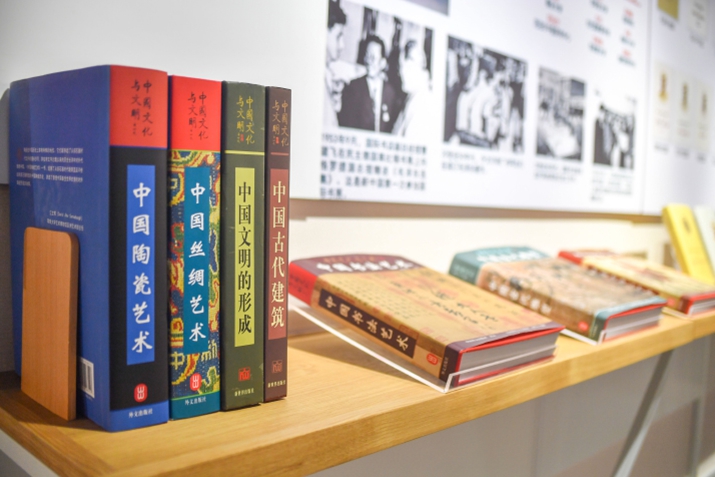
After almost 20 years of hard work, a set of seven beautiful volumes of coffee-table art book and two academic works on the Chinese civilization were presented to the readers. They cover the birth of the Chinese civilization, art, architecture, sculpture and philosophy and are a feast both for the eye and the mind. The books caught the attention of people in China and the United States, and people from Europe and other parts of Asia came on board with their own language editions.
Many individual works won awards, in China and the United States. During the Olympic and Paralympic Summer Games Beijing 2008, the project won the International Truce Award for its contribution to international understanding and peace.
Now 30 years on, as I view the widening gap in opinions on many issues between our two countries, I cannot help reflecting on what brought us together then and what is dividing us now. Perhaps there is one element we have to think of and think hard: What do we want to leave for our children?
I remember what my American counterpart in the project, former UN Under Secretary General Joseph Reed, used to say on being asked why he devoted so much of his time and energy to such a publishing project: “I want to leave my children and the children of my children the knowledge of a civilization that has lasted for so many centuries.”
He was sending out a very convincing message when he suggested that the cultural riches of China, the best scholarship produced by the joint efforts of Chinese and American authors, and the availability of original and previously inaccessible resources would lead to the understanding of the Chinese civilization, and what lay at its core that shaped the Chinese mind.
The value of The Culture and Civilization of China project lies in the aspiration to understand the deep roots of Chinese thinking.
Luminary figures in the United States in particular, who were successful in their own fields and were able to see the historic perspectives of the Chinese culture, possessed the kind of learning that enabled them to see the development in art and culture at the time against the background of the society then. They thus could put things in historical perspective and demonstrate a wider and deeper vision.
They also showed a willingness to listen and research so that they could find answers outside their own train of thoughts.
An impactful legacy
As the project progressed, on May 7, 1999, during the NATO bombing of Yugoslavia, U.S. guided bombs hit the Chinese Embassy in Belgrade, killing three and wounding more than 20. The attack immediately put an unpredicted strain on the relations between China and the United States. However, the project gained further support rather than leading to talks of decoupling because people realized that the exchange of ideas would offer a key to peace.
This is the kind of spirit and attitude that is much needed today. Looking back, it is safe to say that people, scholars and politicians may come and go, but the kind of cultural legacy their work embodies will be seen and read by generations to come and continue to have an impact. In China’s case, if a civilization can last for centuries, there must be elements in it that remain undefeated by challenges and the passage of time. The U.S. culture, forged since it declared independence from Britain in 1776, has its own values but has yet to prove its capacity to endure the change of time smoothly and peacefully.
In terms of understanding each other, China’s long history and the relatively short American history both offer sources of study. They will help to see each other’s point of view and become appreciative of each other, instead of growing antagonistic.
The author is former vice president of China International Publishing Group and former vice president of International Federation of Translators.