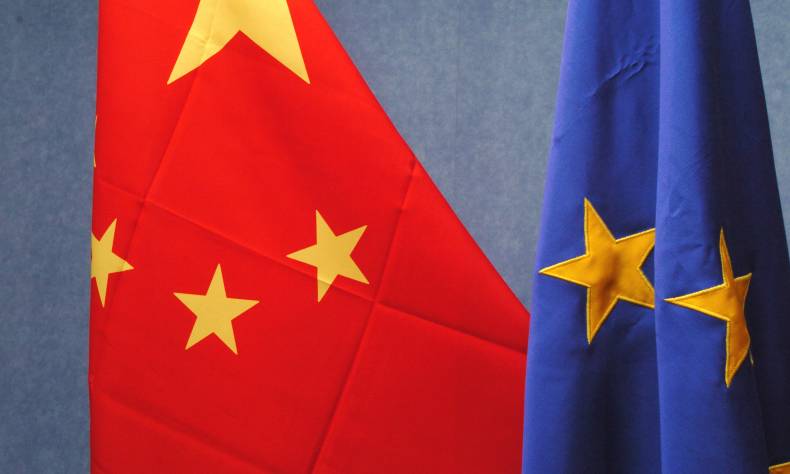
China and Europe: Opening New Cooperation Perspectives
 Linkedin
 Google +
2017 is of great political importance for China and the countries of the European Union. Sino-European economic and trade relations tended to experience a significant structural readjustment, requiring greater cooperation and innovation between the two sides to create new opportunities and solve new problems.
By Tian Dewen
2017 is of great political importance for China and the countries of the European Union. This year, elections that influence future trends took place in the United Kingdom, France, and Germany, and the main parties won out against populist forces.
Sino-European economic and trade relations tended to experience a significant structural readjustment, requiring greater cooperation and innovation between the two sides to create new opportunities and solve new problems.
The 19th National Congress of the Communist Party of China (CPC), held last October, defined the new historical orientation of Chinese development, and socialism with Chinese characteristics has crossed the threshold into a new era. The foundations for political cooperation between China and European countries remain solid, and the prospects for their relationship continue to widen.
 Chinese and Dutch delegates celebrate the first anniversary of the Chengdu-Tilburg express railway in Tilburg on September 22, 2017.
Stable Political Bases
This year is a “super-year of the elections” of European countries, including the early elections of the British House of Commons, the presidential and parliamentary elections in France, and the German parliamentary elections that have drawn special attention. Despite the rise of populist forces, it was the main centrist parties that finally won in France and Germany. Theresa May’s administration organized the early elections in order to create a strong conservative parliament to handle Brexit. But contrary to her wishes, the Conservative Party, after the parliamentary elections, lost absolute majority of the seats in Parliament and had to create a ruling coalition with the Democratic Unionist Party of Northern Ireland. From the perspective of China-Europe relations, the results of these elections have avoided any uncertainties that radical political parties, once in power, would have brought, laying a solid foundation for stable cooperation between the two sides in years to come.
On the Chinese side, at the 19th National Congress of the CPC, it stresses: “China will continue to hold high the banner of peace, development, cooperation, and mutual benefit and uphold its fundamental foreign policy goal of preserving world peace and promoting common development. China remains firm in its commitment to strengthening friendship and cooperation with other countries on the basis of the Five Principles of Peaceful Coexistence, and to forging a new form of international relations featuring mutual respect, fairness, justice, and win-win cooperation.” China’s further advancement of its opening-up policy will undoubtedly lay a strong foundation for China-Europe relations.
In 2017, high-level exchanges between China and Europe have intensified. In January, Xi Jinping attended the World Economic Forum in Davos, and then visited the UN headquarters in Geneva, the World Health Organization, and the International Olympic Committee. In May, Xi Jinping hosted state leaders across the world including those from European countries like Belarus, Czech Republic, Russia, Switzerland, Greece, Hungary, Italy, Poland, Serbia, and Spain in Beijing to exchange views on international cooperation at the Belt and Road Forum for International Cooperation. These discussions then continued in the framework of the G20 Summit in Hamburg and, more recently, during a meeting in Budapest devoted to relations with the countries of Central and Eastern Europe, in which Premier Li Keqiang participated. In addition, there is a list of major political and cultural events between China and Europe, such as the China-EU Strategic Dialogue and the “EU-China Blue Year” activities, which covers the blue economy and the global governance of oceans.
Constant dialogue between the two parties has been extended on an individual basis in the context of numerous high-level bilateral meetings. To name some, President Xi attached great importance to direct contacts with leaders of Switzerland, Italy, Finland, France, Germany, and Great Britain.
The first results are already noticeable. President Xi and Prime Minister May have reaffirmed, through a telephone call on September 25, the deepening of their global comprehensive strategic China-U.K. partnership for the 21st century and the will to continue to build the “golden era” of relations between the two countries. Emmanuel Macron and Xi Jinping reaffirmed, during talks on September 8, the consensus to develop a strong comprehensive strategic partnership between China and France, which both sides attained during the G20 Summit. By phone on November 7, Li Keqiang and Angela Merkel highly appreciated the new progress made in Sino-German cooperation and expressed their wishes to deepen economic and trade cooperation, as part of the “win-win” relationship. In fact, beyond the divergence among political parties in European countries and China, the development of the China-Europe relationship has become a political consensus among different countries.

Structural Changes in Economic and Trade Relations
In a tense economic environment marked by the global financial crisis and debt crisis in Europe, the number of China-Europe trade frictions has increased, due to sluggish economic growth and the resurgence of protectionism in Europe. The most emblematic example is the non-recognition of China’s full market economy status by the EU. However, thanks to the continuous development of the Chinese economy, structural changes are taking places in China-Europe economic and trade relations.
In this respect, the changes in economic and trade relations between China and Germany, which are an important engine of Sino-European economic and trade relations, are a notable element. For many years, Germany has been China’s largest trading partner in Europe. But in recent years, the volume of trade between the two countries has steadily declined, and China’s trade deficit with Germany has been increasing. According to statistics released by the Chinese Ministry of Commerce, Sino-German bilateral trade volume was US $151.29 billion in 2016, down 3.5 percent from the previous year, Chinese exports to Germany was reduced to US $65.21 billion, a decline of 5.7 percent, and Chinese imports from Germany was US $86.08 billion, declined by 1.8 percent, the result is a deficit of US $20.87 billion for China. From January to June 2017, the total trade volume between China and Germany was US $78.046 billion, of which Chinese exports were US $33.35 billion, and imports at US $44.69 billion. China had a trade deficit of US $11 billion to Germany during those six months.
The changes in the structure of Sino-German trade are directly related to those that occurred in their economic structures. Currently, Chinese imports from Germany mainly include electromechanical equipment, transport equipment including railways, automobiles and ships, chemicals, optical and medical instruments. China’s exports to Germany are mainly electrical appliances, mechanical equipment, textile raw materials and manufactured goods, chemicals, and toys.
Now, with the industrial restructuring of China, the two countries should achieve a “dynamic balance” of bilateral trade through cooperation and innovation, to better navigate the sound development of China-Europe economic and trade relations. Currently, Germany is among the countries with the biggest amounts of direct investment in China. By the end of 2016, China had approved 9,394 projects by German companies with a total investment of US $28.18 billion. These projects focus on automotive and chemical industry, power generation facilities, transportation, steel, and telecommunication. At the same time, the number of Chinese companies investing in Germany has exceeded 2,700. All these have played a positive role for the economic development of both countries and confirms this “dynamic balance.”
The Netherlands is China’s second largest trading partner in Europe in recent years. In the first half of 2017, China chalked up US $29.738 billion worth of exports to the country, compared with imports of US $5.5 billion, the largest trade surplus compared to other EU countries, followed by the United Kingdom, Spain, and Italy.
But where do these trade surpluses come from? They mainly come from the export of manufactured products due to the effects of deindustrialization of these countries. This imbalance of trade between China and European countries can be effectively mitigated through the deepening of industrial cooperation between both sides.
During his visit to China in February 2017, Italian President Sergio Mattarella pointed out that China is striving to change its mode of development from low-end manufacturing to a sustainable growth model based on investment in technology and research. For the Italians, this is an opportunity for his country to become a technical partner of China and realize the win-win situation.
So far, most European countries have responded positively to the Belt and Road Initiative, and major European economies have become member countries of the Asian Infrastructure Investment Bank. The Belt and Road, with China as a starting point and Europe as the end point, will inspire a powerful momentum for the development of Sino-European economic and trade relations.
On May 13, 2017, the China-Europe X8024 train, loaded with small commodities and clothes, left Yiwu in Zhejiang Province for Madrid. This is the 1000th China-Europe train in 2017. Until then, the number of such trains had increased by 612 compared to the same period in 2016, an increase of 158 percent.

Jointly Building a Community with a Shared Future for Humankind
All these changes at work today are not guided by profit in the short term. During his address delivered on January 18, 2017 at the Palais des Nations in Geneva, titled “Jointly Building a Community with a Shared Future for Mankind”, Xi Jinping expounded the concept of “a community with a shared future for humankind,” and called to advance its building progress by emphasizing dialogue and consultation, shared development, win-win cooperation, people-to-people exchanges, and green and low-carbon development. The Chinese leader’s vision is motivated by the construction of a new world characterized by openness, inclusion, lasting peace, global security, and common prosperity.
This excerpt from his address sheds light on this desire of China: “The Chinese are convinced that China goes well only when the world is going well, and that the world is doing better when China is doing well … China, once poor and weak, is now the second largest economy in the world. This was not achieved by military expansion or colonial looting, but by the toil of the people and the efforts made to preserve peace. China will unswervingly push the path of peaceful development. China’s determination to promote shared development will not change. The world has contributed to China’s development, and China has contributed to international development. China will continue to pursue the opening strategy of mutual benefit and win-win and to share development opportunities with others.”
Building a community with a shared future for humankind proposed by President Xi is crucial to the Sino-European relationship. In addition, the record of encouraging progress in Sino-European economic and trade cooperation, despite the context of the prolonged recession of the global economy, is pushing for realistic optimism, underpinned by data presented by Premier Li Keqiang at a business summit during the 19th China-EU Leaders’ Meeting last June.
Since the international financial crisis, Chinese exports to the EU have grown at an annual rate of 1.8 percent, while those of the EU to China are at 5.8 percent; the volume of bilateral trade exceeded one million dollars every minute, and the volume achieved every two days was equivalent to that of a year at the beginning of the establishment of their diplomatic relations; more than 600 flights travel between China and Europe a week, and 150 China-Europe trains each month; funds, technology, and management experience from Europe contributed to China’s industrialization process; Chinese products allow European families to reduce their expenses and save money; the vast Chinese market has brought huge profits to the 16,000 European companies in China, and Chinese companies investing in Europe have created a large number of jobs in European countries.
Despite competition and differences between China and Europe, there is a broad consensus between the two sides on many areas such as free trade, multilateralism, and maintaining the stability of the international system. For these reasons, and all those previously mentioned, the China-Europe relationship is an example of success in jointly building a community with a shared future between developing and developed countries.
Source: China Today
Tian Dewen is a research fellow at the Institute of European Studies of the Chinese Academy of Social Sciences.
Opinion articles reflect the views of their authors only, not necessarily those of China?Matters
Editor: Cai Hairuo