Hysteria Surrounding China’s Space Threat Is Spinning Out of Control
 Facebook
 Twitter
 Linkedin
 Google +
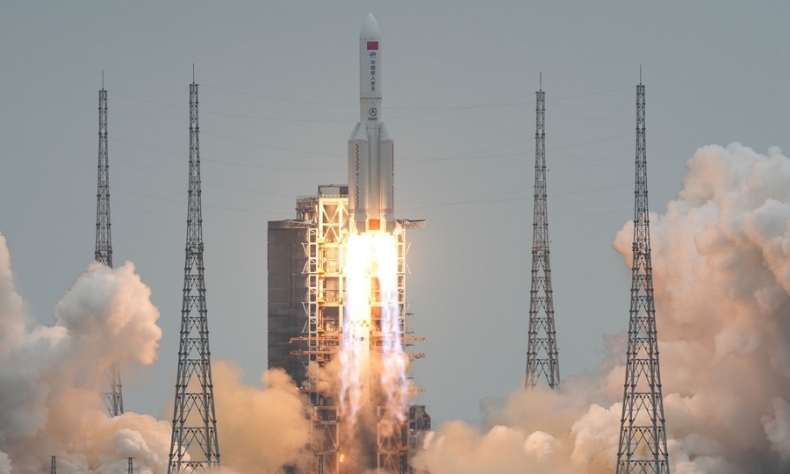
China’s Long March 5B rocket descended to Earth on May 9, with most of it breaking up in the Earth’s atmosphere. Yet the incident once again opened up questions regarding the safety, reliability and purpose of China’s space program.
Hurtling towards earth at 18,000 miles per hour, the uncontrolled re-entry of China’s Long March 5B rocket seemed to have been lifted straight from a Hollywood disaster movie.
It was certainly billed as such by American media outlets, who spent days reporting on how the 22-metric-ton booster was “spinning out of control” towards Earth, potentially onto the roofs of US citizen’s homes. Military officials from the United States were reportedly contemplating “shooting down” the rogue rocket, while hotlines had been established to help people in the event debris hit their roofs.
“Bracing for impact,” CNN’s Ana Cabrera warned. “But we just don’t know where and we don’t know exactly when.”
But rather than being treated to something from Armageddon or Deep Impact, what actually transpired as the rocket entered the Earth’s atmosphere was far more less dramatic.
No shots were fired by the US to break up the debris, nor were any towns destroyed by large chunks of rocket. Instead, in the early hours of May 9, Long March 5B re-entered the Earth’s atmosphere as planned, most of it burning-up and with only a few small bits of debris landing in the Indian Ocean.
Populated collision never in doubt
A certain level of hysteria had bubbled away with regards to this re-entry, perhaps because of the promise of such a spectacular finale. But in reality, Long March 5B was never going to put people’s lives at risk, nor was it even a particularly rare event.
As Harvard astrophysicist Jonathan McDowell put it, chances of being hit by debris from the Chinese rocket were “one in several billion” and certainly not “the end of days” as some had reported. This was because there are approximately 9,000 tons of space junk currently whirling round Earth’s orbit, often falling to Earth without incident.
The last “uncontrolled” re-entry similar to Long March 5B was just two months ago – from SpaceX’s Falcon 9 rocket – and in that instance, while debris did actually land on a populated area rather than the ocean, no one was hurt. Besides, news outlets were however far less concerned by the risk to lives as they were to how beautifully the rocket’s debris had illuminated an otherwise ordinary autumn night.
Debris falling from re-entering rocket bodies is also not exclusively a Chinese problem. There are currently 2,033 rocket bodies in Earth’s orbit, with Chinese missions responsible for only a tiny fraction of them – just 8 percent. In contrast, Russia (51 percent) and the US (27 percent), among others, are the greatest litterers in space, having launched more missions over the past six-decades.
There were other misleading terms as well. While many outlets commented that the rocket was “hurtling towards Earth at 18,000mph”, that speed was only a reflection of how fast it was moving around the earth. In fact, according to astrophysicist McDowell, the rocket’s debris was only crawling towards Earth at a mere 0.3mph, only speeding up once it had entered the Earth’s atmosphere.
Ambiguous comparisons between Long March 5B and NASA’s 85-ton Skylab space station – one of the largest incidents of space debris falling in 1979 – were also widely inaccurate. Skylab was nearly four-times the size of Long March 5B, and dropped considerably more pieces – 500 were eventually discovered – not only in the Indian Ocean but also parts of western Australia.
The mere speculation that the Pentagon was primmed for a John Wayne-styled shoot-out with bits of rocket debris was not only farcical but also quickly dismissed by US Secretary of Defense Lloyd Austin. Yet it added to the sci-fi narrative that many media outlets were portraying, as well as the re-entry being incredibly unsafe.
Responsible space behaviour?
Debris falling from space is therefore something astrophysicists agree a regular and relatively safe procedure conducted by all space agencies, and had Long March 5B been a NASA or SpaceX led-mission, that is exactly how it would have been portrayed.
But this wasn’t a NASA or SpaceX mission. This was a China National Space Administration (CNSA) mission, and by that token, it was therefore treated with greater degree of suspicion and fear. As a Chinese news outlet, the Global Times put it, when debris from an American rocket crashes, it is considered a beautiful light show. But when debris from a Chinese rocket lands in the ocean, it is somehow dangerous and out of control.
This narrative runs through much of the current conversation regarding China’s space ambitions, especially from US officials. This has grown as the CNSA’s capabilities in space have developed; becoming the first country to send a probe to the “dark-side” of the Moon, launching missions to Mars and the start of construction on its first space station.
This isn’t the opinion of many space organisations that have worked with China on their missions, or with the 17 nations already reaching out to work with it on the new Tianhe space station, including the United Nations Office for Outer Space Affairs.
But it is crucially the opinion of US officials, who are increasingly framing China’s space projects as a global security threat.
Who is the real threat?
A recent report released in April this year titled the 2021 edition of the Office of the Director of National Intelligence’s “Annual Threat Assessment”, wrote that China’s space program is one of the top dangers to the US and its allies, as well as voicing concern at its cooperation with other space agencies.
What danger it sees however is difficult to find. For one, there is little evidence to suggest that China is pursuing an aggressive policy in space, with a Chinese white paper published in 2016 stating that the country adheres to “the principle of using outer space for peaceful purposes and opposes the weaponization of, or an arms race, in outer space.”
It has also worked with a number of space agencies including Canada and Russia to have the Outer Space Treaty of 1967 – one of the few treaties that governs space – changed so it recognises the outlawing of weapons in space, called the Prevention of an Arms Race in Outer Space (PAROS).
The US however does not work towards these goals, and has repeatedly looked to block such treaties from ever being changed. In fact, one could argue, the US’ own space program is in fact far more aggressive than China’s.
Since the Cold War and Ronald Reagan’s infamous “Star Wars” program, the US has been developing space weaponry, including hypervelocity guns, particle beams and laser weapons. It has in recent years, upgraded its Space Corps to become a Space Force – effectively establishing a brand-new branch of the US military.
This militarized force, while the brain-child of former president Donald Trump, is unlikely to be disbanded under current President Joe Biden anytime soon, with White House Press Secretary Jen Psaki saying in early February that the organisation has “the full support of the Biden administration.”
It might be cynical to say, but the real danger of China’s space program might be less to do with global security, and more to do with the future impact it will have on NASA’s long held monopoly in space.
Space a new theatre for conflict or cooperation?
With a further 10 Long March 5B launches needed between 2021 and 2022 to complete the construction of the Tianhe space station, the hysteria surrounding China’s space program has the potential to spin even further out of control.
Cooperation rather than confrontation is what both sides should pursue in space, although the Wolf Amendment – proposed by former US Rep. Frank Wolf to limit exchanges between the two countries space agencies in 2011 – makes that a difficult prospect.
At the very least, action should be taken to cool tensions, for the US to respect China’s actions in this new arena and tone down the narrative that it is a threat to global security. Ironically, the issue of space debris offers an opportunity for greater cooperation to be explored, with spokespersons from both countries admitting this is an area that needs constructive action.
If not, both the US and China run the risk of space turning into another divisive issue, one that can be further weaponised like trade, human rights and technology. Long-term this kind of behaviour will serve neither the goals or interests of the US, China or the rest of the world, and only greater deeper and deeper division.