Dawn of the Asian Century
 Facebook
 Twitter
 Linkedin
 Google +
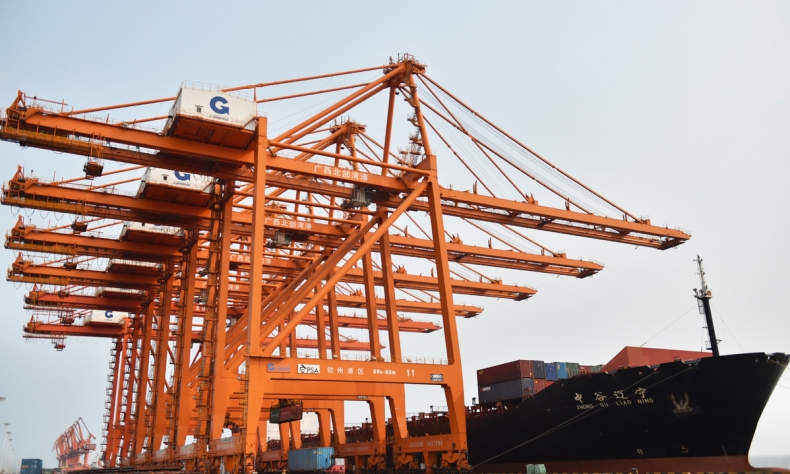
The signing of the RCEP agreement has laid the foundation for the realization of a China-Japan-South Korea Free Trade Zone.
In recent decades, economists have often discussed how long it will take for the Asian Century to arrive. On January 1, 2022, the RCEP agreement entered into force. As the largest free trade agreement covering 30 percent of the world’s total population and trade, it will likely mark an important turning point for the center of gravity of the world economy as it shifts from Europe and the Americas to the East.
The most common indicator of the Asian Century that economists have noted is that Asia’s share of global GDP will rise to 50 percent or more. Ten years ago, the Asian Development Bank (ADB) predicted in its report Asia 2050: Realizing the Asian Century that Asia could, by 2050, account for more than half of global GDP, trade, and investment, and enjoy widespread affluence. McKinsey Global Institute (MGI) declared in a 2019 report that Asia’s share of global trade, capital, personnel, knowledge, transportation, culture and resources has been increasing as it heads for the Asian Century. MGI predicted that by 2040, Asia’s share of global GDP will rise to 50 percent or more, and its share of global consumption will rise to 40 percent or more, 10 years earlier than what the ADB predicted.
In the 18th and 19th centuries, Europe achieved its economic rise with the Industrial Revolution. The United States became the global hegemon after two world wars. In contrast, from 1750 to 1990, Asia’s share of global GDP declined all the way from 60 to 20 percent. Since the 1990s, the dividends of globalization have helped Asia gradually reach the road to rejuvenation. Asia’s share of global GDP gradually recovered to 27 percent in 2010, and has been maintaining good momentum of growth.
Many economists believe Asia will regain a dominant global economic position in the 21st Century. According to late economic historian Angus Maddison, Asia accounted for more than half of the world’s economic output for nearly 18 centuries of the last 20 centuries. He predicted the Asian Century would simply be a “restoration” of its economic leadership.
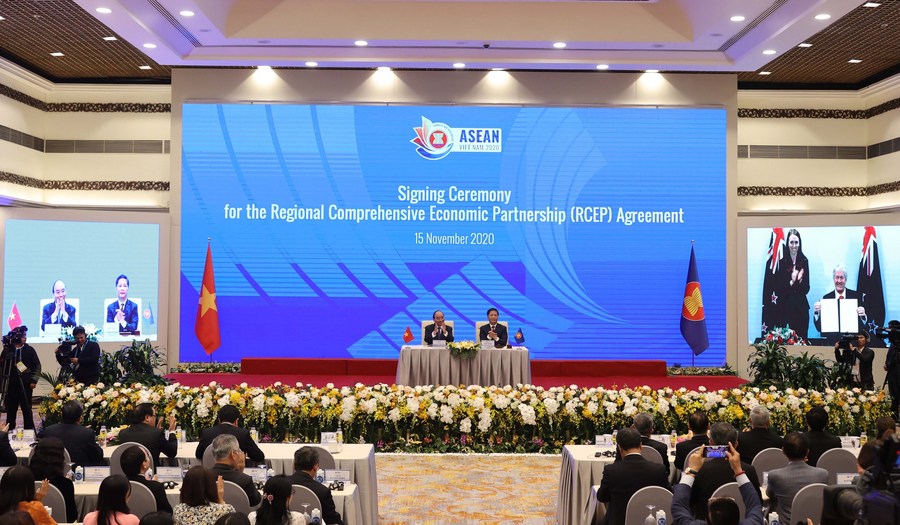
The core proponents of RCEP are ASEAN and East Asian economies represented by China, Japan, and South Korea. The signing of the agreement underscores the ambitions of Asian countries to expand their global economic landscape. “This reflects both the economic rise of major Asian countries and Asia’s change in identity,” opined Zhai Kun, vice president of Peking University’s Institute of Area Studies. “Asia’s role has changed from being passively embedded in the world economy to actively leading world development. The entry into force of RCEP will mark the beginning of the Asian Century.”
The ADB report also noted that although restraints on economic integration remain, trade in Asia is increasingly open on the whole. Regional cooperation and economic integration, as well as barrier-free flow of trade and investment across Asia, are important strategies to achieve the Asian Century. As an important institutional arrangement for regional cooperation and integration, RCEP will help Asia fend off external shock and promote trade and investment facilitation, which will be conducive to the free flow of labor force while laying the foundation for shaping a unified and open Asian market, reducing regional development imbalance, and further driving comprehensive cooperation in Asia.
Shaping a big unified market
RCEP has completed integration of rules and standards, which will upgrade regional integration. “Over time, various bilateral free trade agreements have emerged in Northeast Asia and Southeast Asia,” said Yuan Chunqiang, deputy director of the Department of World Economics at the China Institute of Contemporary International Relations. “But there hasn’t yet been a comprehensive free trade framework, so rules have been fragmented, leaving every regional economy on its own.” The signing of the RCEP agreement enables regional economies at different levels of development to integrate their advantages in resources, technology, manpower, and market under unified rules, so as to tap their respective strength for mutual benefits and further expand the free trade network.
The RCEP agreement contains 20 chapters covering intellectual property rights, e-commerce, market competition, government procurement, and many other issues. RCEP has also reached consensus on small and medium-sized enterprises and economic and technological cooperation, beyond the scope of WTO rules.
In terms of trade liberalization, more than 90 percent of trade in goods in the region will gradually achieve zero tariffs, 65 percent of the service industry will open, and foreign equity restrictions will be relaxed. In terms of investment, trade barriers will be further eliminated, business requirements such as local component proportion or technology transfer as market access conditions will be prohibited, and relevant procedures will be simplified to promote growth of regional investment.
“By implementing higher levels of trade and investment liberalization and facilitation measures than the WTO, the world’s largest regional integrated market will gradually emerge,” said Yuan Bo, deputy director of the Asia Institute at the Chinese Academy of International Trade and Economic Cooperation (CAITEC). It will not only help to expand internal regional trade and investment, but also attract more foreign capital to promote regional economic growth.
According to CAITEC’s calculations, by 2035, the RCEP will boost the region’s real GDP by 0.86 percent, exports by 18.30 percent, and imports by 9.63 percent, while lifting global real GDP by 0.12 percent and global foreign trade by 2.91 percent. The entry into force of the RCEP agreement will undoubtedly accelerate the shift of center of gravity of the world economy eastward, which is certainly good news for Asian and global economic recovery from the pandemic.
“The continuous economic development of East Asia and gradual upgrading of Asian regional cooperation will eventually lift Asia to stand toe-to-toe with North America and the EU, laying a foundation for the world economy to develop on an equal footing,” said Yuan Chunqiang. “That will be of epoch-making significance.”

Promoting free flow of economic factors
As member states significantly reduce restrictions on trade and investment, the flow of economic factors such as capital, labor, and technology will be smoother in the RCEP region, which will help to deepen the division of labor and cooperation within the region and improve production efficiency.
The RCEP has adopted the cumulative rules of origin, stipulating that only 40 percent of regional value content is required for goods to be considered of RCEP origin, much lower than the threshold of other free trade agreements. Once a company obtains the certificate of origin, it is eligible for preferential tariff treatment. The rules will not only significantly reduce the trade cost of enterprises and improve the actual utilization of preferential tax rates, but will also greatly promote the circulation and optimal allocation of production factors, which is conducive to forging stronger industrial chains.
According to a report released by German financial institution Allianz Group, the RCEP rules of origin will help to remove non-tariff barriers and reduce transaction costs. The report estimated that implementation of the rules of origin would generate US$90 billion in annual trade growth for the RCEP region. Experts from the ADB and UNCTAD jointly published an article that deemed it an impressive arrangement and explained that full implementation of RCEP commitments will ensure trade across the entire value chain will not be subject to tariffs if it complies with rules of origin and relevant procedures. The essay suggested that implementation of these rules will be directly related to the success or failure of RCEP.
Including China, Japan, and South Korea in the same free trade zone is a historic breakthrough propelling regional economic integration in East Asia to take an important step forward. Within the RCEP framework, China, Japan and South Korea are establishing free trade zone relations for the first time. Previously, geopolitical conflicts, historical disagreement, territorial disputes, and other issues caused the three countries to suffer continuous setbacks in free trade agreement negotiations, resulting in an integration agreement never being reached. The signing of the RCEP agreement has laid the foundation for the realization of a China-Japan-South Korea Free Trade Zone.
China, Japan, and South Korea are important economies in the Asia-Pacific region. Their inclusion in the unified free trade zone will accelerate integration of regional value chains and invigorate the regional economy. In terms of China-Japan trade, China will grant zero-tariff treatment to 86 percent of taxable items from Japan, as compared to 8 percent previously. Meanwhile, Japan will exempt tariffs on 86 percent of taxable items from China. In terms of Japan-South Korea trade, Japan will exempt tariffs on 92 percent of taxable items from South Korea, as compared with a previous 19 percent. These changes will be a great impetus for trade in East Asia.
The Economic Research Institute for ASEAN and East Asia (ERIA), a think tank based in Jakarta, Indonesia, predicted that the RCEP’s inclusion of China, Japan, and South Korean would trigger a “CJK effect” causing more goods, services, and investment from the three countries to flow into ASEAN countries and promote the economic and social development of Southeast Asia.
“Southeast Asian countries are now more accustomed to small economic circles within the region,” commented Kiyoyuki Seguchi, research director at the Canon Institute for Global Studies. “The RCEP agreement will bring more opportunities for Southeast Asian enterprises to integrate with Japan, China, and South Korea to boost development.”
Pou Sothirak, executive president of the Cambodian Institute of Cooperation and Peace, said that the RCEP agreement taking effect would create benefits from technology transfers from stronger countries, freer trade in goods, and closer people-to-people exchanges. Southeast Asian countries are expected to achieve annual growth of US$19 billion by 2030. Advanced production technology and human capital will converge in East Asia, and RCEP will accelerate the arrival of the “Asian Century.”
Reducing imbalances in regional development
The ADB report noted that outsourcing pieces of the industrial chain originating in Europe and East Asia has provided new jobs and value-added space for low-income economies and achieved greater flow of goods and services.
RCEP members have a large development gap. The agreement includes both highly developed countries, such as Japan, Australia and Singapore, and underdeveloped countries such as Laos, Cambodia and Myanmar. From this perspective, the RCEP is more flexible and broader than agreements dominated by developed countries, achieving unity of quality and inclusiveness. The agreement does not contain provisions susceptible to controversy such as state-owned enterprises, labor standards, or environmental standards. Instead, its flexibility and consultation mechanisms enable member states to seek a better position in the industrial chain suitable for their unique advantages.
“It’s a challenging task to get the 15 partners together to negotiate high-level free trade rules that are fairly comprehensive and fulfilling,” commented Cai Qiang, director-general of the Tariff Department at the Chinese Ministry of Finance. The RCEP member states vary greatly in the level of development, natural resources, and economic structure. But this diversity is also an advantage that helps to solve problems ranging from financing to raw materials, production, and sales within the RCEP region, which is conducive to the industrial upgrading and optimization in the region.
Ong Tee Keat, former deputy speaker of the House of Commons of the Malaysian Parliament and chairman of the Malaysian think tank Centre for New Inclusive Asia, opined that RCEP preferences for its member states would help underdeveloped countries attract more investment. “Look at Myanmar and Laos, two member states which will leave the ranks of underdeveloped countries in the coming years,” Ong said. “Although they will soon lose EU and North America trade preferences for underdeveloped countries, implementation of RCEP will bring new opportunities to the two countries that will likely be enough to offset the impact of the former on their economy.”
According to a CAITEC forecast, in terms of real GDP growth rate, ASEAN countries will benefit most. By 2035, ASEAN’s overall cumulative GDP growth rate is expected to increase by 4.47 percent because of RCEP. The cumulative imports and exports of ASEAN member states such as the Philippines, Cambodia, Thailand and Vietnam are expected to increase by more than 20 percent. RCEP will create more jobs for ASEAN countries and improve the wage levels of unskilled and skilled labor in these countries. RCEP will also drive regional investment growth, raise the cost of capital in most ASEAN member states, and increase returns on investment in Cambodia, Thailand, Malaysia, Singapore, and Indonesia, which will further narrow the development gap between the member states in the region.
The COVID-19 pandemic has exerted a profound impact on the Asia-Pacific region. The digital economy is expected to be a driver of economic recovery. Following global development trends, RCEP has promoted digital trade and the digital economy by eliminating tariff barriers, developing e-commerce, improving trade facilitation, and awarding preferences to small and medium-sized enterprises and technical cooperation.
“Among the RCEP member states, China, Japan, South Korea and Singapore are in leading positions in digitization at the global level, while some ASEAN countries such as Myanmar, Cambodia and Laos are lagging behind,” commented Wang Ruibin, deputy director of the Department for World Economics and Development at the China Institute of International Studies. “RCEP will support universal and equal participation of its members in the digital economy, help to bridge the digital gap between ASEAN member states, and steadily transform the economy through digitization.”
Challenges and opportunities
Many have great expectations for the RCEP’s role in tapping economic potential and promoting economic integration in Asia. At the same time, however, the regional free trade agreement will face many challenges.
The aforementioned ADB report mentioned that Asia’s economic take-off is not necessarily inevitable, nor is the Asian Century. Imbalances and inequality in regional development, the middle-income trap, global warming, and other factors may all lead to slower economic growth.
RCEP covers a wide area and has vast differences among member states in the level of development, culture and ethnicity. Some of the members also have historical, religious and territorial disputes within the region. All these could cause uncertainty for implementation of the agreement.
Zhai Kun noted that disputes among states are not conducive to the construction of an external environment for economic performance, which will ultimately affect the common interests of all in the region. But all transnational economic and trade agreements face similar problems. “We need to effectively mitigate risks by focusing on specifics rather than allowing specific difficulties to get in the way of overall development,” he said.
Pou Sothirak predicted that the RCEP would cause further opening of the market, which could lead to external shocks to emerging industries in some countries and a rising trade deficit. The Centre for Indonesian Policy Studies (CIPS) made a similar point in its November 2020 policy analysis report. It also noted that Indonesia would see economic growth after joining RCEP, while withdrawing would lead to a drop of its GDP by 0.07 percent. So, participation in RCEP was the only rational choice. The government was motivated to formulate policies to improve industrial competitiveness and production efficiency and constantly upgrade the industrial structure to better benefit from participation.
Full implementation of the agreement is also facing challenges. Cyn-Young Park, an economist with the ADB’s Department of Economic Research and Regional Cooperation, said that since some RCEP members had already concluded 10+1 free trade agreements with ASEAN, the benefits of liberalization could be limited initially, meaning that there is little incentive for the member states to implement the RCEP agreement immediately. However, the RCEP Secretariat and other relevant bodies will closely monitor the implementation of the agreement, and RCEP’s open architecture will attract new members in the future. RCEP will serve as a catalyst for strengthening regional cooperation.
In order for businesses to benefit more from the provisions of the RCEP agreement, Yuan Bo suggested governments strengthen outreach and raise awareness to help businesses understand and take advantage of the agreement. “The entry into force of RCEP will encourage more enterprises to invest in the member states, but a lack of knowledge of the laws and regulations in many host countries will be a constraint on investment,” said Yuan.
At a State Council policy briefing on December 30, 2021, Chinese Vice Minister of Commerce Ren Hongbin said that China has completed domestic preparations for implementing the RCEP agreement and is ready to fulfill a total of 701 binding obligations under the agreement.
Ren also said that implementation of the agreement marks a new milestone for China’s opening-up.
RCEP has laid an institutional foundation for high-level regional cooperation and economic integration, providing sustained and strong impetus for the prosperity and development of the Asia-Pacific region and ensuring Asia’s share of global GDP will rise to 50 percent or more as soon as possible.
RCEP is likely to mark the dawn of the Asian Century. The people of Asia are holding their breath.