India-China Ties Shouldn’t Be Held Hostage to Quad
 Facebook
 Twitter
 Linkedin
 Google +
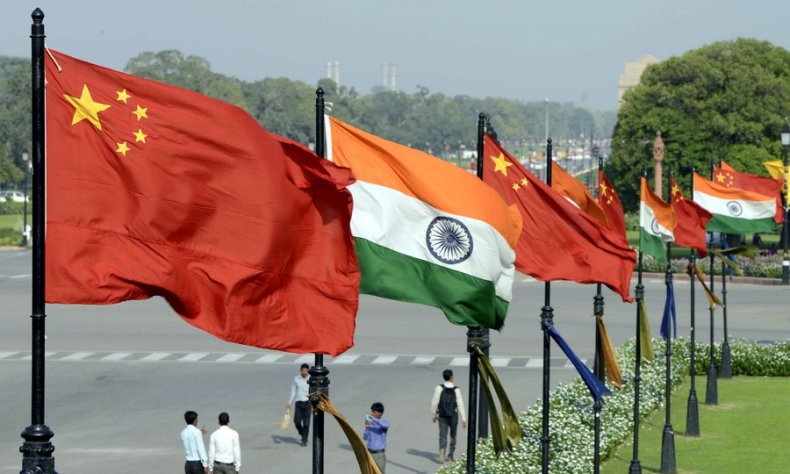
The United States with the aim to preserve its own hegemony attempts to divide Asia and wage a new Cold War through the so-called Indo-Pacific strategy.
U.S. President Joe Biden, Japanese Prime Minister Fumio Kishida, Indian Prime Minister Narendra Modi and Australian Prime Minister Anthony Albanese convened the second in-person Quad summit in the Japanese capital, Tokyo last month. Although the leaders of the Quad countries at their meeting exchanged views about safeguarding “peace and stability” in the Asia-Pacific region and contemporary global issues of mutual interest, their main focus was to counter China’s increasing economic and political influence in the Indo-Pacific region and beyond.
China is the Quad’s long-term focus
Born out of humanitarian cooperation on the 2004 tsunami in the Indian Ocean, the Quadrilateral Security Dialogue, colloquially called Quad, seemed innocuous at first. It was revived at the initiative of former U.S. President Donald Trump in a bid to take on China in its own backyard. On November 12, 2017 at a dinner of the ASEAN summitry in Manila, Trump, Modi and Japan’s former Prime Minister Shinzo Abe held their first official Quad talks with a focus on keeping the Indo-Pacific region “free and open” to check China’s “growing assertiveness” in the area.
Since then, it has become a geopolitical tool for the U.S. to prolong its hegemony in the Asia Pacific region. President Biden has reinvigorated the four-nation grouping to counter China’s influence across the Pacific. In March last year, Biden hosted the first summit of the Quad leaders in the virtual format that was followed by an in-person summit in Washington D.C. in September 2021. The Quad leaders also held a virtual meeting on March 3, 2022.
But given the divergences of interests and values among partners, it is doubtful what the Quad can deliver as it promises. More importantly, the four countries do not represent the Asia Pacific, which is a diverse and dynamic region home to countries with various cultures, political systems and levels of socioeconomic development. The Quad regime is making the Asia-Pacific region less free, less open and less stable by flexing muscles with joint military exercises and weapons transfer. Plainly speaking, the Biden-led Quad 2.0 with its hidden agenda is dangerous for Asia, and dangerous for the world.
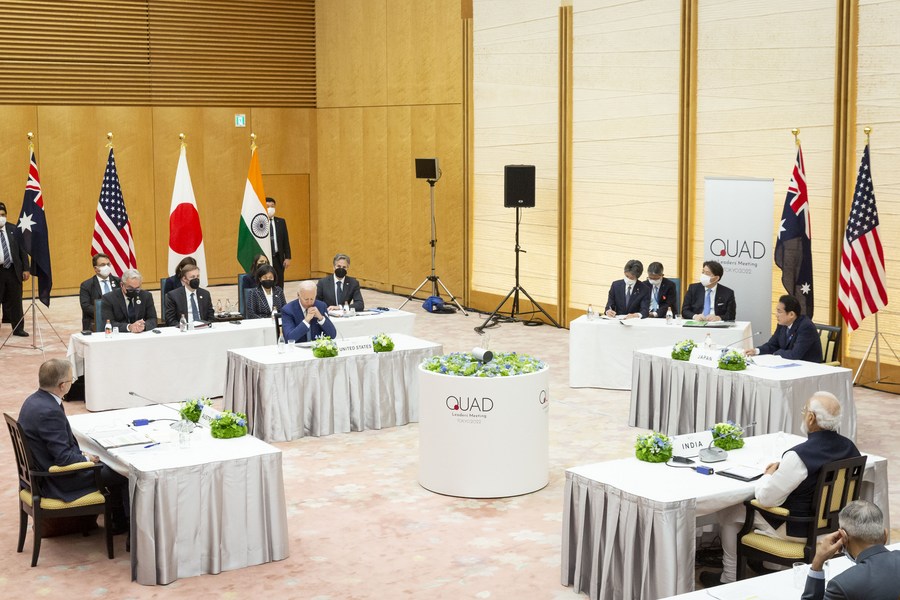
The Tokyo Quad summit took place under the shadow of the pandemic and the Ukraine crisis which is already wreaking havoc. More importantly, it also took place at a time when relations between China and the Quad member countries have become fraught due to their respective geopolitical interests. The Biden administration’s rivalry with China is reflected once again when President Biden said during a joint news conference with Prime Minister Kishida on May 23 that his country “would be ready to intervene militarily to defend Taiwan in the event of a Chinese attack”, prompting China to accuse him of “playing with fire”. It is entirely reasonable and justifiable for Chinese State Councilor and Foreign Minister Wang Yi slamming the U.S. Indo-Pacific strategy, charging that the Quad grouping was formed in the guise of freedom and openness but with the purpose to contain China. He hit out at the U.S. by stating that the Indo-Pacific strategy was “concocted by the United States under the banner of ‘freedom and openness’” and Washington was “keen to gang up with ‘small circles’ and change China’s neighborhood environment.”
Following their in-person summit, the Quad leaders issued a joint statement aiming to contain China’s economic and military might in the Indo-Pacific region, although there is no explicit mention of China in the joint statement.
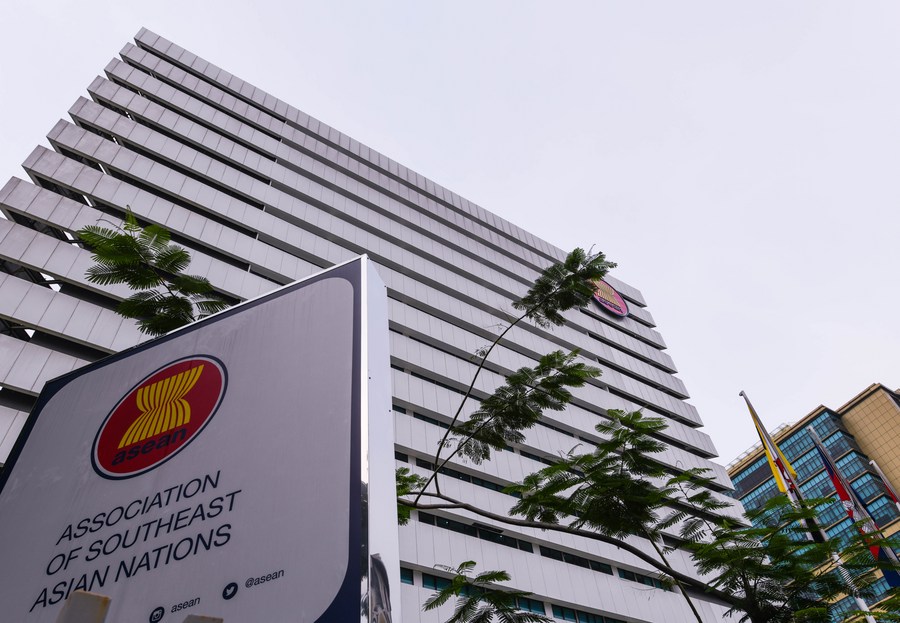
They affirmed their unwavering support for the Association of Southeast Asian Nations (ASEAN) unity and centrality and for the practical implementation of ASEAN Outlook on the Indo-Pacific in their deliberate attempt to pull the leaders of ASEAN into its anti-China camp. They have launched a new maritime surveillance initiative – the Indo-Pacific Partnership for Maritime Domain Awareness (IPMDA) to combat illegal fishing in three critical regions — the Pacific Islands, Southeast Asia, and the Indian Ocean region – in the Indo-Pacific and pledged to invest $50 billion plus in developing infrastructure in the Indo-Pacific as part of their efforts to counterbalance the China-led Belt and Road Initiative in the region.
The US-led IPEF aims to fend off China
In addition to the Quad summit, President Biden launched his long-awaited “Indo-Pacific Economic Framework” (IPEF) during his stay in Japan. Many analysts believe that through IPEF, Biden hopes to restore U.S. economic leadership the Indo-Pacific after walking out of the Trans-Pacific Partnership (TPP) and counter China’s increasing economic and political dominance in the region.
It should be noted here that in 2021, China and other Asia-Pacific countries signed the Regional Comprehensive Economic Partnership (RCEP), the world’s largest free trade agreement, which officially came into force on January 1, 2022. All ASEAN countries and some close U.S. allies including Australia, Japan, New Zealand, and South Korea joined RCEP.
India should be wary of Biden’s geopolitical intent about the new trade initiative. Today the U.S. is targeting China, but the next one could be Japan, India, Vietnam or others. One cannot but ask: Will the IPEF let the American market open for Indian agricultural and engineering products or lead to the reduction in tariffs on steel and aluminum exported from India to the United States? More importantly, how many Asia-Pacific countries are willing to confront China on security and decouple from China on economy? Why India remains committed to a largely US-led camp despite differences over Russia-Ukraine crisis? On several occasions, India has expressed its reservations about condemning Russian aggression in Ukraine and isolating the latter from the global economic order. Notably, in Tokyo, Biden couldn’t get even the word Russia into the Quad summit’s joint statement.
Keep India-China ties on the right track
It is unrealistic to think that the trio nations of the U.S., Australia and Japan in the Quad come to India’s rescue in its border conflict with China militarily with any such eventuality. Despite India’s stringent restrictions on Chinese investments and prolonged border faceoffs as well as all the negative media coverage surrounding China, the good news is that India-China trade reached an unprecedented rise of $125.66 billion in 2021, up 43.3 percent from $87.6 billion in 2020.
Furthermore, Chinese companies are strong participants in the Indian government’s “Make in India” campaign, with total investment of $8 billion in 2019. As such, if the Indian government beats the Chinese companies with no just, for example, banning Chinese telecom gear vendors Huawei Technologies Co. and ZTE Corp. from participating in India’s 5G network rollout or launching a large-scale investigation on Chinese companies including Chinese smartphone giant Xiaomi,?it will not only damage the confidence of all foreign investors including China, but also finally harm the investment environment of India as an open economy and the interests of Indian consumers.
To confine oneself in a cage or build walls is certainly no way out. India’s economic and trade interests with China shouldn’t be held hostage to a divisive Quad alliance. The United States with the aim to preserve its own hegemony attempts to divide Asia and wage a new Cold War through the so-called “Indo-Pacific strategy” under the geopolitical bloc of Quad, an Asia-Pacific version of NATO through military alliances. India should refrain from embracing the U.S. “Indo-Pacific strategy” that undermines the international unity and cooperation.
More than 60 years ago, India, China and other Asian countries jointly advocated the Five Principles of Peaceful Coexistence and the Bandung Spirit, contributing oriental wisdom to handling state-to-state relations. As major countries in Asia, China and India have the responsibility to join hands to resolutely safeguard peace, cooperation and unity in Asia. The two neighboring countries should keep working on building an Asian community with a shared future, make sure that they always keep their future in their own hands, and jointly continue to write the “Asian Miracle”.
The article reflects the author’s opinions, and not necessarily the views of China Focus.