Codependency to Conflict?
 Facebook
 Twitter
 Linkedin
 Google +
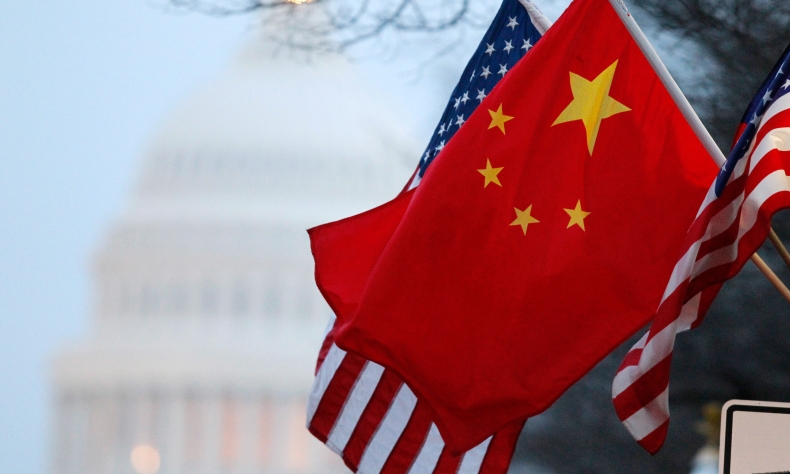
The world’s most important economic relationship is in serious trouble. Long drawn together by the mutual benefits of codependency—an export-led China relying on U.S. demand and a saving-short United States in need of low-cost Chinese imports and surplus foreign capital—the air is now thick with tension.
—Scapegoating China Puts both Countries’ Most Valuable Partnership at Risk
By Stephen Roach
The world’s most important economic relationship is in serious trouble. Long drawn together by the mutual benefits of codependency—an export-led China relying on U.S. demand and a saving-short United States in need of low-cost Chinese imports and surplus foreign capital—the air is now thick with tension.
The United States’ shifting stance on trade policy is hardly surprising. In his inaugural address as the 45th president of the United States, Donald Trump was crystal clear in stressing that “protection will lead to great prosperity and strength.” The Trump administration has now moved from rhetoric to action in its avowed campaign to defend U.S. workers from what the president calls the “carnage of terrible trade deals.” China is clearly in the cross-hairs as the main target.
Tensions are coming to a boil. The January 22 imposition of so-called safeguard tariffs on imports of solar panels and washing machines were aimed largely at China and South Korea. While the early March announcement of steep tariffs on steel and aluminum imports will have only limited direct impacts on China—especially for steel, with China accounting for just 3 percent of total foreign shipments into the United States—there can be little question of collateral impacts on China’s position as the world’s largest producer of both metals.
Significantly, more dramatic follow-up actions are likely. Last August, under instructions from President Trump, U.S. Trade Representative Robert Lighthizer commenced investigations against China in accordance with Section 301 of the U.S. Trade Act of 1974 in three areas of alleged harm to U.S. interests: intellectual property rights, innovation, and technology development. These probes, which are focused on whether China’s laws, policies, practices, or actions are “unreasonable or discriminatory,” are widely expected to lead to sanctions on a broad array of America’s imports from China, which exceeded $500 billion in 2017.
Flawed Analysis
Unfortunately, the Trump administration’s anti-China trade stance rests on a serious flaw in macroeconomic analysis that has long been endemic in Washington—a nationalistic bias that has led to an ill-conceived fixation on scapegoats. Blaming China and its outsize bilateral trade deficit for the squeeze on middle-class U.S. workers misses the important point that the U.S. had a multilateral trade deficit with 102 countries in 2017.
Multilateral trade imbalances do not arise in a vacuum. They are an outgrowth of a shortfall in domestic saving. America’s net national saving rate—the combined depreciation-adjusted saving of businesses, households, and the government sector—averaged just 1.9 percent of national income in the first three quarter of 2017; at less than one third the 6.3 percent average that prevailed in the final three decades of the 20th century, the U.S. has the weakest saving position of any leading nation in modern times. Lacking in domestic saving and wanting to consume and grow, the United States must import surplus saving from abroad and run massive current-account and multilateral trade deficits to attract foreign capital.
Consequently, going after China, or any other country, without addressing the root cause of low saving is like squeezing one end of a water balloon—the water simply sloshes to the other end. In other words, without addressing the saving problem, any U.S. trade diverted from China by tariffs or other sanctions will simply go to higher-cost producers elsewhere in the world, and that would be the functional equivalent of a tax hike on U.S. consumers.
Unfortunately, this problem is going from bad to worse. With President Trump having just signed a tax cut estimated at $1.5 trillion over the next 10 years, and with the U.S. Congress adding another $300 billion to the federal deficit in its latest effort to prevent a government shutdown, pressures on domestic saving will only intensify. This underscores the increasingly problematic disconnect between fiscal policy and trade policy for a saving-deficient U.S. economy: trade deficits are likely to widen just as the U.S. turns protectionist.

Frictions Mount
All this points to mounting frictions in the China-U.S. economic relationship. As the United States’ third largest and rapidly growing export market, Chinese reaction would hardly be inconsequential. And, of course, if things get really bad, China could reduce its purchases, or even ownership, of U.S. treasuries at precisely the time when deficit-prone America will need more foreign capital.
The challenge is to avoid such a dire outcome—to convert distrust back into trust. This will require collective buy-in to policies with overlapping benefits for both the United States and China. Three possibilities should be stressed.
First, there is a clear need for a more robust framework of bilateral engagement between the two largest economies in the world. Bi-annual or annual summits such as the Strategic and Economic Dialogue, or its recent incarnation as the Comprehensive Economic Dialogue, have achieved very little over the years. A permanent secretariat for ongoing consultation stands a much greater chance of success and dispute resolution.
Second, both the United States and China should put a much higher priority on the enhanced market access provided by a bilateral investment treaty (BIT). China’s nascent and rapidly growing consumer markets offer enormous growth potential for U.S. multinational corporations; similarly, as the world’s richest and deepest market, the United States is a magnet of opportunity and return for outbound Chinese capital—with the added advantage of providing inflows that are sorely needed by saving-short America. Both nations need to commit to breaking the nine-year logjam on BIT negotiations.
Third, there are some important soft power options that could go a long way in tempering U.S.-China tensions. For the United States, it would help to take politics out of analytics—specifically, recognizing that there can be no bilateral fix for a multilateral problem, no China solution for America’s saving problem. The blame game is a foil for ducking the responsibility of rebuilding strength at home. For China, it is important to appreciate the upside that would come from addressing the issues that have had a negative impact on its image in the West—not just with respect to trade but also on the cyber-security and geo-strategic fronts.
History is littered with examples of wars that have started by accident. The same is true of trade wars. With tensions mounting between two increasingly nationalistic nations, this is not a time to neglect the destructive tendencies of China-U.S. codependency.
Source: Beijing Review
Stephen Roach, a faculty member at Yale University and former Chairman of Morgan Stanley Asia
Opinion articles reflect the views of their authors, not necessarily those of China Focus