Working for Global Progress in Human Rights
 Facebook
 Twitter
 Linkedin
 Google +

It should be ensured that all peoples enjoy human rights as equals by allowing them to follow their respective paths of modernization.
December?2023 marked the 75th anniversary of the Universal Declaration of Human Rights (UDHR). On December 10, 1948, the United Nations General Assembly adopted the UDHR (General Assembly resolution 217 A), the first international document on this issue. Chang Peng Chun (P.C. Chang, 1892-1957), vice chairman of the original UN Commission on Human Rights at the time, played a pivotal role in the drafting of this milestone document – incorporating elements of Chinese philosophy, such as “do as one would be done by others” and “harmony in diversity,” into the conceptual framing of human rights. Their inclusion highlights the diversity of the human rights culture, and is one of China’s significant contributions to global human rights governance as a founding country of the international system of human rights protection.
By adapting the universal tenets of human rights to its specific reality, China has blazed a path of human rights protection fitting the needs of the times and national conditions. In his message to the Forum on Global Human Rights Governance held in Beijing last June, Chinese President Xi Jinping called for the world to protect human rights by creating a secure environment and promote human rights through development and cooperation. His words promise inspiring efforts to steer global human rights governance toward greater fairness, justice, equity, and inclusiveness.
Security and human rights
When attending the 37th group study session of the Political Bureau of the 19th CPC Central Committee on February 25, 2022, President Xi said, “Subsistence is the foundation of all human rights. Living a life of contentment is the ultimate human right.” Security is the precondition of subsistence and a fundamental demand of humanity. No human right is possible without peace and stability. When addressing the opening ceremony of the Boao Forum for Asia Annual Conference 2022, President Xi proposed the Global Security Initiative on behalf of China, marking a new step in global security governance.
Only by ensuring security, respecting the sovereignty and territorial integrity of all countries, and following the path of peaceful development as advocated in the Global Security Initiative can the world create a peaceful environment for the realization of human rights.
Over the past 75 years since the founding of the People’s Republic, China has not initiated any wars or conflicts, nor has it occupied an inch of land of other countries. Instead, it has worked earnestly to maintain global strategic balance and stability.
Since sending its initial batch of military observers to the United Nations Truce Supervision Organization (UNTSO) in 1990, China has participated in UN peacekeeping operations in more than 20 countries and regions, with the total personnel exceeding 50,000 – the largest in number among all permanent members of the Security Council. China was the second largest contributor to the regular UN budget and peacekeeping budget from 2019 to 2021, accounting for 12 percent and 15.22 percent respectively.
In 2014, China put forward the vision of pursuing common, comprehensive, cooperative, and sustainable security. This reflects its belief that the key to security lies in development. It is imperative to solve conflicts through socioeconomic development, hence eradicating the root of insecurity, and seek to achieve lasting security. Sustainable security would be impossible without sustainable development, and it can only be achieved when the world pays equal attention to development and security.
China’s new vision of security also underscores common interests and cooperation. Only by ensuring the equal right to security for all countries and accommodating their security concerns can we safeguard security through development. Countries should give priority to development programs in regional and international cooperation, improving livelihood and narrowing the wealth gap through cooperation in the fields of economy, trade, infrastructure, and industry. Only by advancing common development and regional integration can the world achieve sustainable security.
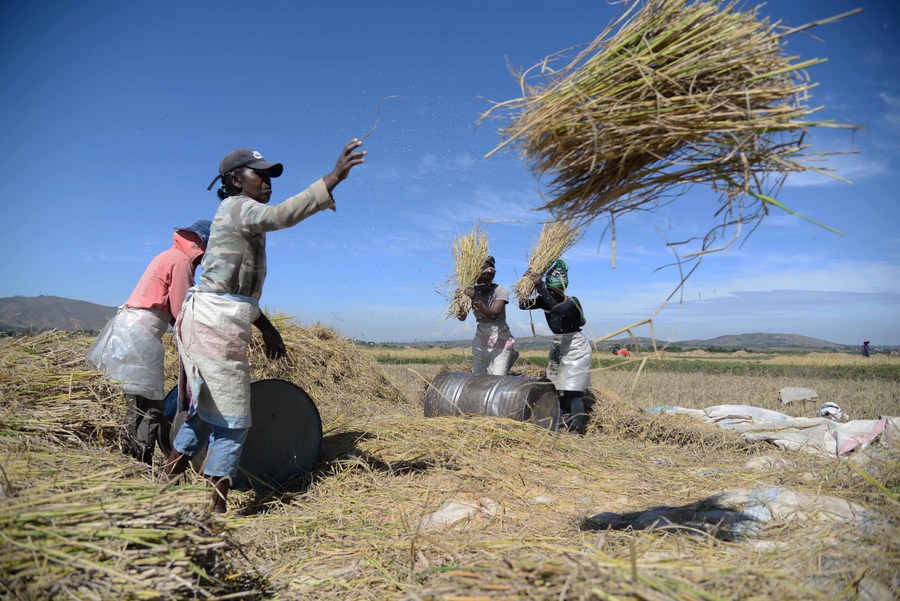
Poverty, a persistent menace to human society, is a major obstacle to happiness for many people around the world. China has been active in global efforts to combat poverty. By the end of 2019, China had implemented 82 projects for this purpose in partnership with 14 international organizations, including the United Nations Development Programme, the World Food Programme, the United Nations Children’s Fund, the Office of the United Nations High Commissioner for Refugees, and the International Committee of the Red Cross. They cover the areas of poverty reduction, women and children’s health, post-disaster reconstruction, immigration, and refugee protection.
Between 2013 and 2018, China forgave 98 interest-free loans that totaled RMB 4.18 billion to the least developed countries, heavily indebted poor countries, landlocked developing countries, and small island developing states. In order to consolidate achievements and achieve better outcomes in poverty reduction, the Chinese government has, after a review of its experience in international cooperation in this field, sent experts and technicians to other countries and invited personnel from these countries to China for various types of training – including short-term courses and on-the-job degree programs with government scholarships. They span more than 100 specialties of 17 fields, including national development, agricultural technology, poverty reduction, and healthcare. From 2013 to 2018, China held more than 7,000 sessions of these initiatives, benefiting about 200,000 people. In providing its experience, solutions, and resources to the international efforts against poverty, China has won global recognition for its poverty reduction concepts and practices.
Food security is the foundation of national security, and is also a very important global public issue. While China is doing all it can to ensure its production and supply of agricultural products, it also diligently performs its international obligations under the framework of South-South cooperation, providing assistance to countries and regions suffering food crises due to disasters or wars. Since 2016, China has provided emergency food assistance to more than 50 countries in Asia, Africa, and Latin America, helping tens of millions of people affected by disasters. As of the end of 2019, China had also used its South-South Cooperation Assistance Fund (now called Global Development and South-South Cooperation Fund) and cooperated with the World Food Program to provide food assistance to the most vulnerable communities in 24 countries in Asia, Africa, Latin America, and the Caribbean.
In addition, China has been active in addressing global food security issues by promoting agricultural technology, carrying out cooperation in agricultural research, cultivating high-caliber talent, and advancing development of the agricultural whole industrial chain. It supports other developing countries in improving their agricultural science and technology, agricultural productivity, and food security. By the end of 2019, China had dispatched 808 agricultural technology experts to 37 Asian and African countries, helped African countries build 22 agricultural technology demonstration centers, and transferred more than 450 technologies to other developing countries including Liberia under the FAO-China South-South Cooperation Program.
Confrontation and a new Cold War will only exacerbate security challenges in the 21st century. With this understanding, China has proposed the Global Security Initiative, emphasizing that humanity is an indivisible security community. The indivisibility of security is a term first included in the preamble of the Helsinki Final Act of 1975, and was subsequently adopted in the 1990 Charter of Paris for a New Europe and the 2010 Treaty between the United States of America and the Russian Federation on Measures for the Further Reduction and Limitation of Strategic Offensive Arms. Although this principle was originally intended to maintain common security in local areas, especially among European countries, it has acquired new meaning through international security cooperation during the following decades.
Based on the central tenet and purpose of the idea of building a community with a shared future for mankind, the Global Security Initiative underscores greater equity, inclusiveness, and balance in international security. It adds a new dimension to the principle of indivisible security, as it both emphasizes the indivisibility of security for the international community and recognizes the need to accommodate legitimate concerns of all parties through negotiation and dialogue to safeguard common security. This initiative therefore represents China’s solution to problems hindering global security and global human rights governance. The international community should embrace a vision of common, comprehensive, cooperative, and sustainable security, work together to safeguard world peace and security, and better protect and promote human rights.
Development and human rights
In his letter to the seminar on the 70th anniversary of the Universal Declaration of Human Rights in December 2018, President Xi Jinping pointed out: “The times are moving forward, and human rights are making progress. China regards people’s happy life as the greatest human right. Combining the principle of universal human rights with the reality of modern times, China remains committed to a path for human rights that aligns with its prevailing conditions. Adhering to a people-centric vision, China takes the rights to subsistence and development as primary and basic human rights, works for coordinated progress in economic, political, social, cultural, and environmental rights, defends social fairness and justice, and promotes the right to all-round development.” He concluded that the right to development is a universal, inalienable, and basic human right.

China’s approach to human rights is people-centric, valuing the all-round development of people more than anything else. Putting people first is the central idea of China’s traditional culture. Ancient classics teem with expressions of this idea, such as “among all things, people are the most important,” “those who want to accomplish big undertakings must put people first,” and “those who administer the country must put people first.” Similar phrases, such as, “do as one would be done by others” and “harmony in diversity,” are also revealing of the inclusive nature of Chinese civilization.
During the drafting process of the Universal Declaration of Human Rights, Chang Peng Chun insisted on incorporating the concept of “benevolence” from Chinese culture into the international framework of human rights, arguing that liberalism was not the only form of expression of human rights. He opposed any act of harming the interests of others in the name of human rights, and believed that the purpose of protecting human rights is not advancing self-interest, but raising people’s moral standing. This view is reflected in Article 29 of the Declaration, “Everyone has duties to the community in which alone the free and full development of his personality is possible.” In the cause of human rights, China represents an alternative approach and thinking in addition to those of the West.
Being committed to international human rights protection, China has endeavored to advance human rights through development, and agrees to the principle prescribed in the Declaration. In this spirit, China taps into the Marxist view of humanity, society, history, and human rights as well as its traditional cultural wisdom to build a society where everyone can develop fully and freely.
In 1993, the World Conference on Human Rights adopted the Vienna Declaration and Programme of Action, which stated that all human rights are universal, indivisible, interdependent, and interrelated. While emphasizing the primacy of the rights to subsistence and development, China attaches great importance to balanced, coordinated development of all human rights – including economic, social, and political rights. Human rights cover a wide range of areas, and they are all interdependent. In promoting human rights through development, China gives top priority to ensuring people’s rights to subsistence and development. In the meanwhile, it also works to meet the people’s expectation for a better, higher-quality life, and meet their growing demand for rights in all respects. For this purpose, China coordinates development of the economy, democracy, the rule of law, ethics, and culture, works for all-round improvements in employment, income distribution, education, social security, and healthcare. It also strives to strengthen human rights protection in the process of advancing material, political, cultural, ethical, social, and eco-environmental progress.
Today, global development remains unbalanced, uncoordinated, and inadequate, which has a negative impact on the human rights of people in all countries, especially in developing countries. To change this situation, we must make development more inclusive, universally beneficial, and sustainable, and ensure that all peoples can enjoy human rights as equals by allowing them to follow their respective paths of modernization. At the same time, the principle should be adhered to that all human rights are indivisible and interdependent, protecting and promoting all human rights and fundamental freedoms. Under unified planning, efforts should be coordinated to promote all human rights and pursue balanced progress in various areas.
Cooperation and human rights
An ancient Chinese saying states, “When the path is just, the common good will reign over all under Heaven.” The issues concerning human rights fall within the jurisdiction of individual states. The rules of respect for national sovereignty and non-interference in internal affairs are hence applicable to them. Human rights should by no means be exploited as an excuse or weapon for one country to impose its ideology on another. But at the same time, we cannot deny the commonality and universal nature of human rights.

As President Xi Jinping said, “Peace, development, equity, justice, democracy, and freedom are common values of humanity.” He observed, “Peace and development are our common cause, equity and justice our common aspiration, and democracy and freedom our common goal.” The common values of humanity lie at the core of human rights. Ensuring full human rights for all is the dream and pursuit of all humanity, and promoting human rights requires the efforts of each and every one of us.
China is an active participant in and contributor to global human rights governance. It has fulfilled its obligations as a major country in addressing human rights affairs at the international level, including at the UN, been engaged in extensive international cooperation, and taken concrete action to make international human rights governance more fair, reasonable, and inclusive. In recent years, the United Nations and its human rights agencies have incorporated China’s human rights concepts into some resolutions, winning broad support from the international community.
In March 2017, the United Nations Human Rights Council included the phrase “building a community of shared future for humanity” in the resolution at its 34th session. This marks the first time this Chinese concept entered the international discourse. In June of the same year, the Council adopted a resolution proposed by China called The Contribution of Development to the Enjoyment of All Human Rights, which marks that the idea “development promotes human rights” was introduced into the international human rights system.
In March 2021, the Council adopted another resolution submitted by China – Promoting Mutually Beneficial Cooperation in the Field of Human Rights – which called on all countries to carry out constructive dialogue and cooperation over human rights, strengthen technical assistance and capacity building, promote win-win cooperation, and build a community of shared future for humanity. The idea of building a community with a shared future for humanity transcends the outdated concept that global human rights governance is confined to relevant international mechanisms. It reveals that the major obstacle to global human rights governance is an outcome of governance deficit, peace deficit, development deficit, and trust deficit. The solution lies in peace, development, and cooperation.
Facts have proved that only by embracing the spirit of unity and cooperation, having sincere and in-depth communication, seeking consensus, and managing differences, can countries around the world better protect human rights and jointly advance this cause.
Xia Yipu is an associate research fellow with the Research Center of Xi Jinping Thought on Socialism with Chinese Characteristics for a New Era under the Chinese Academy of Social Sciences.