An Intersection of Ancient Wisdom And Modern Ideals
 Facebook
 Twitter
 Linkedin
 Google +

The Chinese approach is to ‘seek common ground while reserving differences,’ while also recognizing that there is genius on both sides of cultural divides that must be assessed and valued.
The contemporary concepts of civilization and culture (respectively wenming and wenhua in standard Chinese) promoted by Chinese President Xi Jinping draw on a combination of ancient and modern Chinese wisdom. Both concepts have been creatively synthesized with Chinese Marxism.
It’s helpful to know that civilization and culture in standard Chinese share a direct linguistic association, as both are compounds of wen, and thus for the average Chinese speaker the relationship between the two concepts is more immediate than in other languages, including English.
In English, culture and civilization are highly debated terms, both having much to do with economic and social advancement and with the unique psychical structures of a nation. In Chinese, the terms generally have a more positive and less controversial relationship with each other, one in which progressive and traditional values and wisdom are intentionally balanced to strengthen social development and national?rejuvenation.
Civilizational growth
The instrumentally invaluable insights of Chinese Marxism are developed in tandem with building socialism with Chinese characteristics and leading national rejuvenation.
Of course, this includes learning from other civilizations, including Marxism and modern science and industry from the West.
At the same time, Chinese Marxism has always drawn substantially from Chinese traditions and values, including some of the most ancient among these, like yin and yang thought, which represents the dualistic nature of the universe and how seemingly opposite forces are interconnected.
For example, Chinese Marxism begins, in some respects, by emphasizing the “unity of opposites” in its understanding of dialectics, distinguishing it from classical and Soviet Marxism, which tended to view sublation as a zero-sum game. Another well-known example: China achieved the goal of establishing a xiaokang society, or a moderately prosperous society, in 2021, a modern advance that drew direct inspiration from a social development first described under the same name by the ancient Chinese philosopher Confucius (c. 6th century B.C.) several millennia ago in the Book of Rites, as a critical threshold for advancing socialism.
Now, facing a new era with new challenges but with the Chinese path toward modernization well-established, the principle of Chinese Marxism asserts that China must continue to learn from and combine Chinese know-how, past and present.
This has sparked a renewed interest in cultural recovery and reevaluation.
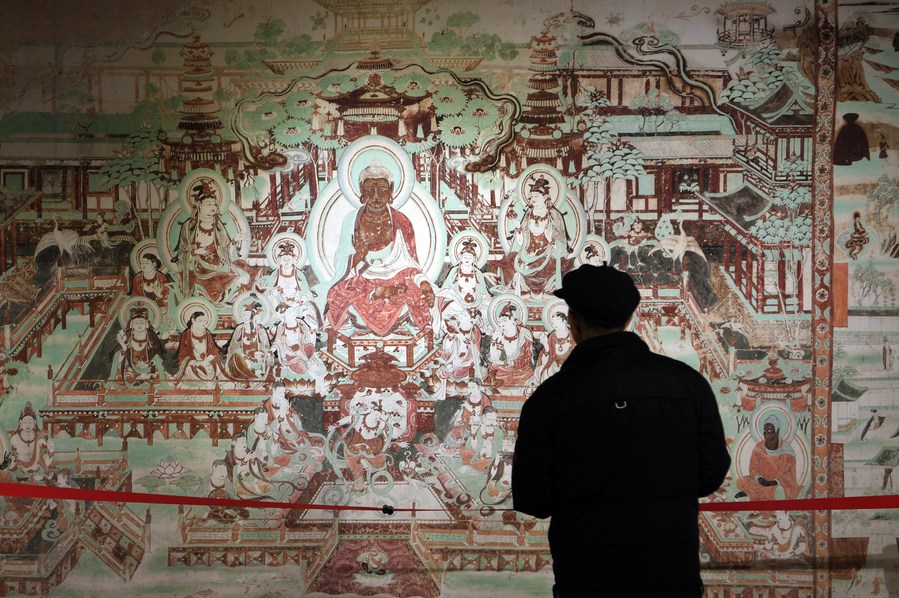
This includes studying Chinese Buddhist paintings from the Dunhuang Caves to reinforce values that bridge different civilizations, similar to those highlighted in President Xi’s Global Civilizations Initiative (GCI). The GCI advocates the respect for the diversity of civilizations, the common values of humanity, the importance of inheritance and innovation of civilizations, as well as robust international people-to-people exchanges and cooperation.
It also involves promoting the core principle of Taoism, which emphasizes achieving a balance between humans and nature to support environmentally friendly development and innovation.
This approach aims to address issues such as climate change while also strengthening the vision of a community with a shared future for humanity.
Chinese civilization is one of the oldest in human history and is often considered the oldest continuous civilization. While popularly dated to more than 5,000 years of age, some scholars argue that 3,500 is a more reliable figure. There is clear archaeological evidence of Neolithic civilizations predating the earliest known dynasties,?including some like the one associated with the Yangshao Culture, which flourished in China by some estimates as early as 7,000 years ago, with images and symbols, including the dragon, for example, that suggest much older cultural linkages than even the 5,000 figure suggests.
The point here is not to debate the precise age of a civilization that first emerged in a pre-historic era, long before the Chinese writing system was developed. Rather, it’s to acknowledge the tremendous pool of wisdom that accumulated over such a long period of cultural and civilizational development.
This wisdom not only contributed to the longevity of the Chinese civilization, but much of it also still offers critical insights for continued civilizational growth and development, including insights useful for human civilization as a whole.
Individual to international
Equally important however is realizing that Chinese modernity could only be accomplished by taking into positive consideration Chinese cultural and civilizational values.
The endeavor of saving and developing China could have come at the expense of ceasing, effectively, to be Chinese—the opposite of national liberation, salvation and rejuvenation.
China’s successful modernization, which has drawn positive lessons from others, has also succeeded in avoiding Western development models that practiced imperialism, colonization, genocide and slavery, among other ills, all of which continue to haunt many developed and developing countries today. Thus, China’s development path is not only the best possible option for itself but also valuable for the rest of the world.
One of the dominant features of Western societies today, and of those that have emulated Western universalist values, is the emergence of “culture wars,” most commonly fought between “traditionalists” and “progressives.” Both sides of such conflicts tend to be universalist in their thinking, locked in zero-sum battles for cultural hegemony at home and abroad.

Indeed, these conflicts play out inside individual societies, but they also gravely impact international relations.
They foster instability and contribute to insecurity of various sorts, including economic, national defense and public health, among others, all of which easily cross borders and become larger problems for humanity as a whole.
Furthermore, if you’re inclined to compete existentially with your fellow citizens, then you’re even more likely to do so when faced by other nations, cultures and civilizations. So it’s unsurprising to see some countries, including the United States, directly advocating cultural and civilizational struggles internationally, effectively normalizing practices like the so-called “clash of civilizations,” which has once again become a vogue concept in Western capitals, especially those that have viewed themselves in civilizational conflicts with Russia, China and others.
While no country can be completely immune from competing social values, including both internal and external differences, the Chinese approach, one that takes its wisdom from tradition, is to “seek common ground while reserving differences,” while also recognizing that there is genius on both sides of cultural divides that must be assessed and valued.
One should not, for example, revert to the old gender discrimination norms that were common in pre-modern Confucian society, and that still linger in some respects, or place Taoist metaphysics ahead of the natural sciences.
Nevertheless, China has demonstrated that both Confucian and Taoist philosophies offer great insights. These insights have not only helped China solve the riddle of its modern development but also offered wisdom in combating the excesses of Western-style modernization.
These negative consequences have led to global issues and frequently caused even the most advanced Western nations to become divided societies that struggle to cooperate with others—or even internally.
These are some of the key lessons of Chinese civilization and culture, consistent with Chinese Marxism.
When President Xi promotes the GCI, it should be understood that he understands China as a unique civilization within human civilization as a whole and that human civilization includes many other individual civilizations that should enjoy mutual respect and recognition as they seek to improve themselves and contribute their development and own wisdom to the larger project of human development as a whole.
This is the logic of Chinese development and the logic of Chinese foreign policy.
These are the lessons China has learned from its development process and it’s the good news that it shares with others, including those trying to solve their development riddles as well as those who mistake China’s rise as a threat.
The author is a professor of politics and international relations at East China Normal University and a senior research fellow with the Institute for the?Development of Socialism with Chinese?Characteristics at Southeast University and the Hainan CGE Peace Development Foundation.