Brazil’s Future Lies Within the Global South
 Facebook
 Twitter
 Linkedin
 Google +

Brazil is shifting focus to Global South partnerships, seeking economic growth and infrastructure development through BRICS and the Belt and Road Initiative.
As early as in the 1990s, Brazil embraced a strategy of aligning with the U.S.-led liberal multilateral system and implementing liberal reforms to foster economic development through globalization after the 1980s economic crisis. The internal reforms were a condition for Brazil’s full integration with multilateral institutions like the World Trade Organization, International Monetary Fund and World Bank.
During Lula da Silva’s first presidency in the 2000s, Brazil turned to diversifying its partnerships toward the Global South amid economic growth driven by China’s dynamism. Brazil strengthened its relations with various Global South countries, especially Russia, India, South Africa and China, which emerged as Brazil’s main trading partner, surpassing the United States.
With these countries, Brazil advocated for reforms of multilateral institutions like the WTO, IMF and World Bank to better reflect the new global economic balance, where Global South economies collectively surpassed their developed Western counterparts. These institutions, they argued, should increase representation from the Global South in their decision-making and rule-making processes.
Despite rhetoric about democracy and inclusiveness in international institutions, Western powers led by the U.S. are reluctant to address the Global South’s demands. They prefer to focus on maintaining their historical privileges. As a result, Brazil and its Global South partners have turned to informal multilateral organizations emphasizing consensus and mutual benefit, such as BRICS and the G20, trying to overcome the stagnation of traditional institutions.
BRICS is an important multilateral group in the current international system, having established institutions like the New Development Bank (NDB) and the Contingent Reserve Arrangement (CRA), which serve functions similar to the World Bank and IMF. However, these institutions complement rather than compete with each other. For example, a member state seeking benefits from the CRA must meet its IMF obligations. The difference is that BRICS institutions don’t require internal political and economic reforms as conditions for benefits.
Another key objective of the BRICS is to enhance trade and investment among its members. Traditionally, many of its members have had stronger trade and investment ties with Western economies than with Global South countries. This new development presents significant growth potential for economic interactions within the group.
Bilateral trade between Brazil and China is a great example. Over the past 15 years, Brazil has maintained trade surpluses with China, driven by Chinese demand for Brazilian commodities and Brazil’s appetite for high-value Chinese products. This relationship shows mutual benefits and complements both nations’ economic interests. Brazil was the first country to sign a strategic partnership with China, remains one of the few countries maintaining consistent trade surpluses with China, and is a major recipient of Chinese investments.
One key opportunity to enhance this cooperation is through the Belt and Road Initiative (BRI). The BRI provides needed investment in infrastructure and other areas where many Global South countries lack resources, acting as a catalyst for both economic and cultural exchange. It can serve as a vital development tool for Global South countries that, under the Washington Consensus, failed to secure significant investment.
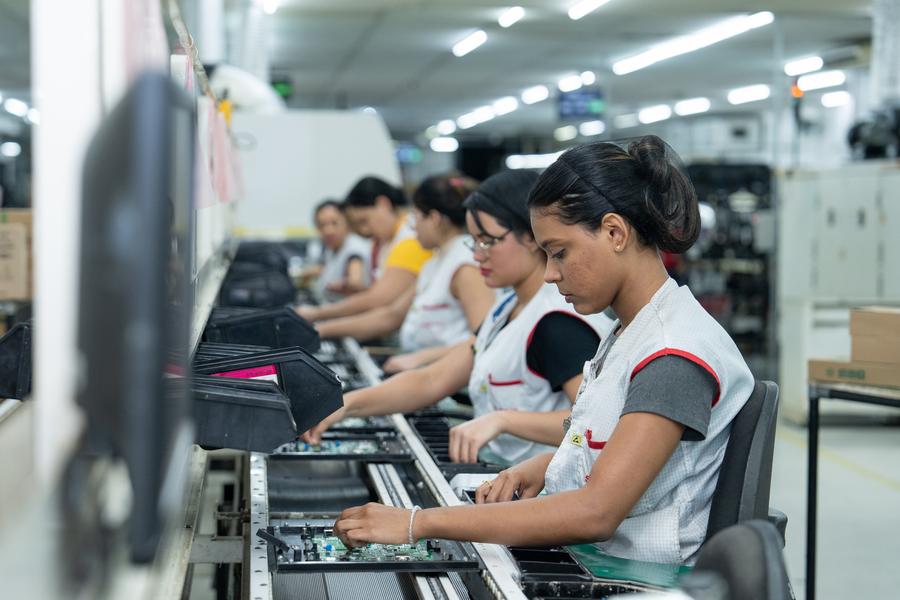
In Brazil’s case, after six years of right-wing governments cutting public investment to fulfill liberal austerity policies, the country fell behind in its development strategy. China’s proposal for Brazil to join the BRI presents an opportunity to revive economic development and address resurging poverty.
The Workers’ Party returned to power in 2023, with Lula starting his third presidential term after a 13-year gap. During Lula’s previous terms, Brazil saw significant growth in trade and investment with China, resulting in strong GDP growth, including 7.5% in 2010. Given this track record, President Lula is expected to sign the BRI agreement, strengthening the partnership with China— a proven example of win-win cooperation. This move would help put Brazil back on a path to economic growth.
Brazil needs investment in infrastructure, communications and other key sectors, which the BRI could help address as the country recovers from the economic turmoil of Jair Bolsonaro’s far-right government. Bolsonaro damaged Brazil’s relations with China through ideological stances while increasing public spending on populist re-election measures. He left what Lula calls a “wasteland” of economic challenges.
Brazil and China have common ground on international issues, including fighting hunger, promoting peace, opposing unilateral sanctions and addressing climate change. Given the shared positions, strengthening ties with China aligns with Brazil’s foreign policy goals.
Signing a BRI agreement would foster goodwill and expand markets for both Brazil and China. For the Lula administration, joining the BRI would reaffirm Brazil’s Global South identity, marking a shift away from what it sees as a declining Western axis. The move would also reset relations between Lula’s government and China after previous administrations favored ties with the U.S. and European Union despite China’s prominent role in trade and investment.
Supporters of Brazil’s new industrialization push see the BRI as a way to attract infrastructure investment and build partnerships with Chinese companies to boost technological and industrial capabilities. They say Brazil needs a long-term agreement to achieve technological and industrial integration to support sustainable economic growth.
In the future, with Brazil likely joining the BRI and deepeningits ties with China, BRICS stands to emerge stronger. Such would help pave the way for a multilateral system that reflects today’s multipolar world, promoting a more balanced global order.
Italo Poty teaches international relations at Fluminense Federal University’s Institute of Strategic Studies and conducts research at the Center for Studies in Contemporary China and Asia.
Li Xing is a Yunshan leading scholar and distinguished professor at the Guangdong Institute for International Strategies at the Guangdong University of Foreign Studies. He is also an adjunct professor of international relations at Aalborg University in Denmark.