‘Decoupling’ Debunked: China’s Trade Engine Keeps Surging
 Facebook
 Twitter
 Linkedin
 Google +
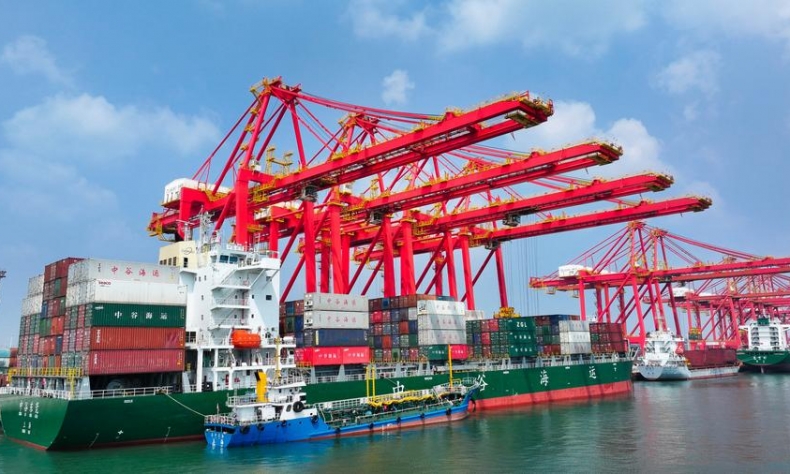
China’s overall model drives down costs through productive efficiency and output abundance. Its own economy and those of the Global South benefit from this.
Trade has, undoubtedly, become a political focal point over the past six years, ever since the first Trump Administration initiated a trade war with wide-ranging tariffs on Chinese-made goods in 2018. Post pandemic, some Western countries have pursued, rhetorically at least, a direction anchored by notions of “de-risking,” “re-shoring,” and “friend-shoring” as they spoke of a need to reconfigure global production systems and supply chains and reduce dependence on China. On the back of this, some academics, like Dani Rodrik, argued that the post-1990s era of ‘hyper-globalisation’ is over.
Characterizing eras is an inherently difficult task. There are good reasons to doubt that the characterization necessarily tells us much about the changing contours of trans-national economic value flows. The dynamics of trade and capital flows of the past 35 years are, in fact, not unprecedented. For instance, the internationalization of trade, capital flows and monetary systems was evident between 1870 and 1914. The international economy has been subject to bouts of significant structural change in the past century, suggesting that a lens that emphasizes ‘never-ending change’ makes more sense.
In the past 35 years, we have witnessed the dramatic growth of the Chinese economy in terms of its productive capacity. In the past 25 years, it has played an increasingly important role in the networks of trade and investment flows. This transformation underpins the patterns that are being amplified today, but in no way should be treated as recent or sudden phenomena.
In the years immediately following its accession to the WTO, China’s principal trading relations were with the developed economies of the world. China emerged as the world’s manufacturing hub, supplying high volumes of low-cost goods to the consumer markets of the developed world. Today, however, while China remains the only global manufacturing superpower, accounting for around 30% of manufacturing value added, its export markets have dramatically diversified.
Today, China’s trading relations with the Global South are more important than those with the transatlantic markets and Japan. In 2020, ASEAN surpassed the EU as China’s largest aggregate trading partner. More broadly, the key drivers of China’s ongoing trade growth and surpluses continue to be the secular expansion of its economic relations with the Global South, especially participants of the Belt and Road Initiative (BRI). In 2024, China’s trade volume with BRI partner countries reached more than 50% of its total trade for the first time in history. In 2018, when Trump began the tariffs war, exports to the U.S. comprised around 20% of China’s total exports. This is no longer the case. The U.S. market makes up about 15% of China’s total exports. The U.S. is simply not as important a market as it once was.
Advocates of “de-coupling” point to this sliding share as a sign of success. What they don’t acknowledge is that trade value with the U.S. has actually grown. That the share of total exports has declined is a result of the fact that exports growth elsewhere have been faster. In 2018, China’s trade surplus globally was about $350 billion. It has now reached almost $1 trillion, a three-fold increase in six years. The world isn’t decoupling from China, period.
The trade wars have failed. The changing contours of global trade is a demonstration of this, illustrating some key points.
Firstly, China’s ability to expand its overall trade is premised on its expanded productive capacity. China’s model has been to not only move up the value curve, but to drive down unit costs. Intense domestic competition underscores the pursuit of productivity and efficiency, resulting in the availability of high-quality products at world-beating prices.
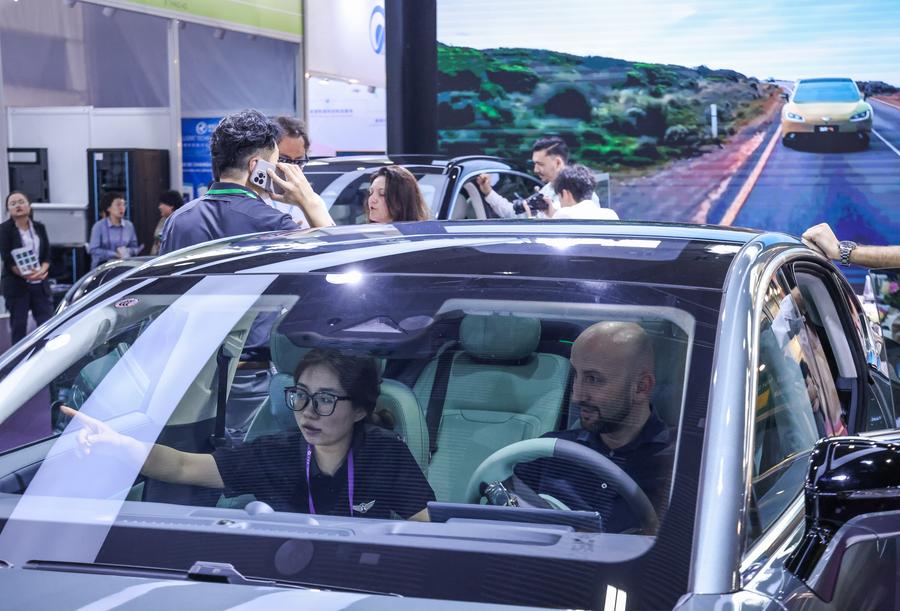
Secondly, China’s manufacturing output growth has in fact been largely absorbed by growing domestic demand. As of 2020, around 80% of Chinese manufacturing output is sold domestically, according to OECD TiVA database. In some sectors like EVs, the domestic market has reached a share of around 90%. While China is a major trading nation, its economic drivers are principally anchored by the expanding domestic market.
Thirdly, China’s aggregate trade balance is approximately 5% of its GDP. This is modest, illustrating the reality that the modern China model is not export-dependent.
Fourth, Chinese enterprises are becoming capital exporters, establishing factories in various countries. This has seen some shift in trade patterns to the U.S. for example, where reduced imports from China are offset by increased imports from Chinese firms operating outside of China.
China’s overall model drives down costs through productive efficiency and output abundance. Its own economy and those of the Global South benefit from this. By way of contrast, the Western model of financialized capitalism is built on confected scarcity underpinning a rentier economy. The trade data for 2024 amplifies the effects of these differences.
The author is an adjunct professor at Queensland University of Technology and senior fellow at Taihe Institute.