Together We Thrive
 Facebook
 Twitter
 Linkedin
 Google +

In light of unexpected and uncertain changes in the region and across the world in recent years, Xi’s vision emphasizes peace, sincerity, mutual benefit and shared development through cooperation.
This world is always changing, but it is also true that some things remain constant, with the continuity and stability of China’s policies toward its neighbors being a fine example.
These consistent policies have been reaffirmed during the five-day, three-nation tour of Southeast Asia by Xi Jinping, General Secretary of the Communist Party of China Central Committee and Chinese President, from April 14 to 18. The visit was also Xi’s first overseas trip this year.
“We will stay committed to the principle of amity, sincerity, mutual benefit and inclusiveness. We will continue to pursue the policy of forging friendship and partnership with our neighbors. And we will steadily deepen friendly cooperation with them to advance Asia’s modernization,” Xi said in a signed article published in Viet Nam’s Nhan Dan newspaper.
Xi arrived in Viet Nam on April 14 for the first leg of his visit.
Pham Phu Phuc, former deputy head of the World News Desk at Vietnam News Agency, welcomed China’s diplomatic approach. In light of unexpected and uncertain changes in the region and across the world in recent years, this vision emphasizes peace, sincerity, mutual benefit and shared development through cooperation, he told Xinhua News Agency.
Camaraderie plus brotherhood
Xi’s visit came as China and Viet Nam celebrate the 75th anniversary of their diplomatic relations this year. Facing the changing and turbulent world, the two countries have remained committed to peaceful development and deepened their friendly cooperation, bringing much-needed stability and certainty to the world, Xi said during his talks with To Lam, General Secretary of the Communist Party of Viet Nam Central Committee, on April 14.
This was Xi’s fourth visit to Viet Nam in the last decade. On multiple occasions during each trip, Xi has quoted late Vietnamese leader Ho Chi Minh’s famous description of China-Viet Nam bilateral relations—a bond of “camaraderie plus brotherhood.”
The expression remains the “best testament to that shared history of standing together through storm and stress with unwavering loyalty,” Nguyen Vinh Quang, Vice President of the Viet Nam-China Friendship Association, told Xinhua.
During Xi’s last visit, in December 2023, the two sides agreed to build a China-Viet Nam community with a shared future that carries strategic significance on the basis of deepening the comprehensive strategic cooperative partnership. This time, Xi proposed six measures to deepen the shared vision, including lifting strategic mutual trust to a higher level, building stronger security safeguards, expanding higher quality mutually beneficial cooperation, tightening the bond of people-to-people ties, conducting closer multilateral coordination and engaging in more constructive maritime interactions.
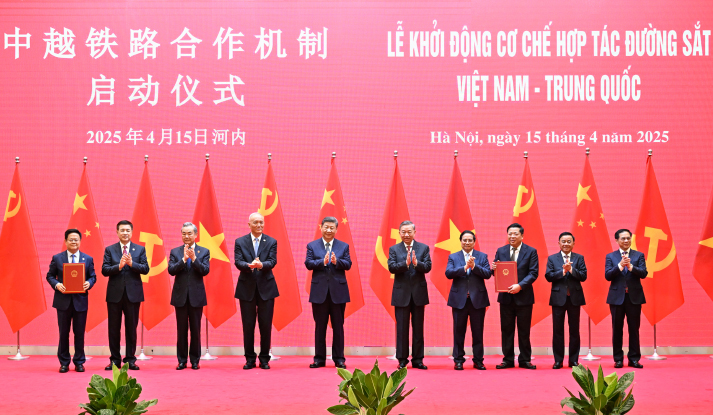
Building the China-Viet Nam community with a shared future carries great global significance, Xi said in his meeting with To Lam, noting that as the two countries jointly pursue peaceful development, their combined population of over 1.5 billion is jointly advancing toward modernization, which will contribute to regional and global peace and stability while promoting common development.
Over the past three decades, trade between China and Viet Nam has skyrocketed by an astonishing 6,400 times. According to Chinese customs statistics, bilateral trade volume exceeded $260 billion last year. Viet Nam has retained its position as China’s largest trading partner within the Association of Southeast Asian Nations (ASEAN) for eight consecutive years and has risen to become China’s fourth largest trading partner globally.
Since 2004, China has been Viet Nam’s largest trading partner, and in 2020, it overtook the European Union to become the country’s second largest export market. It has also become the largest export destination for Vietnamese agricultural products, accounting for 65.2 percent of its total fruit and vegetable exports.
In addition to robust trade ties, Viet Nam’s shared political system, similar development path, and close geographical and cultural ties have made it a preferred destination for Chinese enterprises, Nie Huihui, a research fellow with the Institute of Southeast Asia and Oceania Studies at the China Institutes of Contemporary International Relations, told Beijing Review.
China is Viet Nam’s sixth largest source of foreign investment, with a total volume of $31.26 billion. Last year, it outperformed any other country in terms of the number of newly added investment projects in Viet Nam.
During Xi’s visit, he also emphasized the importance of accelerating infrastructure projects. He proposed the early realization of cross-border connectivity of standard-gauge railways, highways and smart port systems between the two countries.
The ongoing progress is expected to further boost bilateral trade, while also facilitating the integration of Viet Nam with China’s railway networks extending to Central Asia and Europe. This will strengthen China’s connections to the ASEAN region, playing a pivotal role in revitalizing regional economic and trade exchange, Nie added.
Water can’t be cut apart
From the voyages of renowned Chinese navigator Zheng He in the 15th century to the establishment of diplomatic relations in 1974, and to the building of a community with a shared future in 2023, China and Malaysia—the second leg of Xi’s visit—have long enjoyed cultural affinity and strategic trust.
In his signed article in Malaysian media on April 15, Xi said China and Malaysia are friendly neighbors across the sea. The Maritime Silk Road has stood witness to a thousand years of friendly exchange between the two countries. As a Malay proverb puts it, “air dicincang tidak akan putus,” or “water can’t be cut apart.”
On April 16, Xi separately met with Malaysian King Sultan Ibrahim Sultan Iskandar and Prime Minister Anwar Ibrahim. Both sides emphasized their commitment to enhancing economic cooperation within the framework of the Belt and Road Initiative (BRI), which Xi proposed in 2013 to boost connectivity along and beyond the ancient Silk Road routes, and developing emerging industries such as AI, the digital economy and the green economy.
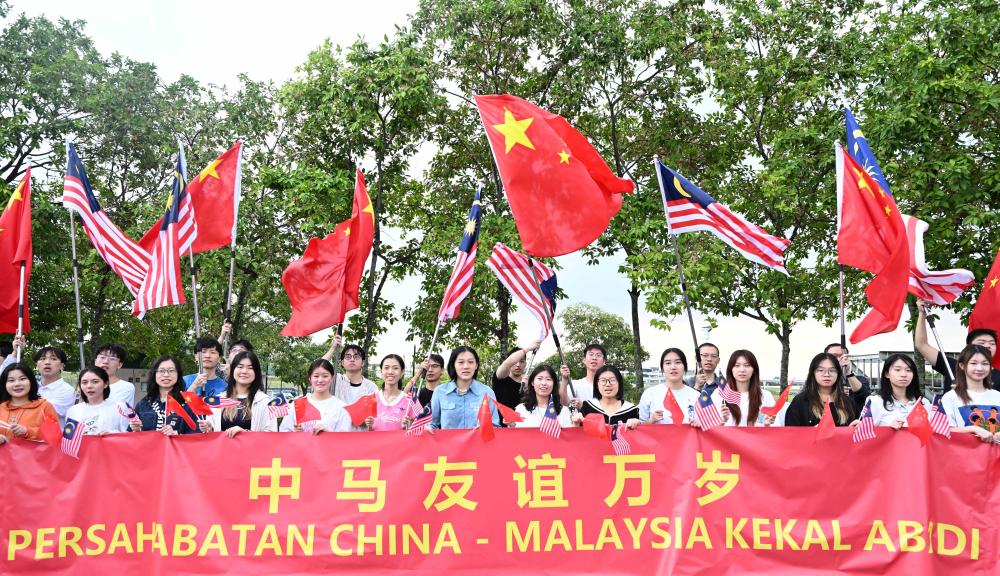
“Xi’s recent visit brings key outcomes at a critical moment. The interactions that took place between Chinese and Malaysian leaders signify the deepening of mutual political trust,” Ong Tee Keat, President of the Belt and Road Initiative Caucus for Asia Pacific and former Minister of Transport of Malaysia, told Beijing Review, adding it is also an indicator of the success of China’s neighborhood diplomacy.
The visit came at a time when the international economic and political environment became even more unstable, Zhong Darong, Director of the Research Center for Malaysia at Huaqiao University, told news portal ThePaper.cn. China is expected to send out positive signals for the current uncertain international trade order and play a more constructive role in international affairs, according to Zhong.
In 2024, China-Malaysia trade reached $212 billion—nearly a thousandfold increase since the establishment of diplomatic ties in 1974, and China has been Malaysia’s top trading partner for 16 consecutive years.
According to Malaysian newspaper The Star, Malaysia’s Minister of Communications, Fahmi Fadzil said on April 11 that his country hopes to seize this opportunity to foster closer economic and trade ties with China as well as strengthen people-to-people exchange. He added that this effort is part of Malaysia’s broader strategy, as a trading nation, to enhance trade relations with all countries, including China.
In recent years, pragmatic cooperation between China and Malaysia has yielded numerous highlights. A hallmark of China-Malaysia cooperation, the Two Countries, Twin Parks initiative—the China-Malaysia Qinzhou Industrial Park and the Malaysia-China Kuantan Industrial Park—continues to be upgraded in quality and scale. By the end of 2024, Kuantan had secured 15 projects with a cumulative industrial output exceeding 100 billion yuan ($13 billion) and provided some 20,000 local jobs.
In December 2024, Malaysia’s national car brand Proton launched its first locally produced electric vehicles (EVs), as the latest result of its technological collaboration with Chinese automaker Geely. In November 2024, Chery introduced its first locally assembled EVs to the Malaysian market.
Koh King Kee, President of Malaysia’s Centre for New Inclusive Asia, highlighted the immense potential for collaboration between the two countries in the digital economy. He expressed hope that the two nations would strengthen policy alignment and industrial collaboration to ensure that technological advancements benefit more people.
In the realm of cultural exchange, bilateral interaction has also deepened. In June 2024, China extended its visa-free policy for Malaysian nationals until the end of 2025. As part of a reciprocal arrangement, Malaysia extended its visa-free policy for Chinese nationals until the end of 2026. “Given the upcoming expiration of the mutual visa exemption agreements, we hope both sides will extend these arrangements and work toward establishing a permanent visa-free mechanism. This would further deepen bilateral exchange and enhance ties between the two peoples,” Zhong said.
Malaysia holds the chairmanship of ASEAN this year and “can play a pivotal role in coordinating and connecting ASEAN member states’ interactions with China,” Ong said, adding that China-ASEAN cooperation can go beyond the existing economic and trade partnership. For example, China and ASEAN countries can further expand Belt and Road cooperation, jointly promote the China-proposed global initiatives for development, security and inter-civilizational exchange and dialogue in Southeast Asia, in conjunction with the implementation of ASEAN Community Vision 2025, a roadmap for unity and improved wellbeing in the region, according to Ong.
Ironclad friendship
Cambodia was the last leg of Xi’s visit.

In May 2024, a road in Phnom Penh was named Xi Jinping Boulevard by the Royal Government of Cambodia to honor the Chinese president’s historic contributions to the country’s development.
At the naming ceremony, Cambodian Prime Minister Hun Manet highlighted that, under the leadership and joint efforts of Xi and Cambodian leaders, bilateral ties have entered their best period in history.
China and Cambodia share a millennia-old friendship, with their people having always striven together and thrived together. Regardless of changes in the international landscape, China and Cambodia have stood by each other in good faith and with mutual assistance, offering unwavering support on issues concerning each other’s core interests and major concerns, Xi said while meeting with Cambodian King Norodom Sihamoni on April 17.
Situated along the ancient Maritime Silk Road, Cambodia was among the first countries to join Belt and Road cooperation. China has been Cambodia’s largest foreign investor and trading partner for several consecutive years. Over the past decade, bilateral trade has nearly quadrupled.
Over the years, key BRI projects in Cambodia have reaped highly beneficial results. For example, the Sihanoukville Special Economy Zone (SSEZ) has attracted over 200 international enterprises and institutions, generating 32,000 jobs. Cambodia’s first expressway, the Phnom Penh-Sihanoukville Expressway, has reduced travel time between the two cities from over five hours to less than two. And the Siem Reap Angkor International Airport has given a strong boost to Cambodia’s tourism sector, operating 17 routes by the end of last year.
“The SSEZ, along with other flagship BRI projects, has played a crucial role in helping Cambodia achieve its ambitious targets of becoming an upper-middle-income country by 2030 and a high-income nation by 2050,” Neak Chandarith, Director of the Cambodia 21st Century Maritime Silk Road Research Center, told Xinhua.
During their talks on April 17, Xi and Hun Manet agreed to build an all-weather China-Cambodia community with a shared future in the new era, and designated 2025 the China-Cambodia Year of Tourism.
“Building a community with a shared future is an integral part of China’s neighborhood diplomacy. It goes far beyond sheer economics. It constitutes a multi-dimensional partnership allowing good neighborliness to create a conducive environment for economic development. The prosperity accrued therefrom will further bolster peace across the region,” Ong said.