Where New Journeys Begin
 Facebook
 Twitter
 Linkedin
 Google +

Two millennia after caravans connected Asia with Europe, Xinjiang is again emerging as a hinge between regions. But this time, the cargo is broader.
In the autumn of 2013, Chinese President Xi Jinping set out a vision that would reshape China’s role in global connectivity. He proposed the Silk Road Economic Belt in Kazakhstan and the 21st-Century Maritime Silk Road in Indonesia. Together, the two proposals revived the legacy of the ancient Silk Road, adapting it to a new era of trade, infrastructure and cultural exchange in the form of the Belt and Road Initiative (BRI).
For Xinjiang, the initiative carries special weight. Long a passage between East and West, the region once again finds itself at the heart of transcontinental exchange.
Xi has repeatedly underscored this. During a visit to Xinjiang in April 2014, he described the region as holding an “irreplaceable position and role in building the Silk Road Economic Belt.” Subsequently, in July 2022, he observed in the Urumqi International Land Port Area in Urumqi, capital of Xinjiang, that the region had shifted from a relatively enclosed hinterland to the forefront of opening up as China expands opening up, advances the development of its western regions and promotes Belt and Road cooperation.
Xi called for accelerating the construction of the Silk Road Economic Belt’s core area and incorporating Xinjiang’s regional opening-up strategy into the country’s overall plan of westward opening up.
Xinjiang borders eight countries and is interlaced with railways, highways and fiber-optic networks that anchor the Silk Road Economic Belt. Targeted policies have added momentum to the progress. At the China (Xinjiang) Pilot Free Trade Zone, which was inaugurated in November 2023, companies benefit from faster customs clearance, more flexible financial services and cross-border digital trade facilitation measures. The zone, encompassing three iconic areas—Urumqi, Kashi (Kashgar) and Huoerguosi (Khorgas or Horgos)—is the first of its kind in China’s northwestern border regions and the 22nd nationwide.
For BRI partner countries, the advantages are tangible: shorter access to Chinese markets, expanded opportunities for two-way investment, as well as new areas of cooperation in agriculture, manufacturing, education, healthcare, tourism and the digital economy.
Reducing time and distance
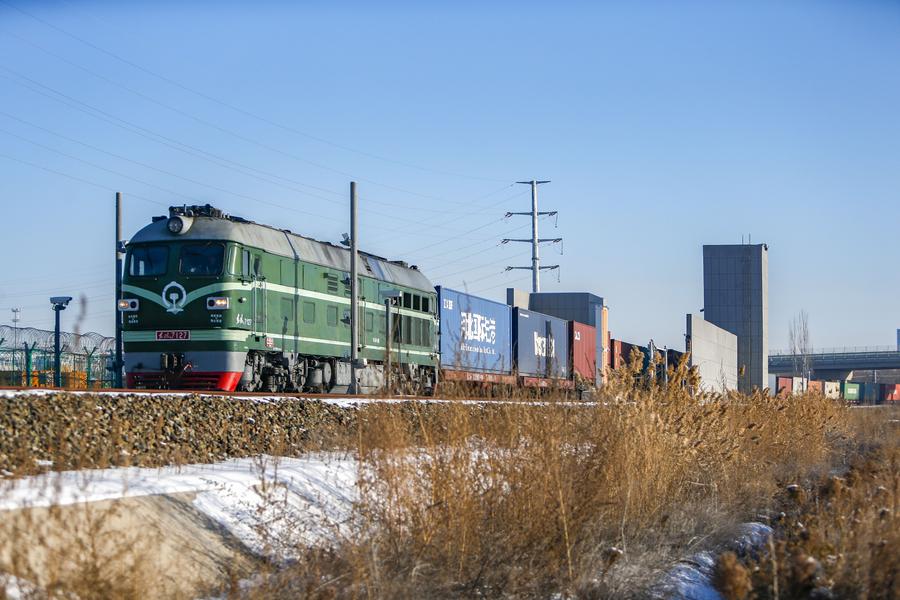
Rail is the most visible sign of Xinjiang’s opening up and integration. In 2024, some 16,400 China-Europe freight trains passed through the region, a 14-percent increase year on year, and more than half the national total. Once fully operational, the China-Kyrgyzstan-Uzbekistan Railway, launched in December 2024, will cut about 900 km from the China-Europe route and save up to a week of transit time.
Rail corridors are also linking with sea lanes. The Urumqi-Chongqing intermodal freight transport service connects with the New International Land-Sea Trade Corridor, a trade and logistics passage jointly built by provincial-level regions of west China and Association of Southeast Asian Nations (ASEAN) countries, shipping Central Asian cargo to ASEAN ports.
Air and digital infrastructure is rounding out Xinjiang’s connectivity backbone. On April 17, the northern terminal of the Urumqi International Airport began trial operations. The expansion, one of the BRI’s key projects in the region, has transformed the airport from a single-runway facility into a three-runway hub. Once fully operational, it will be able to handle 48 million passengers, 550,000 tons of cargo and mail, and 367,000 takeoffs and landings annually, significantly boosting its capacity and service level.

At the same time, Xinjiang is emerging as a hub of cross-border data flows. With support from China Telecom’s Xinjiang branch, nine cross-border terrestrial optical cables now link the region with neighboring countries, providing nearly 4 terabytes of outbound optical cable capacity and forming digital corridors westward, southward and northward along the Silk Road Economic Belt.
Construction of logistics hubs is progressing quickly. To support the development of port city Huoerguosi in north Xinjiang, which shares a border with Kazakhstan, Mongolia and Russia, as a border logistics hub, a comprehensive trade and logistics service platform has been launched, integrating bulk commodity trading, warehousing, supply chain finance and smart logistics data.
“When our Kazakh counterparts used to ask where a particular China-Europe freight train was at that moment, we had no clear answer,” Hao Xinqi, head of the Huoerguosi Eurasian Trade and Logistics Group’s information platform, said in an interview last year. “But since this platform was established, we have real-time information on both trains and container shipments. It has greatly improved our connectivity in terms of information flow.”
Turning transit into market
Xinjiang’s next step is stepping up introduction of cooperation projects. The China-Eurasia Expo in Urumqi, started in 2011, has evolved from a showcase into a dealmaking platform. At the 2025 edition, delegations from around 50 countries and regions took part, resulting in over 300 economic and trade cooperation projects worth over 417 billion yuan ($57.5 billion).
Smaller fairs, from the Kashi-Central and South Asia Commodity Fair to trade expos in Huoerguosi, draw in small and mid-size firms that might have had otherwise remained on the margins of cross-border commerce.
Agriculture shows clearly how Xinjiang’s location is being translated into value. Cold-chain upgrades now bring Uzbekistan’s cherries and Kazakhstan’s camel milk to Chinese consumers within days, while Xinjiang’s tomatoes, cotton yarn and processed foods go westward. Collaboration is extending to research and development as well. For instance, Xinjiang’s Jiushenghe Seed Industry Co. Ltd. is working with institutions in Kazakhstan to produce drought- and salt-tolerant maize and field trials show yields substantially higher than what traditional varieties produce.
This May, China and Saudi Arabia signed 57 agricultural trade agreements worth 14 billion riyals ($3.78 billion), widening channels for agro-trade in which Xinjiang serves as a major hub.
The momentum carried into June, when the 2025 China (Xinjiang) Agricultural Economic and Trade Cooperation Matchmaking and Agricultural Brand Promotion Event convened as part of the 2025 (China) Eurasia Commodity and Trade Expo. The event linked enterprises and institutions and supported high-quality Belt and Road agricultural cooperation to boost business efficiency and farmers’ incomes. Agricultural departments, research institutions and industry associations from 14 countries, including Russia, Kazakhstan, Nigeria and Pakistan, joined Xinjiang’s leading agricultural firms to showcase products and strengthen cooperation.
More manufacturing projects have also settled in the region. For example, Switzerland-based Saurer set up textile machinery operations in Xinjiang in 2017 to serve West Asia, South Asia and Africa, evidence that the region is increasingly viewed not as an end point, but as a launchpad.
In the first seven months of 2025, Xinjiang’s import and export value surpassed 321 billion yuan ($43.96 billion), a year-on-year increase of 27.3 percent.
Partner diversity is also widening. By the end of 2024, Kashi Prefecture had established trade relations with 199 countries and regions worldwide, 64 more than in the previous year. Its trade with BRI partner countries saw a 17.3-percent increase in imports and exports.
Human face of connectivity
Visa-free entry for nationals of Kazakhstan and Uzbekistan has boosted cross-border mobility, bringing a surge of visitors to Xinjiang. In 2024 alone, the region welcomed more than 5.14 million inbound visits, with international tourism revenue reaching $4.47 billion, a 174-percent year-on-year increase.
Sports and cultural events are helping to build this momentum. Launched in 2005, the Taklimakan Rally has grown into Asia’s longest, largest and most competitive off-road race. The 2025 edition featured 23 motorcycles and 105 vehicles navigating roughly 5,200 km over 13 days, concluding on June 1. The 2025 China Xinjiang International Dance Festival, running from July 20 to August 5, staged 52 performances by 24 troupes from eight countries across Urumqi, Ili and Hetian (Hotan).
Education and healthcare cooperation are also deepening ties. According to the Xinjiang Education Bureau, the number of international students in the region rose by 1.75 times in 2024 compared with the previous year. The students came from 28 countries, with Central Asian students accounting for 77.6 percent. Increasingly, Xinjiang is becoming a favored study destination for BRI partner countries.
Twenty-three-year-old Kalibek Yerbosyn from Almaty, Kazakhstan, is one of them. His fascination with traditional Chinese medicine began after an unexpected acupuncture session. “When the doctor inserted a needle into my hand, I felt a tingling sensation—it was incredible!” he recalled. Encouraged by fellow Kazakh students studying in China, he applied to Xinjiang Medical University. After completing a preparatory language course, he joined the undergraduate program in traditional Chinese medicine, studying alongside Chinese peers.
Stories like his are multiplying. At present, Xinjiang Medical University has 695 international students, including 199 from Central Asian countries. Of the 262 scholarship recipients, 75.57 percent are Central Asians—evidence of Xinjiang’s growing role as an educational gateway.
The logic is clear: Hard connectivity (rail, road, air and data) combined with soft connectivity (rules, services and culture) creates lasting connectivity, where investment, industries and people remain, not merely pass through. As one Kazakh official remarked at this year’s China-Eurasia Expo, “Xinjiang is no longer the end of a road, it is where new journeys begin.”
Two millennia after caravans connected Asia with Europe, Xinjiang is again emerging as a hinge between regions. But this time, the cargo is broader: not just cotton and fruit, but also data, designs and ideas. For BRI partner countries, the opportunity lies not only in moving goods faster, but in joining an opening-up ecosystem where corridors become markets and markets drive industries.