Firm in Globalization
 Linkedin
 Google +
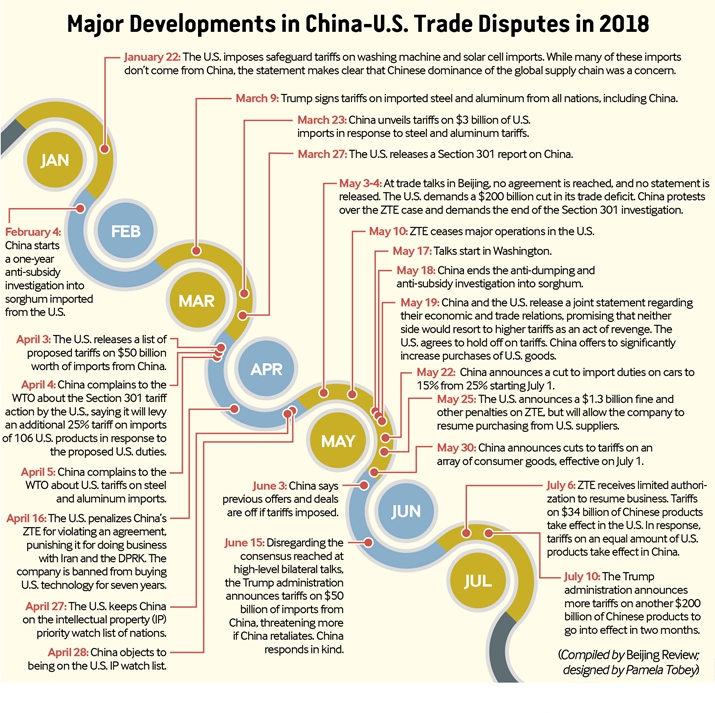
Under the banner of “America First,” U.S. President Donald Trump has launched a trade war against his country’s main trading partners, with China the major target.
By Wang Huiyao
 Under the banner of “America First,” U.S. President Donald Trump has launched a trade war against his country’s main trading partners, with China the major target. Notably, besides China, most of the countries under fire are long-term political and military allies of the United States. Few anticipated the antagonism of the Trump administration in initiating such trade friction worldwide. Unilateralism and protectionism from the United States—the world’s largest economy—will likely further hinder the already slow recovery of the global economy. It is so far unclear which side, if any, can win this global trade war, but one outcome is certain: The world economy will be the major victim of escalating tariffs.
Effective since July 6, the United States and China have imposed 25-percent tariffs on $34 billion of each other’s imported goods. If the two sides eventually introduce tariffs on $250 billion of imports each, as threatened, then the world economic growth is expected to fall 0.5 percentage points between 2019 and 2020. The potential consequences are better illustrated by the stake each country holds in the global economy. Global GDP was $81 trillion in 2017, of which the United States contributed $19.39 trillion—a share of 23.9 percent—while China accounted for $12.25 trillion or 15.12 percent. The economies of China and the United States together constituted nearly 40 percent of the world’s GDP and made up more than 40 percent of global economic growth. According to statistics from the World Bank, the global economy increased 3 percent in 2017, and China alone contributed 34 percent of the total.

Trade disputes are certain to give rise to more uncertainties in the world. Heavy tariffs will inevitably raise the cost of goods, resulting in a negative impact on investment, production and consumption. The ensuing drop in investment, downsizing of enterprises and unemployment of workers will in turn affect consumption, leading to a vicious cycle.
Deliberate Errors
As the initiator of this trade war, policymakers in the United States believe that their success is assured. Based on a few simple calculations, Trump seems to have drawn the conclusion that his attempts to intimidate China can help achieve the goal of restricting imports from China and balancing the China-U.S. trade deficit. But in an era of globalization, national economies are intertwined in a system of cooperation and labor division, and such a strategy cannot succeed.
Several misjudgments have been made by the United States in formulating the justification for its trade war, and closer analysis suggests there are inaccuracies in statistics used. Last year, of the $530 billion trade between China and the United States, more than $100 billion was actually transited from Hong Kong, Macao and places other than the Chinese mainland, which was not included in U.S. exports to China. Moreover, the volume of trade in services between China and the United States reached $118.2 billion in 2017, of which services purchased by China from the United States reached $90 billion. Yet this number was excluded from the calculated trade volume between the two countries, thus the United States’ $54.7 billion service trade surplus has been deliberately ignored.

Another major error is the underestimation of the Chinese market. After 40 years of reform and opening up, China, with a population of around 1.4 billion, is not only the factory of the world, but also a substantial international market. Without China’s manufacturing capacity and market demand, a lot of high-end U.S. technology companies would struggle to maintain their current rate of profit, hindering their operation and innovation. U.S. chipmaker Qualcomm is a good case in point. Experts have pointed out that the global market value of the chip industry was $440 billion in 2017, of which China accounted for $260 billion, with around 70 percent of high-end chips manufactured by the United States sold to China. Without the Chinese market, the United States would struggle to find another place to sell 70 percent of its chips. The research and development of the U.S. chip industry would instead be badly affected and lose its dominance in the global market, with leading companies like Qualcomm set to bear the brunt.
Moreover, for many U.S. multinationals, the Chinese market sits atop their list of global business priorities. In 2017, China became the world’s largest market for General Motors with a sales value of $42 billion, surpassing the company’s domestic market. Apple’s sales reached $46 billion in China last year, second only to the U.S. market.
The United Sates has not taken all these factors into account when initiating this trade war, but has instead chosen to use simple and crude logic to fantasize about victory over its opponents.
Opportunity for Reform
China also cannot escape from the trade spat unscathed. The increase of tariffs will certainly impact China’s exports, affecting the business of a large number of export-oriented enterprises and causing a corresponding rise in unemployment. However, after decades of rapid development, China has accumulated plenty of experience in addressing external challenges, which is the basis for a mature crisis-management system. In addition, China’s huge population provides the country with the unique advantage of an expanding domestic market which can help effectively shift the growth driver from exports to consumption and promote consumption upgrading.
In the meantime, China must seize the opportunity to further expand opening up and accelerate domestic reform. The case of ZTE, the Chinese telecommunications equipment maker that was forced out of business by a U.S. export ban, has allowed China to fully understand the gravity of its technology gap with developed countries and has also shown the direction in which the country’s industry must develop. Integrating its resources to concentrate on technological breakthroughs should be the key requirement of China’s supply-side structural reform.
International free trade will inevitably be affected by a global trade war. After a series of unexpected events targeting globalization in the past two years, the world is facing new challenges. China, as a beneficiary from globalization and free trade in the past several decades, should stand firm and unite with the international community in order to safeguard globalization and to prevent the world from becoming mired in the downward spiral of anti-globalization.
Faced with challenges from the United States, joining the Comprehensive Progressive Trans-Pacific Partnership (CPTPP) and helping to reshape the rules of global trade are other important steps that China must take. Following the United States’ withdrawal from the Trans-Pacific Partnership after Trump took office, the 11 other countries in the trade agreement reached the CPTPP. The agreement, led by countries such as Japan, Australia, New Zealand and Chile, maintains a more liberal approach to global trade, even more so than the World Trade Organization (WTO). In joining the CPTPP, China can overcome U.S. attempts to isolate it.
While the WTO is stagnating, the CPTPP lays more emphasis on the protection of intellectual property rights and liberalization of trade in services. In 2017, the service industry contributed 51.6 percent to China’s GDP and 58.8 percent to China’s economic growth. The CPTPP will give a new boost to the development of the service industry in China.
Perhaps most importantly, joining the CPTPP conforms to the principles of safeguarding globalization and promoting trade liberalization and facilitation. It can also help contain the current trends of protectionism and isolationism, manifesting China’s resolve for further opening up.
There is no winner in a trade war, just as there is no loser in globalization, with every country able to benefit from the process. Over the past 40 years, global trade has been a major force in promoting globalization and globalization has in turn served as an important driver of global growth. It is thus clear that the current protectionism of the United States harms others without benefiting itself.
Source: China.org.cn
The author is president of the Center for China and Globalization?