A Future-Oriented San Francisco Vision
 Facebook
 Twitter
 Linkedin
 Google +

The meeting has the potential to serve as a turning point in the current China-U.S. relationship, at least between now and early 2024, and opens the door for the gradual restoration of cooperation across a broad spectrum.
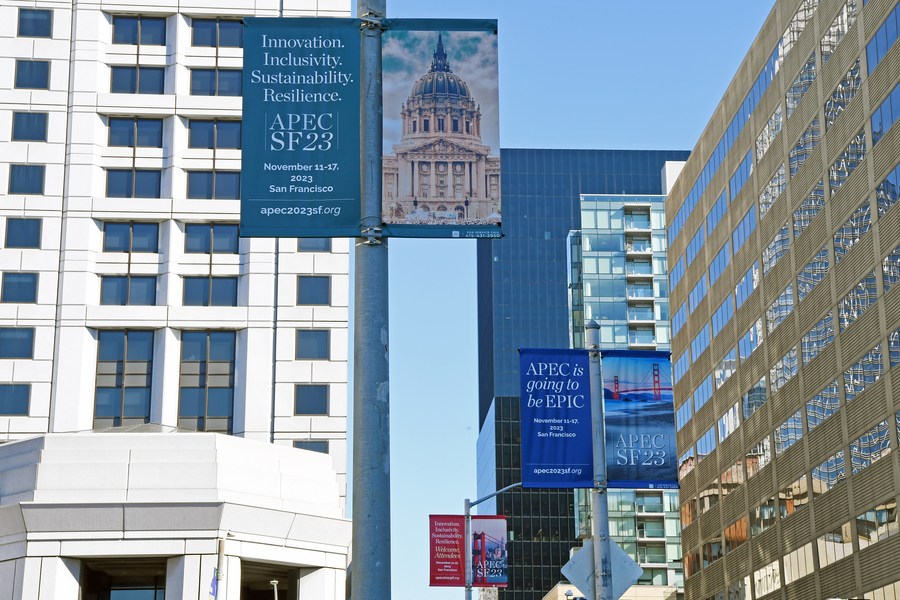
On November 15, the highly anticipated meeting between Chinese President Xi Jinping and U.S. President Joe Biden took place at the Filoli Estate, a country house approximately 40 km south of San Francisco, the United States.
Never has a meeting between the heads of state of China and the U.S. received such a high level of international attention. The relationship between the two major countries has been strained for more than five years. The tension has not only cast a shadow over the security in the Asia-Pacific region, but also left economic globalization currently on the verge of breakdown. It further weakens the ability of the international community to cooperate in addressing increasingly complex global challenges, and has put pressure on the world as a whole.
China and the Chinese people hope the meeting is a signal that stability and cooperation in China-U.S. relations are resuming. This would allow China’s domestic reform measures to proceed with fewer stumbling blocks from the complicated external environment.
For the U.S., the meeting provided an opportunity to step back from conflict in the Asia-Pacific region and turn around its economic decline there, revive and broaden U.S. business opportunities, and ensure that U.S. foreign policy—already strained by both the Ukraine crisis and Palestinian-Israeli conflict—will not run into new troubles, at least not in the near-to-medium term.
Most countries around the world hope that the meeting is a sign the two sides are moving in a direction away from a cold war, or even hot war,?between them. They are unwilling to face the very urgent pressure to choose sides, and can thus continue to focus on their own economic development, as well as sharing in the benefits brought by the recovery and development of the two major countries, as well as the cooperation between them.
The meeting has the potential to serve as a turning point in the current China-U.S. relationship, at least between now and early 2024, and opens the door for the gradual restoration of cooperation across a broad spectrum. However, it has not and cannot fundamentally resolve the major differences between the two on key issues, and the fuse that may lead to another deterioration of relations still exists.
Candid and in-depth talks
The two leaders’ meeting lasted four hours. They had a candid and in-depth exchange of views on strategic and overarching issues critical to the direction of China-U.S. relations such as the Taiwan question, China-U.S. economic and technological relations, military-to-military relations, people-to-people exchanges and on major issues affecting world peace and development, including the Ukraine crisis and the Palestinian-Israeli conflict. After the meeting, Chinese Foreign Minister Wang Yi, also a member of the Political Bureau of the Communist Party of China Central Committee, said the two heads of state had “a very good, comprehensive, and in-depth meeting.”
Wang said the two leaders also discussed the correct way for the two countries to get along, clarified their shared responsibilities as major countries and proposed a future-oriented San Francisco vision, creating a roadmap for the sound, stable and sustainable development of China-U.S. relations.
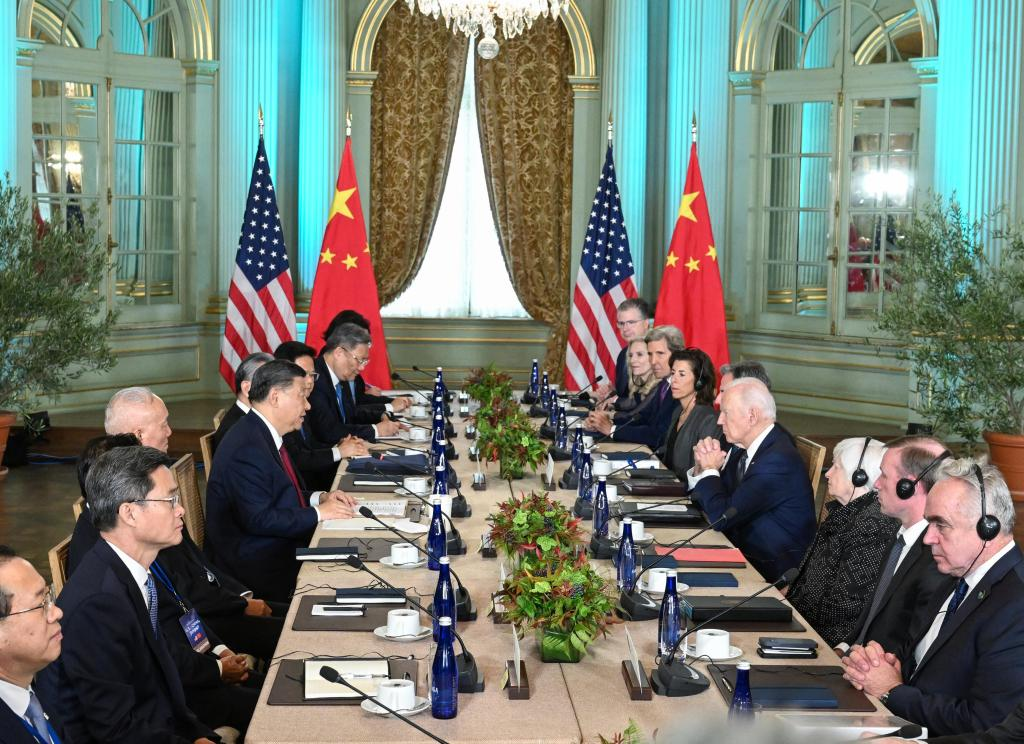
Are China and the U.S. partners or rivals? Should they engage in mutually beneficial cooperation or antagonism and confrontation? These are fundamental questions, and disastrous mistakes must be avoided. Xi called on the two countries to create a new vision and expressed his hope they will be partners that proactively advance a cooperative agenda in areas where their interests converge. He called on both countries to follow the principles of mutual respect, peaceful coexistence and mutually beneficial cooperation, and together build five pillars for bilateral relations—China and the U.S. should jointly form a right perception, effectively manage disagreements, advance mutually beneficial cooperation, shoulder their due responsibilities as major countries and promote people-to-people exchange.
Noting that the bilateral relationship is the most important one in the world, Biden said that a U.S.-China conflict is not inevitable, adding that a stable, developing and economically growing China serves the interests of the U.S. and the world at large. When the two countries keep their relations stable, prevent conflict, manage differences and cooperate in areas of shared interest, they will be better able to handle the issues facing themselves as well as common challenges, the U.S. president said.
He also reaffirmed the five commitments he made at the Bali Summit last year, that the U.S. does not seek a new cold war, it does not seek to change China’s system, it does not seek to revitalize alliances against China, it does not support “Taiwan independence,” and that it has no intention of creating conflict with China.
Similar to previous meetings between the two heads of state, this meeting reached broad and specific consensus on cooperation. At the bilateral level, the two presidents agreed to promote and strengthen bilateral dialogue and cooperation in such areas as China-U.S. government talks on artificial intelligence and the establishment of a working group on counternarcotics cooperation. They agreed to resume, on the basis of equality and respect, high-level communication between the two militaries, the China-U.S. Defense Policy Coordination Talks, and the China-U.S. Military Maritime Consultative Agreement meetings, and to conduct telephone conversations between theater commanders. They also agreed to work toward a significant further increase in scheduled passenger flights early next year, and expand bilateral exchange in education and overseas study, youth, culture, sports and between business communities.
At the global level, the two leaders also underscored the importance of working together to accelerate efforts to tackle the climate crisis in this critical decade. They welcomed recent positive discussions between their respective special envoys for climate, including on national actions to reduce emissions in the 2020s, common approaches toward a successful 28th Conference of the Parties of the UN Framework Convention on Climate Change and operationalization of the Working Group on Enhancing Climate Action in the 2020s to accelerate concrete climate actions.
For China, the meeting was positive, comprehensive and constructive, and charted the course for improving and developing China-U.S. relations. San Francisco should be a new starting point for stabilizing bilateral relations. In the coming months, the ties between China and the U.S. will usher in a period of stability and improvement rarely seen in the past decade.
The two presidents have tasked their teams with following up on the new vision reached in San Francisco in a timely manner, on the basis of implementing the Bali consensus. The White House press release on the meeting also stated that “their teams will follow up on their discussions in San Francisco with continued high-level diplomacy and interactions, including visits in both directions and ongoing working-level consultations in key areas, including on commercial, economic, financial, Asia-Pacific, arms control and nonproliferation, maritime, export control enforcement, policy-planning, agriculture, and disability issues.”
Cautious optimism
From Bali to San Francisco, the leaders of both countries have made painstaking and persistent efforts to improve bilateral relations and achieved major initial results. But challenges facing both sides are still complex and acute. As the 2024 U.S. presidential election draws near, China-related issues might be more deeply involved in the nation’s increasingly complex domestic politics. The Biden administration, which has been accused of being “weak” by Republicans and anti-China politicians in the U.S., may not rule out the possibility of taking new tough measures against China on issues concerning Taiwan, human rights, trade, science and technology to satisfy the political needs of Biden’s reelection campaign.
At the same time, Taiwan local elections are approaching, and the security situation in the Asia-Pacific region is also fluctuating in areas including the South China Sea, the Korean Peninsula and Myanmar. The risk of new tensions, and even conflict, between China and the U.S. cannot be completely ruled out.
The U.S. has long defined its relationship with China as “strategic competition” and its Indo-Pacific Strategy, targeting China, has also stepped up its implementation. The Biden administration seeks to “responsibly manage” competition with China rather than make a change to its strategy. It’s clear that competition will continue to prevail in bilateral relations, and so China must maintain sufficient strategic determination and wisdom to manage this.
After the meeting lifted expectations for China-U.S. relations from pessimistic to cautiously optimistic, the hope for a warmer relationship was placed on the people of both countries.
During his trip, Xi attended a welcome dinner hosted by friendly organizations in the United States. The Chinese president has pinned his hopes on the American people to lift the ailing bilateral relations out of the doldrums. “The foundation of China-U.S. relations was laid by our peoples,” Xi said, stressing that “the door of China-U.S. relations was opened by our peoples,” “the stories of China-U.S. relations are written by our peoples” and “the future of China-U.S. relations will be created by our peoples.”
In this sense, the resumption and strengthening of people-to-people exchange might be one of the meeting’s major outcomes.
The author is an adjunct fellow with the Center for International Security and Strategy at?Tsinghua University.