The CPC’s Strong Leadership is the Key to China’s Success
 Linkedin
 Google +
Today, the rapid economic expansion and enormous improvement in people’s living standards, especially when put in an international context, show that China’s reforms have been rather successful. The CPC led China out of poverty, and achieved an economic miracle that surprised the whole world.
By Zhang Weiwei

The author Zhang Weiwei is dean of the China Institute of Fudan Univesity.
The Communist Party of China (CPC) draws its strength from the people, who fought alongside it to achieve national independence and helped it win the domestic war against the Kuomintang.
Nonetheless, the Party had at one point lost its course due to misjudgments and miscalculations, resulting in tragic outcomes such as the “cultural revolution” (1966-76) or implementing policies that disparaged trade and commerce, causing a loss of economic dynamism.
Realizing its mistakes, the CPC readjusted its policies, led China out of poverty, and achieved an economic miracle that surprised the whole world.
Today, the rapid economic expansion and enormous improvement in people’s living standards, especially when put in an international context, show that China’s reforms have been rather successful. Since the idea of “socialist market economy” was put forward in 1992, China has made a lot of breakthroughs, injecting vigor and vitality into its economy without experiencing the painful cycles of economic and financial crises.
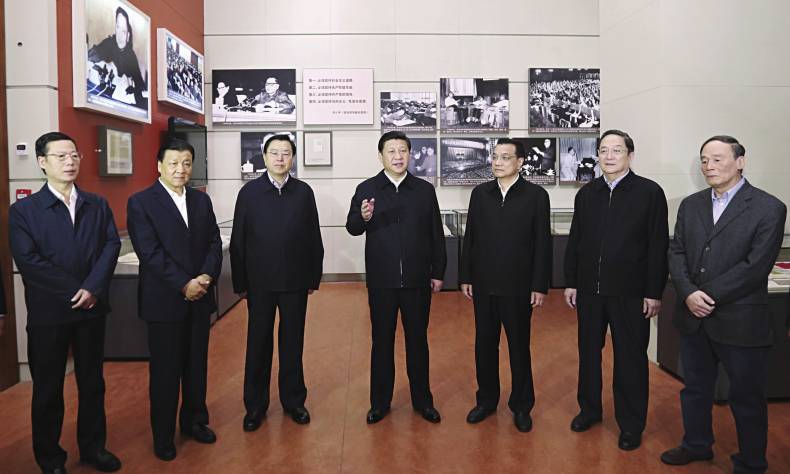
Visitors at an exhibition on China’s achievements over the past five years at the Beijing Exhibition Center as a prelude to the upcoming 19th CPC National Congress on September 29 (WEI YAO)
One-party governance
All these achievements would not have been possible if China had taken on a Western-style multi-party system. Under CPC governance, China is free from Western-style partisan political wrangling, which partly explains why the nation can always establish consensus to move forward in the interests of the vast majority of the country’s people.
The CPC has to a great extent followed Confucian traditions and built an impressive system of selecting its leaders based on merit and performance. For instance, most of its top decision-makers worked at least twice as Party secretaries or governors at the provincial level, which means that on average, they have administered a population of at least 100 million before being promoted to their current positions in Beijing.
Actually, the word “party” may be a misnomer for the CPC, as it bears no similarity to the type of political institutions like the Republican or Democratic parties of the U.S., which openly represent the group interests of their constituencies and compete with each other for influence. The CPC has, based on China’s political traditions, represented the interests of the overwhelming majority of its people. The people acknowledge that, due largely to the fact that most people have found their living standards significantly improved over the past decades.
In this sense, the CPC is better viewed as a state party or, in a hypothetical American context, an amalgam of the Republican and Democratic and all other parties, in which competence is the norm and consensus as well as a can-do spirit is prized.
Lesson from the West
China’s population of 1.3 billion is now covered by a national scheme of medical insurance and pension, while its counterpart across the Pacific Ocean is still debating whether to keep or remove “Obamacare.”
The current U.S. political dysfunction is somewhat rooted in what political scientist Francis Fukuyama claims as the “vetocracy,” where a party can independently block important political actions. Former U.S. President Barack Obama promised to “change” the country’s rigid institutions. Not only did he fail to deliver, but many of his actions are likely to be rolled back by his successor.
From a Chinese point of view, America’s over-capitalistic tendencies which have plagued U.S. society for years causing cyclical economic crises, stagnant wages, and widening income inequality should be reformed immediately.
In Europe, any forward-looking political reformers may end up in losing his or her job, as evidenced by the fate of former German Chancellor Gerhard Schr?der. Germany’s strength in the EU today has much to do with Schr?der’s extensive social and regulatory reforms. But his last years in the Bundestag were filled with controversy, which eventually led to his resignation.
The problem is breaking the gridlock between reform measures and Western-style democracy.
Here is the crux of the matter. There are three powers which form the fundamental core of a nation: political, social and capital. The balance between these powers decides the prospect of reform and even the fate of a nation.
In the U.S., the power of capital has a marked advantage over political and social powers. Under the influence of capital, American political power lacks independence and neutrality, having no choice but to yield to the demands of various vested interests.
Likewise, the power of capital has essentially permeated social power as well. This is particularly evident in its ability to control mainstream media and set the social agenda for the country. If the current equilibrium in favour of the power of capital cannot be addressed in due course, it is very likely to trigger an even larger crisis However, the reforms needed to address these issues are nowhere in sight.
In China, it is impossible for the 100 richest Chinese to sway the Political Bureau of the CPC Central Committee in their favor; but in the U.S., the dozen or so richest tycoons can shape White House policies.
In the case of Europe, social forces can often cripple the decision-making process; more often than not, it tends to lead to a dilemma in which people are inclined to prioritize personal gains at the expense of collective and long-term targets. The lack of consensus in European democracy makes it hard for European governments to form a solid foundation for reform.

A dynamic equilibrium
China’s political power has on the whole managed to keep their independence and neutrality during more than 30 years of reform and opening up, despite the rapid growth of its social and capital power. In China, capital power is to a great extent restrained by political and social forces, which render it incapable of dictating political decisions. While the wealth gap in China has admittedly widened in recent years, China’s political power has for the most part managed to ensure a constant rise in the living standards of low-income groups.
At the same time, China’s social power has inherited a tradition of egalitarianism, and Chinese society has almost always leaned toward restricting the power of capital. This balance between political, social and capital powers has enabled China to avert the kind of financial crisis and debt crisis that has played out in America, turning the vast majority of Chinese people into the beneficiaries of the country’s rapid development.
The relatively neutral and disinterested position of China’s political power—the CPC—is the key to understand why China’s reform has been successful. A stable equilibrium between these three powers underpins China’s present-day success.
The power of capital can create efficiency and wealth, but its profit-driven nature might lead to extreme wealth gaps or economic crises. While an active Chinese society has been exerting more influence on every aspect of the political and decision-making process, we should not lose sight of long-term goals.
After I spent 20 years working and studying overseas and traveling to more than 100 countries and regions, I have reached a simple conslution that China’s party structure and meritocratic governance transcends the Western model, as exemplified by the consistent improvement of people’s well-being and rising level of public satisfaction with the Chinese approach to modernization.
A year ago on October 5, the U.S.-based Pew Research Center published a survey result, which shows the Chinese are optimistic about their long-term economic future. “Roughly 82 percent think that when children in the country today grow up, they will be financially better off than their parents,” the report said. It noted that the Chinese people’s “positive outlook stands in stark contrast to the pessimism found in the United States and much of Europe.”
Tactically, China can learn a lot from the West, but staying clear of the American symdrome of over-caplitalism or Greek symdrome of excessive welfare state; strategically, it is imperative for China to maintain its political stance as it has done in the past.
As for other developing nations, the CPC can serve as a reference for those seeking the right path for economic growth, be they in Asia, Latin America or Africa.
In the future, China should continue down the path it has chosen and pursue reform to serve the best interests of the vast majority of its people.
Source: Beijing Review













CPC is the best!!