A Strategic Slip
 Facebook
 Twitter
 Linkedin
 Google +
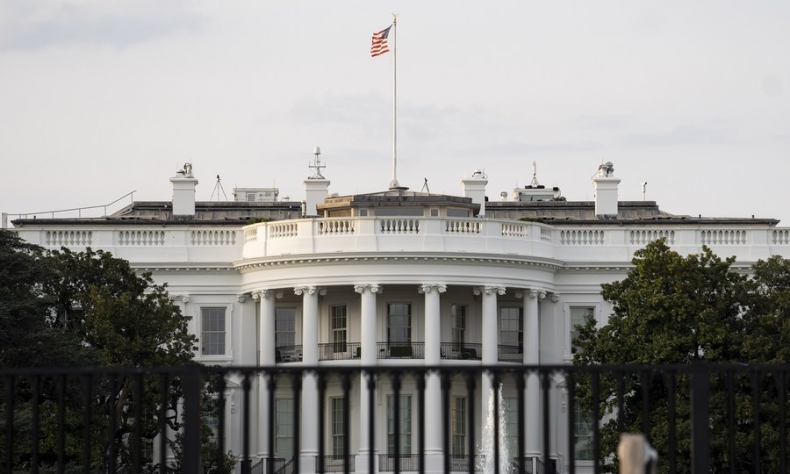
There are indeed serious deviations in the American policymakers’ understanding of the current international situation, the U.S. status in the world, China-U.S. relations and other major issues.
U.S. President Joe Biden’s administration published its long-awaited national security strategy report on October 12, according to which the country is now in the early years of a decisive decade that will determine the direction of the world and impact the security and prosperity of its people for generations to come. Although “Russia poses an immediate threat to the free and open international system,” China “harbors the intention and, increasingly, the capacity to reshape the international order,” the report read.
The U.S.’s strategy toward China, based on the arguments that China remains its major geopolitical competitor and the future international order depends on competition with China, constituted a core part of the report’s narrative.
Outcompeting China?
The third part of the report focused on “outcompeting China and constraining Russia.” Although the U.S. showed certain concerns about the conflict between Russia and Ukraine over the past months, it does regard China as “the only competitor with both the intent to reshape the international order and, increasingly, the economic, diplomatic, military, and technological power to do so.” The document said the U.S. would out-compete China by investing in the foundations of its strength and aligning efforts with its network of allies and partners, asserting competition with China is most pronounced in the Indo-Pacific.
The Indo-Pacific strategy was put forward by former U.S. President Donald Trump. The Biden administration has inherited it and taken it much further than its predecessor.
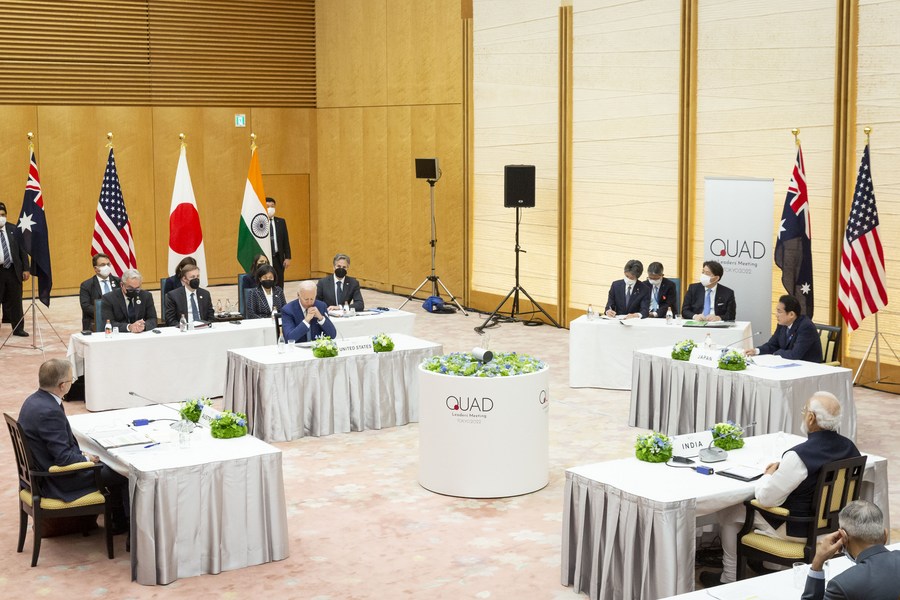
To keep China down, the U.S. has reinvented its traditional alliance system, taken cliquism to the extreme and established a new trilateral security alliance with the UK and Australia (or AUKUS)—under which it went on to undermine international nuclear nonproliferation efforts. It has also strengthened the Quadrilateral Security Dialogue with India, Japan and Australia (commonly referred to as the QUAD), trying to draw India into its small circle of trust.
But the White House also mentioned several common challenges facing all of humanity, most notably climate change and global public health. “The U.S. and China can coexist peacefully, and share in and contribute to human progress together,” the report stated.
China has proposed to the U.S. the principles of mutual respect, peaceful coexistence and win-win cooperation for developing bilateral relations in recent years but received no direct response from the U.S. side. The report’s aforementioned references to “common challenges” may perhaps finally be an answer to the Chinese proposal.
Tech competition
“Technology is central to today’s geopolitical competition and the future of our (U.S.) security, economy, and democracy,” according to the report. Indeed, hi-tech has become a powerful booster for the global economy and society.
Trump initiated a trade war against China during his presidency and imposed additional tariffs on almost all imports from China—which are still in place today. Biden now pursues a so-called “small yard, high fence” strategy, trying to “decouple” from China across a selection of key industries and fields.
The country has defined some core technologies, chips in particular, and formulated laws and policies to establish a so-called “friend-shoring,” which limits supply chain networks to allies and “friendly countries” only. It also proposed to establish a chip alliance in an attempt to decouple from Chinese companies by enhancing cooperation between members on the design and production of sophisticated semiconductors. The U.S. unilateral sanction lists have been elaborated to include more than 1,000 Chinese entities and individuals, obstructing their access to American technology and its market.
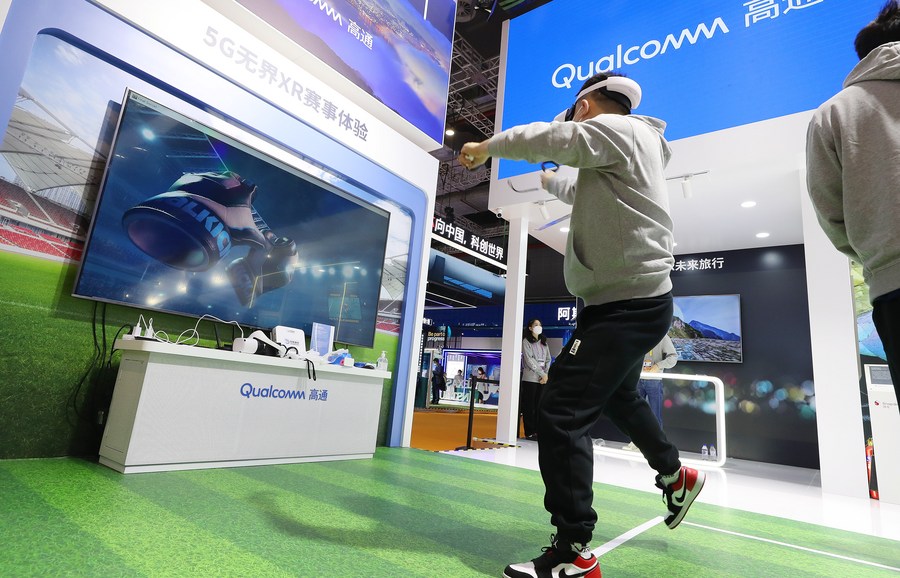
In the long run, this crackdown on China is unlikely to succeed. After decades of development, China’s hi-tech enterprises have established a sound foundation. In some fields, like those of artificial intelligence and quantum computing, China is leading the world. The current hi-tech industrial chain is not dominated by the U.S. alone, with European and East Asian countries sharing considerable advantages.
Most importantly, China intends to keep its door open. As Chinese State Councilor and Foreign Minister Wang Yi said in his speech at New York-based Asia Society in September, “China has developed itself during reform, opening up and integration in the world. China will not and cannot decouple from the rest of the world.” The statement sent the clear message that China will continue its exchanges, communication and cooperation with enterprises, universities and scientific research institutions in the U.S. and other countries.
While the U.S. report did call for attracting talents in science, technology, engineering and mathematics from around the globe, at least 1,400 U.S.-based Chinese scientists switched their affiliations last year from U.S. to Chinese institutions, according to a joint report, Caught in the Crossfire: Fears of Chinese-American Scientists, by academics from Harvard, Princeton and the Massachusetts Institute of Technology on October 18. This will result in a negative impact on the U.S. side, as pointed out by some American scholars.
Wishful thinking
Internally, the U.S. now is more divided than ever. Divisions are deeply rooted in every aspect of society, from politics and the economy to racial and cultural affairs. And it is even harder for the American people to truly reach a consensus as its two major political parties leave no stone unturned in undermining one another. Some scholars even bitterly quip the U.S. is now a “Divided States of America.”
The country’s international influence is indeed declining. The Indo-Pacific only features limited resources and tools for the U.S. to invest in. The so-called Indo-Pacific Economic Framework proposed and touted by Biden personally is more rhetoric than reality. Countries in the region are more interested in easing market access and tariff reduction, whereas the U.S. is trying to define rules and propose standards—instead of offering concrete benefits.
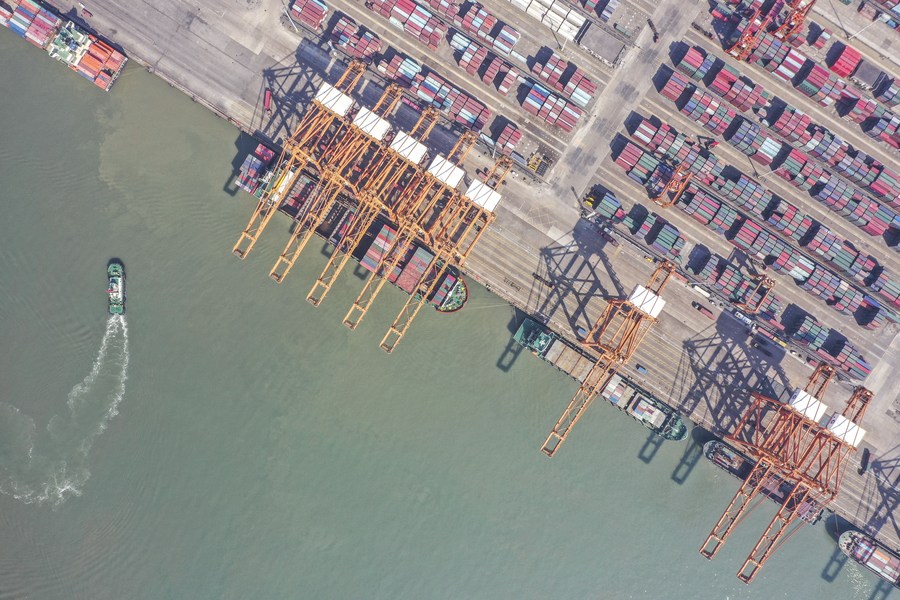
Moreover, following the coming into effect of the Regional Comprehensive Economic Partnership (RCEP) in January, the U.S. lost its leading role in regional economic affairs as the world’s largest free trade agreement consists of 15 major Asia-Pacific economies, without the U.S. It’s hard for the U.S. to come up with a new approach. The RCEP groups the 10 members of the Association of Southeast Asian Nations (ASEAN), as well as China, Japan, the Republic of Korea, Australia and New Zealand.
India is a major regional country that the U.S. values highly. However, the country tends to maintain strategic autonomy and is unwilling to follow the U.S. On certain issues, New Delhi is sometimes at odds with Washington.
ASEAN countries are also important players in this region in terms of politics, economy and security. They have repeatedly expressed their reluctance to choose and take sides between the U.S. and China and have so far presented little interest in the Indo-Pacific strategy.
This sense of unwillingness has also hit much closer to home. The Ninth Summit of the Americas in Los Angeles this year was boycotted by some Latin American countries, a region the U.S. has long regarded as its backyard, and achieved no actual results. It basically was another piece of evidence that the U.S.’s global dominance is about to expire.
This latest report tells us there are indeed serious deviations in the American policymakers’ understanding of the current international situation, the U.S. status in the world, China-U.S. relations and other major issues. It is a serious strategic slip to identify the world today as the return of geopolitical competition and China as its main strategic competitor.
After all, both these major global players stand to gain from cooperation and lose from confrontation.
The author is a senior research fellow with the Institute of?American Studies under the Chinese Academy of Social Sciences.