Biden’s ASEAN Strategy Could Threaten Bloc’s Centrality and Neutrality
 Facebook
 Twitter
 Linkedin
 Google +
The Biden administration’s push for an anti-China Indo-Pacific strategy will not only threaten China but also undermine the cohesiveness of ASEAN countries.
Since Joe Biden assumed the U.S. presidency a year ago, his administration has adopted an anti-China stance, identifying China as a strategic competitor to the U.S. But contrasting with the unilateralism of the Trump administration, the Biden administration has emphasized consolidating its global alliance around an anti-China agenda.
Inheriting and upgrading the Trump administration’s Indo-Pacific strategy, Biden transformed the Quadrilateral Security Dialogue, known as the Quad which includes the U.S., Japan, Australia and India, into a collaborative mechanism targeting China.
Then last September, the U.S. established the Australia-UK-US Trilateral Security Partnership Agreement (AUKUS), aiming to supply Australia with nuclear-powered submarines to strengthen military deterrence against China.
However, a key region of crucial importance regularly highlighted by American strategists as a weak link in the U.S. global strategy is Southeast Asia, where regional countries have repeatedly voiced refusal to take sides in the U.S.-China rivalry.
Diplomatic Offensive
Over the past year, the Biden administration has launched a diplomatic offensive to beef up American presence in the region, with senior U.S. officials making repeated trips to Southeast Asia to seek support and cooperation from the Association of Southeast Asian Nations (ASEAN) in its competition with China.
In July 2021, U.S. Defense Secretary?Lloyd Austin visited Singapore, Vietnam, and the Philippines and persuaded Philippine President Rodrigo Duterte to withdraw his letter of termination for the 1999 Visiting Forces Agreement, reviving its military alliance. In August, U.S. Vice President Kamala Harris visited Singapore and Vietnam, highlighting their importance as “Indo-Pacific partners” of the U.S.
Then in December, U.S. Secretary of State Antony Blinken made his maiden trip to Southeast Asia, visiting Indonesia and Malaysia.
But without any concrete offers to further cooperate in realms of economics and trade, the primary policy focus of regional governments, the impact of these trips appears to be limited.
Prime Minister Lee Hsien Loon of Singapore, a country widely considered to act as the mouthpiece of ASEAN, has said on a number of occasions, often prior to and after visits by U.S. officials, that America’s increasingly hardline policies towards China are “very dangerous,” while calling for the two countries to find a way to coexist in the region.
In recent years, the economic influence of the U.S. has been steadily declining compared to China, especially after the Trump administration decided to pull out of the Trans-Pacific Partnership, a trade agreement culminated under former U.S. President Barack Obama’s “pivot” to Asia policy and widely perceived to be designed to counter China’s economic influence.
The other TPP members including four ASEAN countries, Japan, Canada, and Mexico later renamed the agreement as CPTPP, which entered into force in December 2018. In the meantime, China has further increased its ties with ASEAN countries. In August 2019, the upgraded protocol of the China-ASEAN Free Trade Agreement came into effect.
Sharp Comparison
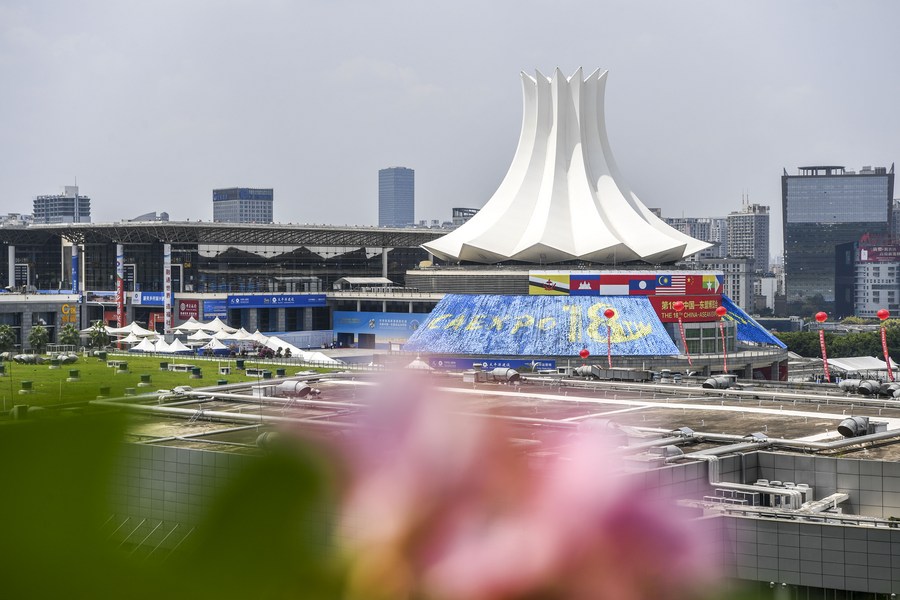
A decade after China replaced the U.S. as ASEAN’s top trade partner in 2009, the total trade volume between China and ASEAN countries reached?US$685 billion?in 2020, nearly twice that of the U.S., whose trade with the region?reached US$362 billion.
Recent data released by the General Administration of Customs of China showed that trade between China and ASEAN increased another 28 percent to reach US$878 billion in 2021.
In November 2020, China and ASEAN joined Japan, South Korea, Australia, and Zealand in signing the Regional Comprehensive Economic Partnership (RCEP), the world’s largest trade deal. On January 1, 2022, the RCEP entered into force in 10 of its 15 member states including China and six ASEAN countries. As tariffs on 90 percent of all goods drop to zero, trade between China and the regional countries is set for even more growth.
Moreover, in an effort to further increase regional economic integration, China formally applied to join the CPTPP in September 2021, an ironic development considering the pact was originally created by the U.S. to isolate China. In November, China applied to join the Digital Economy Partnership Agreement, a deal signed between New Zealand, Chile, and Singapore and deemed a model for future digital trade agreements.
In contrast, under pressure from strong domestic opposition to multilateral trade agreements driven by the Trump administration’s legacy of protectionism and unilateralism, the U.S. has shown little interest in cooperation with regional countries in realms of trade and economics.
To make up for the apparent lack of a comprehensive economic strategy in the region, the Biden administration launched various initiatives over the past year. In June 2021, Biden had the Group of Seven (G7) adopt the “Build Back Better World” initiative, promising to invest hundreds of billions of dollars in projects in relevant areas, but few of these promises have materialized thus far.
In the virtual ASEAN Summit held in October 2021, Biden announced an investment worth up to US$102 million to expand the U.S. partnership with ASEAN. But compared to China’s massive infrastructure investment in the region, the amount is far from impressive and considered only of token significance. Just the high-profile Laos-China railway, for example, which just started operation in December, involved a massive investment of US$6 billion.
According to Qian Yuming, a research fellow at the China Institute of International Studies, despite frequent visits by U.S. officials and repetitive rhetoric highlighting the importance of regional countries, Washington has paid no serious attention to ASEAN countries over the past years.
“During the Trump administration, high-level talks between the U.S. and ASEAN were suspended for four years,” Qian told?China Report ASEAN. Even under the Biden administration, the U.S. has still not appointed ambassadors to most ASEAN countries.? By the end of January 2020, the U.S. had only appointed ambassadors to Singapore, Indonesia and Vietnam. “This shows that the U.S. has no real intentions of developing sustainable relations with ASEAN countries,” said Qian.

No Economic Strategy
In its latest move to beef up its presence in the region, the U.S. released a 12-page document on a new Indo-Pacific strategy on February 12. Explicitly referring to China’s growing influence and “harmful behavior” in the region, the policy overview vowed to “refocus security assistance” on the region, highlighted the importance of “a strong India,” and called for bringing European countries to the region through?the AUKUS security pact.
On the economic front, the paper said that the U.S. would launch an economic framework for the region?early this year?that would “develop new approaches to trade,” set up principles for digital economies, and strengthen supply chains.
Various American media outlets reported earlier that the U.S. would unveil its first broad economic strategy for Asia “within weeks.” According to a?Wall Street Journal?report on February 6, the strategy is aimed at “filling the hole in the U.S.-Asia strategy left by the?TPP,”?but will not include any plan to return the U.S. to multilateral trade deals such as the CPTPP or trade incentives such as tariff cuts or other market-access measures.
Citing various analysts, the report said such a policy would be meaningless for most ASEAN countries. “Without market-access measures, the framework could become simply another club for the U.S. and its rich allies such as Japan, Australia, New Zealand and Singapore,” read the article.
Threat to ASEAN
Qian also argued that Washington’s recent moves to advance its Indo-Pacific agenda including consolidating the Quad and signing the AUKUS with the UK and Australia would only undermine the principle of “ASEAN centrality,” a key concept of the bloc. ASEAN should be the central driver of multilateral frameworks in the Asia-Pacific region.
“Not only does Washington’s attempt to incorporate ASEAN into its Indo-Pacific strategy pose a threat to the peace and stability in the region, it challenges the central role ASEAN plays in regional institutional frameworks,” added Qian.
Such opinions were common among observers in ASEAN countries. In a commentary published on?Chinausfocus.com?on February 8,?Sajjad Ashraf, former adjunct professor at National University of Singapore, argued that Washington’s diplomatic pressure on ASEAN countries to join its global alliance against China threatens the bloc’s very existence.
“The Quad and AUKUS have put the ASEAN states, lying at the center of the region, in a quandary,” said Ashraf. “Forcing a choice, as the U.S. often wants, could crack the consensual basis on which ASEAN works and threaten ASEAN’s existence.”
Arguing that “ASEAN has grown on the back of China’s phenomenal rise,” Ashraf said the region’s peace and prosperity rest not on military dependence but economic interdependence.
For Koh King Kee, president of the Malaysia-based Centre for New Inclusive Asia and president of ASEAN Research Center for a Community with Shared Future, most ASEAN countries are well aware of the delicate situation. It is unlikely that ASEAN countries will change their stance or abandon neutrality in the geopolitical rivalry between the U.S. and China.
“The U.S. is thousands of miles away from Southeast Asia, and its interest in ASEAN is mainly geopolitical, thus its relations with ASEAN countries are transactional,” said Koh. “For China, ASEAN countries are its immediate neighbors, and China’s interests in Southeast Asia are comprehensive and long-term.”
But Koh recognized that the increasing diplomatic pressure from the U.S. means ASEAN countries will need “skilled diplomacy” to continue to maintain “neutrality and centrality” in the coming era of big-power competition.
Yu Xiaodong is a senior media professional specializing in international relations based in Singapore.