China-India Boundary Question: Calling for New Thoughts and Framework
 Facebook
 Twitter
 Linkedin
 Google +
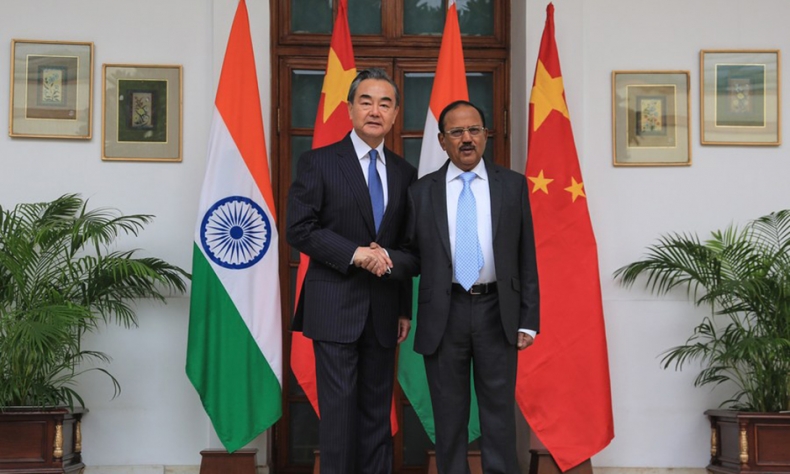
New thoughts and a new framework are necessary for China-India relations to go beyond the boundary question.
A year full of challenges around the globe, 2020 has witnessed the serious clash between Chinese and Indian border troops at the Galwan Valley which pushed the two ancient civilizations to the brink of confrontation. The incident, which has caused injuries and deaths, is an?inevitable result?of the escalation of tension in the border area of China and India. However, it also happened by chance, considering various factors such as geography and climate, not from the intention of the decision-makers of the two countries. Nevertheless, this incident shows that the existing border management and control mechanisms of both sides can no longer meet their needs, and the development of China-India relations has fallen far behind the development of the strengths and international statuses of both countries.
Historically-formed China-India boundary question
China and India are the two most time-honored countries in Asia. The two neighbors never had disputes over territory or border until the establishment of British rule in India (1858-1947). The cruel geographical conditions in the border area of China and India and the two countries’ limited abilities to rule in the past helped form a huge and natural strategic buffer zone. However, with the importation of modern nation-state concepts and the rising governance capabilities of both countries, the strategic buffer zone gradually shrank and was minimized. Therefore, frictions and conflicts emerged. Such frictions and conflicts will be inevitable until a clear China-India boundary is confirmed and recognized by the two sides.
Although the boundary between China and India hasn’t been completely demarcated, through border patrols, governance, treaties, conflicts and diplomatic activities over the past few centuries, both countries hold a not so specific yet generally clear view on the boundary: The line as a whole should follow the alignment of the?Himalayas. In some sections, specific adjustments should be made according to local governance histories and local people’s living habits. For example, in the eastern section of the China-India boundary, in principle the Himalayas serve as a buffer zone, so the watershed can be an ideal boundary between the two countries. However, considering China’s governing history in the south of the watershed and locals’ habits of living along valleys, the watershed is not the de facto dividing line between China and India. The line should follow the boundary alignment between the southern slope of the Himalayas and the plains on the northern bank of the Brahmaputra River. In terms of the middle and western sections of the China-India boundary, they are different from the eastern section due to local governance histories and the living habits of locals.
Different pictures of the border tensions
It seems that there are two completely different pictures of the boundary tensions between China and India. Media outlets and public opinion portray a territorial dispute between the two sides, which involves land areas from tens of thousands to hundreds of thousands of square kilometers. As a result, any tension in the border area is mentioned with land areas up to hundreds of thousands of square kilometers, bringing forth huge psychological and publicity effects.
Today, under the consensus that no war or military conflict should happen between the two sides, territorial claims and unilateral boundary delimitations are embodied through infrastructure construction, increasingly frequent patrols, as well as the management and control of border areas. Therefore, interactions and actions of the two governments show that the dispute is just a boundary question rather than a territorial dispute. And although the two countries did not reach a consensus on most sections of the Line of Actual Control (LAC), the cognitive difference is actually much smaller than expected. In some areas, such as the Sikkim section and some mountain passes where the geographical conditions are quite clear, there are barely any differences and disputes.
Both China and India are big countries. Neither of them has the ability and willingness to force the other side to accept its claims by military means. However, the different viewpoints and stances of the two peoples have produced completely different psychological effects. There is a huge gap of understanding not only between the two countries, but also between the governments, academic circles and public opinions of the two countries. Due to the increasingly democratic and transparent foreign policy-making process in modern times, the decision-making processes on the boundary question in both China and India have been affected by the public opinions. As a result, the independent decision-making abilities on border issues of the two countries’ leaderships have been weakened.
In this sense, the China-India border situation carries more significance in terms of social psychology and domestic politics rather than that of the actual conflict and national interest. Thus, negotiators for the China-India boundary question need to deal with their peers from the other side, and fight with domestic extremist views at the same time.
Consensuses reached
The China-India boundary question has gone through several important stages. At each stage, more consensuses were reached between the two countries, and consequently, the gravity and sensitivity of the question itself continue to decrease.
In the first stage, China and India had no consensus on whether their boundary question existed. India gained its independence in 1947. In 1949, the People’s Republic of China was founded, and the Republic of India was officially established one year later. The two governments soon established formal diplomatic relations. From 1949 to 1959, both countries’ border patrols began to encounter each other in the border region. In February 1951, while the peaceful liberation of Tibet was still underway, the Indian army occupied Tawang in southern Tibet of China, expelled all the administrative staff dispatched by the local Tibetan government, and announced that “the town has since been placed under the administrative jurisdiction of India.”
In 1960, then Chinese Premier Zhou Enlai made a special trip to India. During the visit, he held talks with Indian Prime Minister Jawaharlal Nehru on the boundary question, but no consensus was reached. The China-India border conflict in 1962 led to a drastic change in China-India relations, as well as changes in the political landscape of South Asia and even the world, affecting the developmental paths of the two countries. The improved China-Pakistan ties served as a bridge for the betterment of China-U.S. relations. The improvement of China-U.S. relations laid a diplomatic foundation for China’s reform and opening up in the late 1970s. India took the path of getting closer to the Soviet Union which also affected its domestic economic development. The China-India boundary question produced a “butterfly effect” that channeled the development directions of the two countries and even drove the evolution of the international political landscape.
In the second stage, China and India reached a consensus on the existence of the boundary question, but not on the content of the boundary question. After the 1962 China-India border conflict, both sides agreed that the boundary question existed.
After the two countries resumed diplomatic ties in the late 1970s, they kicked off border negotiations. This shows that both sides have recognized the existence of the boundary question. But the two countries failed to agree on the content of the question. The Chinese side believed that the China-India boundary question mainly involved the eastern section of the boundary, covering about 90,000 square kilometers; The Indian side believed that it was mainly in the western section, covering about 40,000 square kilometers. Adding the two figures together, the land areas involved reach 130,000 square kilometers, which is approximately the same area of a medium-sized province in China or a medium-sized state in India.
In the third stage, although China and India still had no consensus on the content of the boundary question, they have reached consensus on the guiding principles for the settlement of the question. In 1987, India made its occupied Chinese territory a state, which led to border tensions and almost resulted in a larger-scale military conflict. The incident pushed both sides to adopt a more pragmatic approach to this issue. Then Prime Minister of India Rajiv Gandhi’s trip to China in December 1988 was the first visit to China by an Indian prime minister in 34 years and was an ice-breaking event in China-India relations. The two sides signed landmark agreements on border management and control in 1993 and 1996, which stabilized the border situation. When then Indian Prime Minister Atal Bihari Vajpayee visited China in 2003, the two countries resolved a series of major disputes and problems, and downgraded the territorial dispute to a boundary question. In 2005, the two countries reached an agreement on guiding principles and setting political parameters for the settlement of the boundary question, with the aim of moving towards an ultimate solution.
During this period, although many problems still existed between China and India, overall peace and stability has been achieved in the border region. On this basis, cooperation between the two countries in the realms of economics, trade, culture, and multilateral and international affairs is expanding. Both China and India have enjoyed huge dividends from the peace and stability in their border area.
New problems emerged
At present, new problems have emerged in the border area of China and India, as a result of frequent encounters between the two armies caused by routine patrols and of the occasional violent military confrontations between the two countries. These new problems are also caused by some non-border factors: The rapid development of the two countries has given rise to nationalism in recent years. Thus, both peoples hope that their soldiers and diplomats will act tougher with the other side. Besides, since the national strengths of both countries have been growing, their border infrastructure construction and border defense military capabilities have been increasing. Moreover, the control capabilities in the border area of both countries have also significantly increased. Thus, nationalism and national pride, which were in the past mainly manifested in a war of words, now can be transformed into standoffs and violent conflicts due to the enhanced overall capabilities.
This situation shows that current China-India relations have lagged far behind the rising national strengths of the two countries and don’t match the importance of the developing China-India relationship. The border management and control mechanisms of China and India also lag behind the increasingly enhanced management and control capabilities of both countries and cannot meet the requirements for frequent encounters between the two sides’ border troops. Both the relationship between China and India and their border management and control mechanisms urgently call for transformation and upgrading.
The sensitivity of the China-India boundary question weighs over the importance of the question itself, and the social psychological conflict is greater than the conflict of actual national interests. Whether the situation will escalate depends on the communication between the two governments and the two peoples. Thus, new thoughts and a new framework to solve the problem are required.
China-India relations should reduce the sensitivity of the boundary question and go beyond it. The two countries should better manage and regulate their media outlets and public opinions, and control the boundary question within the border region, so as not to affect the overall bilateral relations. Besides, China and India should strive to build strategic mutual trust. Behind the boundary question and some other disputes is a lack of strategic mutual trust between the two sides. China and India are neighbors and major powers. Long-term coexistence is their historical fate as well as a realistic mission for both countries. Therefore, from the viewpoint of history and civilization, and from the perspective of being responsible to their peoples, China and India should establish a series of strategic mutual trust building mechanisms, including a strategic dialogue mechanism, a cultural exchange mechanism and a communication and mutual learning mechanism on development models. The setting up of these mechanisms is necessary and inevitable.
The author is director and professor with the Center for South Asian Studies, Fudan University.