China Is Pushing the Utilization of Clean Energy Resources to Reduce Emissions
 Facebook
 Twitter
 Linkedin
 Google +
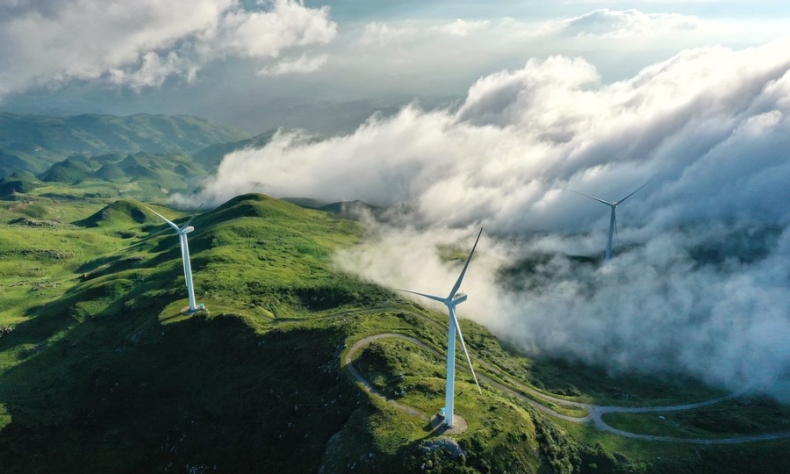
Apart from nuclear energy, the country is developing a variety of new energy sources to replace as much of its current fossil-based energy supply as possible.
On May 19, Chinese President Xi Jinping and his Russian counterpart Vladimir Putin witnessed the ground-breaking ceremony of a bilateral nuclear energy cooperation project, which comprises the Tianwan nuclear power plant in Lianyungang of Jiangsu Province and Xudapu nuclear power plant in Huludao of Liaoning Province, via video link.
Marked as the largest cooperation project on nuclear energy between the two countries so far, the four nuclear power units that started construction on the day, two in each plant, will have total annual energy output of 37.6 billion kWh, which is equivalent to carbon reduction of 30.68 million tons.
“Responding to climate change is a common task for all countries,” Xi said at the ceremony, adding that the two countries should promote more low-carbon cooperation projects and play a constructive role in achieving global sustainable development goals.
China’s pursuit of carbon reduction is a commitment that has been announced to the world. Speaking at the UN General Assembly on September 22, 2020, Chinese President Xi Jinping said that the country aims to reach peak carbon emissions by 2030 and achieve carbon neutrality by 2060.
These targets are also included in the country’s 14th Five-Year Plan (2020-25) adopted during the Two Sessions in March this year. Promoting the use of clean, low-carbon energy was reiterated as a main means to reduce carbon emission. Apart from nuclear energy, the country is developing a variety of new energy sources to replace as much of its current fossil-based energy supply as possible.
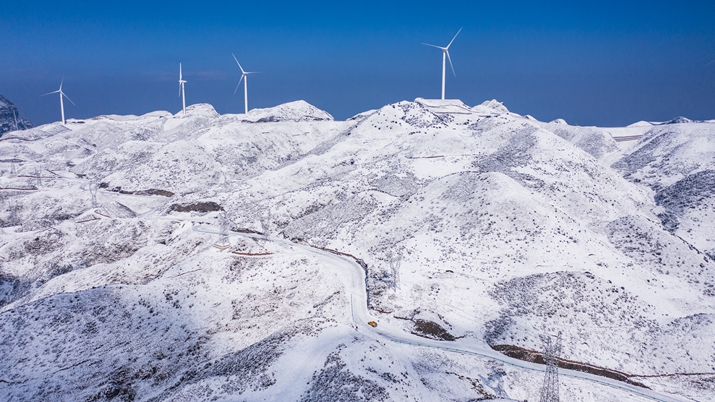
Clean resources
In recent year, China has seen a steady drop of coal-based energy. In 2020, the proportion of coal consumption in China’s energy supply dropped to 55 percent from 60.4 percent in 2017. According to the National Energy Administration (NEA), the targets for 2021 include another one percentage point drop in the share of coal consumption.
Meanwhile, the use of clean energy has been increasing steadily. In 2020, renewable energy resources, including hydroelectric, wind, photovoltaic and biomass power, accounted for 29.5 percent of the country’s consumption of electricity, 9.5 percentage points higher than in 2012. The use of these renewable energy resources in 2020 amounted to a reduction in 1 billion tons of coal and 1.79 billion tons of carbon dioxide emission.
Of the various sources of clean energy, solar power has witnessed a remarkable growth and is now an integral part of China’s energy supply.
China’s photovoltaic industry started at the beginning of this century as a processor of supplied materials in the international industrial chain and was vulnerable to the lack of self-developed core technology.
The turning point came in 2013, when the country initiated new policies to provide strong financial support to the photovoltaic industry and stimulate domestic needs for photovoltaic equipment.
As one of the measures to support the industry, power generation of photovoltaic energy was included as a major project in the country’s poverty reduction campaign. Subsidies were provided to photovoltaic power stations in villages. In Shanxi Province, for example, 5,532 such stations have been built and connected to the grid by May 21, bringing average annual income of 200,000 yuan ($31,100) for each of the 9,963 villages involved.
Today, the industry has seen the emergence of a number of leading Chinese companies along the global industrial chain, supplying over 70 percent of the world’s photovoltaic equipment.
The development of the industry has led to the great reduction of the cost for photovoltaic power generation. Over the past decade, the cost per kWh of photovoltaic power has dropped over 75 percent to become lower than coal-based power in most parts of the country. This has allowed sustainable development of the industry.
For hydroelectric power, a more traditional clean energy resource, new plans have also been drawn. It was stated in the 14th Five-Year Plan that the country will exploit hydroelectric power of the downstream of the Yarlung Zangbo River in southwest China. The planned capacity is 60 billion kWh, close to three times that of the Three Gorges Hydroelectric Power Station, so far the world’s biggest hydroelectric power station.
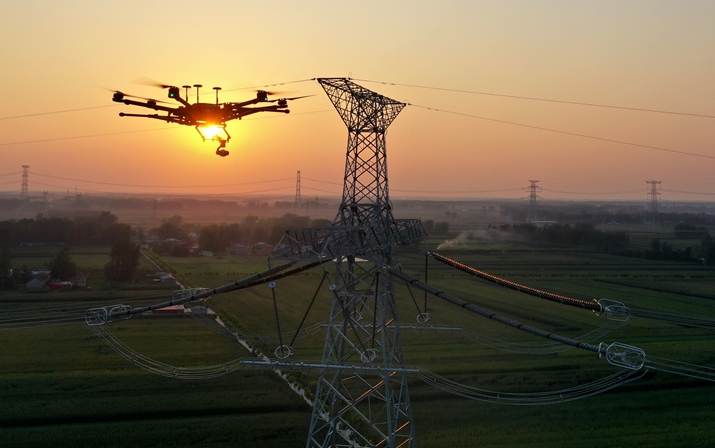
Efficient delivery
One major challenge for China to utilize its energy is that its energy sources are mostly located in the less developed inland areas, while energy is mostly used in the densely populated eastern coast and the central provinces.
For example, the primary sources of oil are located in the northeast and the northwest, wind power and coal deposits are concentrated in the northwest, and hydroelectricity resources are largely found in the southwest.
To use these energy resources, the country needs to transfer the energy or the materials to central and eastern China. Traditionally, this was primarily done by shipping coal via railway to power stations in the eastern regions for generating power locally.
In 2006, China started to develop ultra-high voltage (UHV) power lines, which could transfer large amount of electricity over long distance while limiting loss during transmission. By March 2020, China had built 25 UHV lines, with seven under construction and seven to be approved.
On December 30, 2020, the UHV link between Qinghai Province and Henan Province, the world’s first UHV power line built especially for transmitting clean energy, was put into operation. The 800-kilovolt direct current transmission line, stretching 1,563 km via four provinces can transmit 40 billion kWh of electricity annually at full capacity from the northwestern province rich in solar, hydroelectric and wind power. This is equivalent to power generated from 18 million tons of coal.
In building these lines, China has developed the world’s leading UHV power line technology. In 2017, a project was initiated by State Grid Corp. of China in partnership with a Brazilian firm to transmit the power of the Belo Monte Dam, the fourth-largest hydroelectric dam in the world, on the Xingu River, a tributary of the Amazon, via the UHV line to the densely populated area of Rio de Janeiro.
Experts in the energy sector are also discussing the feasibility of using the UHV technology in Africa, considering the rich resources of clean energy in the continent. At the 2019 Global Energy Interconnection & China-Africa Energy and Power Conference held in Beijing, Liu Baohua, Deputy Director of the NEA, described the promising prospects of exploiting the immense hydro power potential of the Congo River. With a network of UHV power lines, electricity generated along the river can benefit the whole Africa.
Fossil fuel replacement
The 19th International Automobile Industry Exhibition started on April 21 in Shanghai saw electrical vehicles, rather than gasoline ones, take the center stage and gab the media spotlight, showing world’s confidence in the growth of China’s new energy vehicle sector.
China has high hopes for the industry to help meet carbon targets, considering that automobiles account for around 10 percent of carbon dioxide emissions in the country. New energy vehicle was listed in the 14th Five-Year Plan as a strategic emerging industry.
The Chinese market has seen the emergence of a number of new vehicle brands, with more tech giants such as Huawei and Xiaomi entering the market. With improvements in battery performance and charging infrastructure, consumers are becoming increasingly receptive to new energy vehicles. In 2020, China accounted for over 40 percent of the world’s new energy vehicle sales.
The use of electricity is also encouraged in other sectors such as industrial production and construction to replace fossil fuels. One example is the venues for the 2022 Winter Olympic Games, which will be powered exclusively with clean energy.
To transfer wind, photovoltaic and other clean energy to the venues, a flexible direct current grid for renewable energy, the first of its kind in the world, was built. New equipment was designed with heating housings to replace diesel generators used for power supply for broadcasting, timing and other devices in the winter. Graduates of sports schools are trained into electricians to safeguard the monitoring of the operation of electrical equipment installed in the mountains.
According to the NEA, the country aims to increase the proportion of electricity in energy consumption to 28 percent in 2021, one percentage point higher than the last year.