China’s Emission Statement
 Facebook
 Twitter
 Linkedin
 Google +
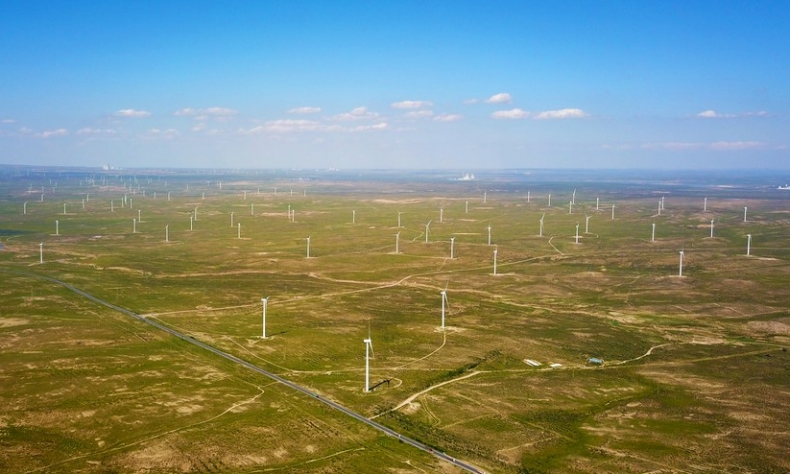
There must be specific and reasonable rules guiding China’s carbon emission market, so that international participants can also contribute to the country’s goal of carbon peaking and neutrality.
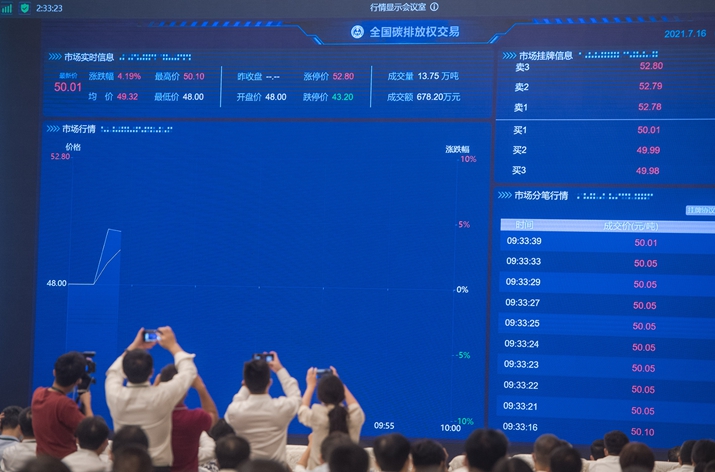
China’s carbon emission trading was formally launched at the Shanghai Environment and Energy Exchange on July 16, marking a tangible step toward the goal of peaking carbon emissions by 2030 and achieving carbon neutrality by 2060.
China’s per-capita GDP is far lower than that of other industrialized countries and its short history of industrialization is maybe responsible for much less damage to the planet’s climate than theirs.
However, China is quick to take on the mission of carbon emission reduction.
The world’s largest market
Carbon emission trading means that greenhouse gas emission rights are traded as commodities. Companies are granted certain emission allowances, and those who release less than the allowance can sell their surplus; those emitting more than permitted will have to pay their overdues. The ultimate goal is to contain the total amount of carbon emissions around the world.
Among China’s various industries, the biggest emitter is the power industry, responsible for 43 percent of carbon emissions, equal to more than 4 billion metric tons of carbon dioxide. Thus, more than 2,000 enterprises from the power industry are involved in carbon emission trading.
China’s carbon market, the largest in the world in terms of size, presents huge business opportunities. It’s estimated that carbon trading this year has thus far reached some 250 million, or even 300 million tons, at a value of roughly 16 billion yuan ($2.5 billion).
The price of carbon trading is crucial to the market. The transaction price on the first day in Shanghai stood at around 51.2 yuan ($8) per ton, as expected. Extreme high or low prices are inappropriate. Too low, many enterprises’ enthusiasm for cutting emissions will be dampened; too high, some big emitters will break down as they can no longer afford the payments. A reasonable price will help encourage enterprises to actively reduce their emissions.
In the short term, carbon trading pricing will unlikely witness any big volatility as it mainly relies on the demand and supply of carbon emission quotas. However, in the long run, it hinges on the country’s overall economic performance. As the volume and the price of the carbon emission trade are notably lower than international levels, China’s carbon trading price may well go up in the mid-and-long term.
Apart from the power sector, in the coming five years, dozens of high-energy-consuming sectors like the chemical industry, construction material, iron and steel, and civil aviation will be adopted into the carbon trading market. By then, China’s carbon emission market will be worth around 150 billion yuan ($23.4 billion). There is huge potential for this market. The application of carbon capture and storage technology, green chemicals, and non-fossil-fuel energy is likely to trigger disruptive innovation and incur huge investment. Together with derivatives like carbon futures, China’s carbon emission trading is expected to reach 600 billion yuan ($93.7 billion).
Economic impact
Some people see carbon emission reduction and economic development as foes. This is not necessarily the case. Carbon reduction is an impetus for China’s green and high-quality development, because advanced science and technology born in the process of emission reduction can also help promote future investment and economic growth.
China is set to develop into a modern socialist country in all respects by 2049 and achieve carbon neutrality before 2060. These two goals have posed big challenges to China’s economic transition. However, on the other hand, carbon emission trading compels enterprises to accelerate economic transition and increase their input in science and technology research.
In the short run, big emitters like the power, steel and auto industries will bear the brunt of carbon emission reduction, as carbon emission quotas will take a direct toll on their performance.
As a result, let’s take the power industry as a case in point: Power plants will surely change their structures. Fossil fuels, like coal, will be cut; non-fossil energy will become the better choice. Reined in by the goal of carbon neutrality, the total consumption of fossil fuels, such as coal, is thus brought under control, but power demand will inevitably rise along with rapid economic growth. In turn, power plants will have to rely on other clean energy sources, like wind and solar power.
Lessons to be learned
China’s carbon emission trading is still in its nascent stages, but the world already has a few mature examples. Until now, 21 carbon emission trading systems are fully operational around the globe, covering 10 percent of the world’s total carbon emissions. Particularly, the carbon emission trading markets in the EU may offer a bespoke template for China in terms of the overall structure, product design, standards and operations.
Carbon price fluctuations once rattled the carbon markets in Europe. In 2008 and 2011, demand tumbled due to the financial crisis and the situation worsened with the ensuing debt crisis, which pushed carbon prices to near zero. The EU later worked out an effective mechanism to stabilize carbon prices. China can take a cue from the EU in terms of preventing and coping with potential carbon price fluctuations in its carbon market in the future.
Problems to be solved
Currently, some high-energy-consuming enterprises are still not enthusiastic about carbon emission trading. Some of them are not clear about how many surpluses of carbon emission quotas they have and thus don’t know how to do the trade math. Meanwhile, many are lacking in experience when it comes to carbon asset management as fresh hands in this market.
As climate change is an international challenge, carbon emission trading is an international business. There must be specific and reasonable rules guiding China’s carbon emission market, so that international participants can also contribute to the country’s goal of carbon peaking and neutrality.
At the present stage, participants in carbon emission trading are business entities, but, in the future, the market can open up to individuals. For example, the daily carbon emissions of individuals can be accumulated in the form of credits. Some banks have already issued carbon credit cards, which can then be used to add to personal credit lines.
Science progress will boost the use of zero-carbon technologies and, at the same time, the cost of conventional fossil fuels and production technologies will drop. As a result, the overall campaign of carbon emissions is likely to lose steam, including a less dynamic carbon market. China must gear up to deal with such scenarios.
The good news is that time is on our side. In the earliest stages, as long as China can avoid deficient designs, maintain relatively high contract compliance rates, and stabilize prices, all will develop well. Its carbon market can gradually grow and reach full-fledged maturity.