China’s Good Neighborhood Policy Gains Support Across Asia
 Facebook
 Twitter
 Linkedin
 Google +

In fact, China’s good neighborhood policy has gained strong support not only from its neighbors, but beyond its borders across Asia.
It is generally acknowledged that a country’s neighborhood?policy is a critical aspect of its foreign policy. Good neighbors?are not just a geographic reality but a fundamental pillar of a nation’s stability, security, and prosperity. The strength of a country lies as much in its borders as in the relationships it nurtures beyond them.
For China, this is particularly relevant. As a vast country sharing land borders with 14 nations, China has long put great emphasis on neighborhood?diplomacy, placing neighboring?relations?high on its diplomatic agenda.
In a policy paper issued in October 2023 with the title “Outlook on China’s Foreign Policy on Its Neighborhood?in the New Era”, China explicitly stated that “The neighborhood?is where China survives and thrives and the foundation of its development and prosperity.”?It emphasized that “As a member of the Asian family and a responsible major country, China attaches great importance to neighborhood?diplomacy, always prioritizes?the neighborhood?on its diplomatic agenda, and remains committed to promoting regional peace, stability, development and prosperity.”
The historical root of China’s good-neighborly policy
Historically, the principles of “親仁善鄰” and “協和萬邦”, meaning “fostering amity with one’s neighbors”?and “promoting harmony among all nations”, used to be central to China’s foreign policy.
Rooted in traditional Chinese culture and Confucian philosophy, these principles underscore China’s commitment to peaceful coexistence and mutual respect for neighboring?states in the ancient days.
While the geopolitical landscape has changed, these principles have continued to shape China’s “good neighborhood policy,” which emphasizes?peaceful, stable, cooperative, and mutually beneficial relationships with neighboring countries.
China’s good-neighborhood policy has not only benefited from historical tradition, but also been guided by the Five Principles of Peaceful Coexistence.
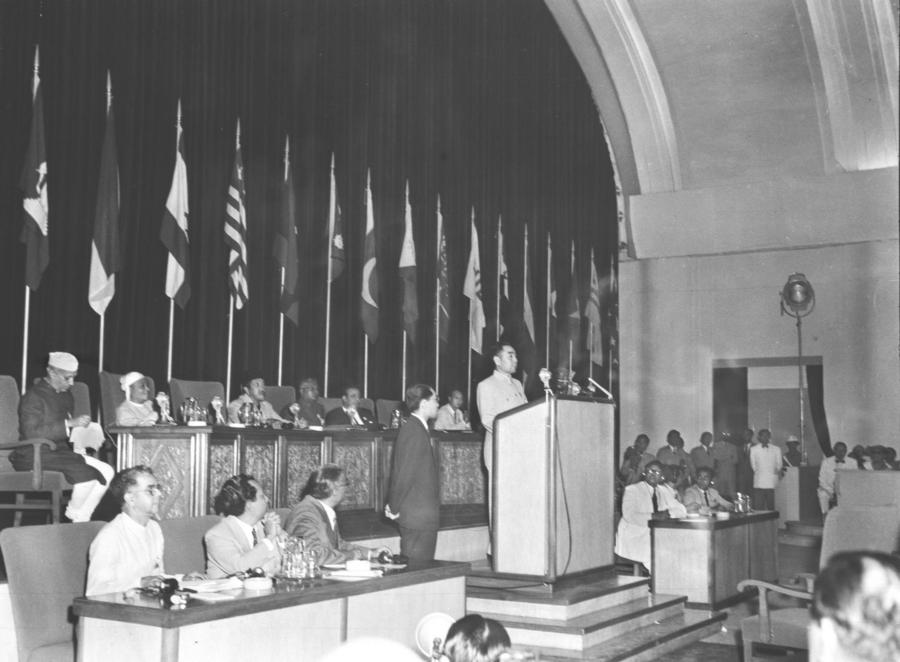
Seventy years ago, Chinese Premier Zhou Enlai first proposed the Five Principles of Peaceful Coexistence during negotiations with the Indian government over border issues regarding Xizang.
These five principles are—mutual respect for sovereignty and territorial integrity, mutual non-aggression, non-interference in each other’s internal affairs, equality and mutual benefit, and peaceful coexistence.
The importance of these principles, which emphasized peaceful means of resolving disputes, was further solidified at the 1955 Asian African Conference in Bandung where they became known as the Bandung Principles. These principles, which aligned closely with its neighborhood diplomacy, have become foundational to China’s foreign policy.
Guided by these principles, China has successfully resolved historical boundary issues with 12 neighbors?on land through negotiations,?and signed the treaties of good-neighborliness and friendly cooperation with neighboring countries. These are certainly a solid testament to the success of China’s good neighborhood?diplomacy.
Good neighbors bring peace and mutual benefits
In fact, China’s good neighborhood policy has gained strong support not only from its neighbors, but beyond its borders across Asia.
To date, China has established a broad range of substantive partnerships and strategic, mutually beneficial relations with 28 neighboring countries and ASEAN. It became the first ASEAN Dialogue Partner to accede to the Treaty of Amity and Cooperation in Southeast Asia and has also signed and ratified the Protocol to the Treaty on a Nuclear-Weapon-Free Zone in Central Asia. In 2021, China and ASEAN further elevated their relationship to a Comprehensive Strategic Partnership.
As China strengthened its relationships with neighboring nations, trade with these countries expanded significantly. In 2022, China’s trade in goods with neighboring countries surpassed $2.17 trillion. China is now the largest trading partner of 18 neighboring countries.
Since China became an ASEAN dialogue partner in 1991, bilateral trade between China and ASEAN has grown from approximately $8 billion to over $911 billion by 2023, reflecting a remarkable increase of more than 120-fold in a span of three decades.
Moreover, China has been ASEAN’s largest trading partner for 15 consecutive years since 2009. In 2020, ASEAN surpassed the European Union to become China’s largest trading partner, and the two have remained as each other’s top trading partner ever since.
These statistics highlight the significant economic integration and interdependence within the region.
While economics is the base to China’s Good Neighborhood Policy, its scope extends well beyond economic considerations. China has consistently championed peaceful coexistence, emphasizing?that peace and security are essential prerequisites for sustainable development.
In this respect, China stresses the?importance of dialogue and diplomacy in resolving border disputes. China’s good neighborhood?diplomacy has contributed in no small way to the peace in the Asia Pacific region over the last 40 years.
For example, China has consistently advocated resolving the South China Sea dispute through dialogue and negotiations with ASEAN claimant countries, proposing that the parties concerned set aside the disagreements and jointly develop the disputed islands.
China has also leveraged its influence to facilitate rapprochement among rival nations in Asia. In March 2023, it successfully brokered a detente between Iran and Saudi Arabia, leading to the restoration of diplomatic ties between the two countries after years of intense rivalry that had destabilized?several countries in the Middle East.
In July this year, Beijing mediated a deal in which various factions in Palestine signed an accord to establish a unity government in Gaza following the conflict.
When China engages with the world, it all along values good faith?and good?neighborliness.
In the above-mentioned policy paper on “China’s Foreign Policy on Its Neighborhood in the New Era”, China reiterated that “China is,?and will always be a good neighbor, good friend and good partner of regional countries, and will always be a major force?underpinning peace, stability, development and prosperity.”

China’s Good Neighborhood?Policy gains widespread support
However, China’s good neighborhood?policy is not without challenges. The U.S., which deems China’s rise as a threat to its global hegemony, has gone all out in every domain from diplomacy, military, economics, and technology to contain and suppress China’s rise.
To further its geopolitical interests, Washington has openly declared that while it cannot change the Beijing regime, it will proactively shape the strategic environment surrounding China to make it unfavorable to China, so as to advance its geopolitical interest and objectives.
A typical example is how the U.S. has sought to destabilize?Xinjiang by covertly supporting the separatist movements, and weaponizing?human rights issues in Xinjiang to demonize?China.
Lawrence Wilkerson, a retired U.S. Army Colonel who once served as chief of staff to U.S. Secretary of State Colin Powell, openly stated that the best way for the U.S. to destabilize?China would be to mount an operation using Uygurs to foment unrest in Xinjiang.
The U.S. has also intervened in the South China Sea dispute by backing claimant countries in their territorial claims and encouraging them to adopt a confrontational approach against China. This includes funding and supporting the Philippines in its 2016 tribunal at?a non-UN court regarding the South China Sea dispute.
In April 2023, the Philippines further granted the U.S. access to four new military bases under the Enhanced Defense Cooperation Agreement (EDCA), as well as allowing the U.S. to station intermediate-range missiles in the Philippines bases.
India, which has not been able to settle its border dispute with China, also has a neighborhood?policy.
India views China’s rise with ambivalence. While admiring China’s remarkable economic success over the past four decades, India is reluctant to accept China’s rise with an open heart.
The main reason for such a national psyche is primarily due to the 1962 border conflict with China as well as a lingering sense of cultural superiority.
India is deeply concerned about China’s rising global influence, particularly its growing presence in South Asia among India’s neighbors. In view of this, India’s ‘Neighbors?First’ policy prioritizes?countering China’s influence and maintaining its traditional role as the dominant regional power, rather than fostering neighborhood?relationships based on peaceful coexistence, cooperation, and mutual benefit.
Although there have been recent reports of some easing of border tensions, it is unlikely that India will change its priorities in its ‘Neighbors?First’ policy, given the entrenched national sentiment that is generally unfriendly toward China.
According to a survey by Singapore think tank ISEAS-Yusof Ishak Institute, “The State of Southeast Asia 2024 Survey Report”, more than half of the people in Southeast Asia would side with China over the United States if forced to choose. It is noteworthy that this is the first time more people in ASEAN would choose China over the U.S.
As we can see from the turnout at the recent BRICS summit in Kazan, it highlights a notable shift in global power dynamics, where U.S. global influence and credibility appear to be waning,?albeit?gradually. In contrast, it is obvious China’s Good Neighborhood?Policy has gained widespread support across Asia.
The article reflects the author’s opinions, and not necessarily the views of China Focus.