China’s Principled Stance on Palestine Exposes U.S. Hypocrisy
 Facebook
 Twitter
 Linkedin
 Google +
For years, instead of promoting peace, Washington has accommodated increasing Israeli aggression that could only lead to war.
When?Chinese leaders met their counterparts in Beijing recently at the 10th?Ministerial Conference of the China-Arab States Cooperation Forum, international media focused primarily on remarks by President Xi Jinping on the Palestinian-Israeli conflict. He said, “Since last October, the Palestinian-Israeli conflict has escalated drastically, throwing the people into tremendous sufferings.”
In addition to pledging more humanitarian aid to Palestinians, Xi said, “War should not continue indefinitely. Justice should not be absent forever. Commitment to the two-state solution should not be wavered at will.”
He noted: “China firmly supports the establishment of an independent State of Palestine that enjoys full sovereignty based on the 1967 borders and with East Jerusalem as its capital. It supports Palestine’s full membership in the U.N., and supports a more broad-based, authoritative and effective international peace conference.”
After the meeting, Chinese Foreign Minister Wang Yi told the media that the “strongest call of the meeting was one to firmly support the Palestinian people in restoring their legitimate national rights.” The forum’s joint statement “puts forward a just voice to promote the speedy resolution of the Gaza conflict and the comprehensive, fair and lasting resolution of the Palestinian issue,” Wang said.
Some Western commentators found China’s stance problematic. For example, CNN noted: “China has chosen to side with Palestine and the Arab countries. The choice is deliberate as it does suggest a desire to align with Arab countries and the Global South. But China didn’t create the crisis. It only capitalized on it.” Capitalize? That is a dark and curious accusation. So, let’s try to find a more reasonable understanding of all of this.
To begin, after the October 7 attack initiated by Hamas, U.S. President Joe Biden swiftly condemned the group, calling it “a terrorist organization whose stated purpose for being is to kill Jews.” He described the attack as “an act of sheer evil” that “slaughtered” more than 1,000 Israeli civilians.
At no point did Biden ask why Hamas attacked or consider if the group had a reasonable strategic objective despite the horrific and inexcusable loss of civilian lives. Instead, he reduced Hamas to “an evil that exists only to kill Jews.” This rhetorical sleight of hand, like an emperor signaling assent, provided Israel the moral justification to launch a devastating campaign that has massacred more than 36,000 Palestinians. It also served to wash the hands of his own administration’s failures.
For years, instead of promoting peace, Washington has accommodated increasing Israeli aggression that could only lead to war.
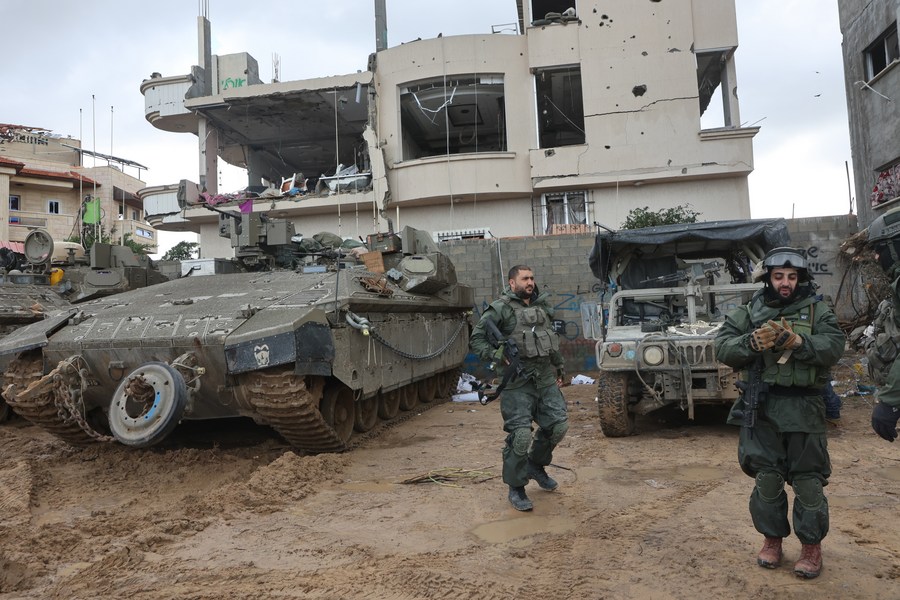
In the months leading up to the recent Palestinian-Israeli conflict, experts and diplomats were predicting that war would arrive soon, pointing to three likely triggers. First, in addition to a multi-year blockade of Gaza, Israel was continuing to advance illegal settlements in the occupied territories at speed, killing Palestinians along the way. These acts further eroded the potential for a two-State solution. To accommodate settlements in the West Bank, Israeli forces killed 492 Palestinians in 2023, including 120 children, according to the United Nations Office for the Coordination of Humanitarian Affairs. This figure was more than twice as many as in any other year since 2005. An additional 12,769 Palestinians were injured.
Second, Israel was suffering from a crippling political gridlock, a domestic problem that, according to experts, has historically been resolved by going to war and forming a “unity government,” thereby externalizing its political dysfunction.
Third, during Donald Trump’s presidency, the U.S. abandoned the two-State solution, moved the U.S. embassy to Jerusalem, and imposed heavy sanctions on Iran. President Joe Biden only tepidly re-embraced the two-State solution and did not reverse Trump’s decision on the embassy.
Relatedly, Trump authorized the assassination of top Iranian military leader Qasem Soleimani while he was visiting Iraq in 2020. Trump claimed the assassination was justified to prevent a war; others have suggested he was unnerved by Soleimani’s alleged purpose in Baghdad, which was to advance negotiations for the normalization of bilateral ties between Iran and Saudi Arabia. This ran afoul of Trump’s objective to isolate Iran and instead promote stronger ties between Arab countries and Israel, achieved in part with the Abraham Accords concluded nine months later. Ultimately, Agnes Callamard, the U.N.’s special rapporteur on extrajudicial killings, concluded Soleimani’s murder was unjustified and violated international law.
Saudi and Iranian ties reached a breakthrough point with Chinese support in March 2023, and this was precisely when experts were predicting that a war against Gaza would follow. One should ask: Did Hamas strike first because they knew a war was coming and needed hostages for leverage? Did Hamas strike because Israel was already killing hundreds of Palestinians and wounding thousands more? And was a conflict more likely given Israel’s unhappiness with improved ties between Riyadh and Tehran? These questions remain unanswered, and few in the West are considering their possible implications despite their tremendous impact on millions of people’s well-being.
Such questions are important because they directly address the deeper causes of conflict and the real impediments to peace. These questions have parallels in other conflicts connected to the U.S. For example, the U.S. has repeatedly characterized the conflict in Ukraine as one resulting from unprovoked Russian aggression. However, a more sober analysis suggests that the U.S. intentionally destabilized Russian-Ukrainian relations over many years, using the ensuing instability and insecurity to advance NATO and then fight Russia by proxy in Ukraine. You would be hard-pressed to find any elected official in the West or Kyiv who would acknowledge this. Yet, during my fieldwork in Ukraine last year, it was commonly understood among dozens of people interviewed across the country, from different classes and political factions, including Azov and government soldiers, that this was a “proxy war” between Russia and the U.S. and that Ukraine bore substantial responsibility for allowing itself to be exploited by the U.S. for this purpose. Meanwhile, the U.S. points the finger at Beijing, suggesting contrary to evidence that China has taken Russia’s side in the conflict to help Moscow undermine Western democracies.

There is a potential conflict that must be noted here, given what appear to be U.S. efforts to play similar tricks in Asia. The U.S. has sparked instability in the South China Sea and the Taiwan Strait as it did in Ukraine and Eastern Europe. When China responded by strengthening its defensive position, the White House blamed Beijing for being the cause of rising friction. Just as it advanced NATO in Europe, the U.S. is advancing AUKUS in the Pacific, moving forward with weapons, including nuclear weapons, and troop buildups. The parallels here are too clear to ignore. We can see this in American spin doctors once again describing an axis of evil, this time Beijing, Moscow and Tehran. At the same time, the U.S. government advances continued military aid packages for Israel, Ukraine and Taiwan in the name of defending freedom and democracy.
These points must be considered and investigated further to elucidate China’s position on Gaza and the promotion of stronger ties with Arab nations and Iran. It’s in these contexts that we should understand China’s call for a peaceful settlement in Ukraine while simultaneously being sympathetic to Russia’s security concerns vis-à-vis NATO expansions and other U.S. provocations. This is why we must push back against demonizing discourses, including facetious characterizations that describe the challenges of the new era as centering on democratic vs. authoritarian states. We must ask: Is killing tens of thousands of Palestinian civilians, including women and children, democratic? Is ignoring UN resolutions democratic? And is pushing the world toward a new cold war or worse democratic? Hopefully, the answers are clear to everyone.
The leaders who met in Beijing during the forum are aware of these points, and others worldwide know them too, whether or not they admit it or prefer to lie. This is why meetings like the forum are so important: it’s not about capitalizing on the suffering of others. It’s about understanding the real geopolitics driving conflicts, how these fit into a bigger picture, bringing new dangers to the world as a whole, and how people might instead work together to find a different path, one that calls for peace, security, development, mutual respect, and cooperation, to ensure humanity can survive these risks and enjoy a shared future.
Josef Gregory Mahoney is professor of politics and international relations at East China Normal University and senior research fellow with the Institute for the Development of Socialism with Chinese Characteristics at Southeast University and the Hainan CGE Peace Development Foundation.