China’s Renewable Energy Industry Sees Robust Growth
 Facebook
 Twitter
 Linkedin
 Google +

China’s new energy industry is making sizeable contributions not only to domestic growth but also to global efforts in combating climate change and achieving a green transition.
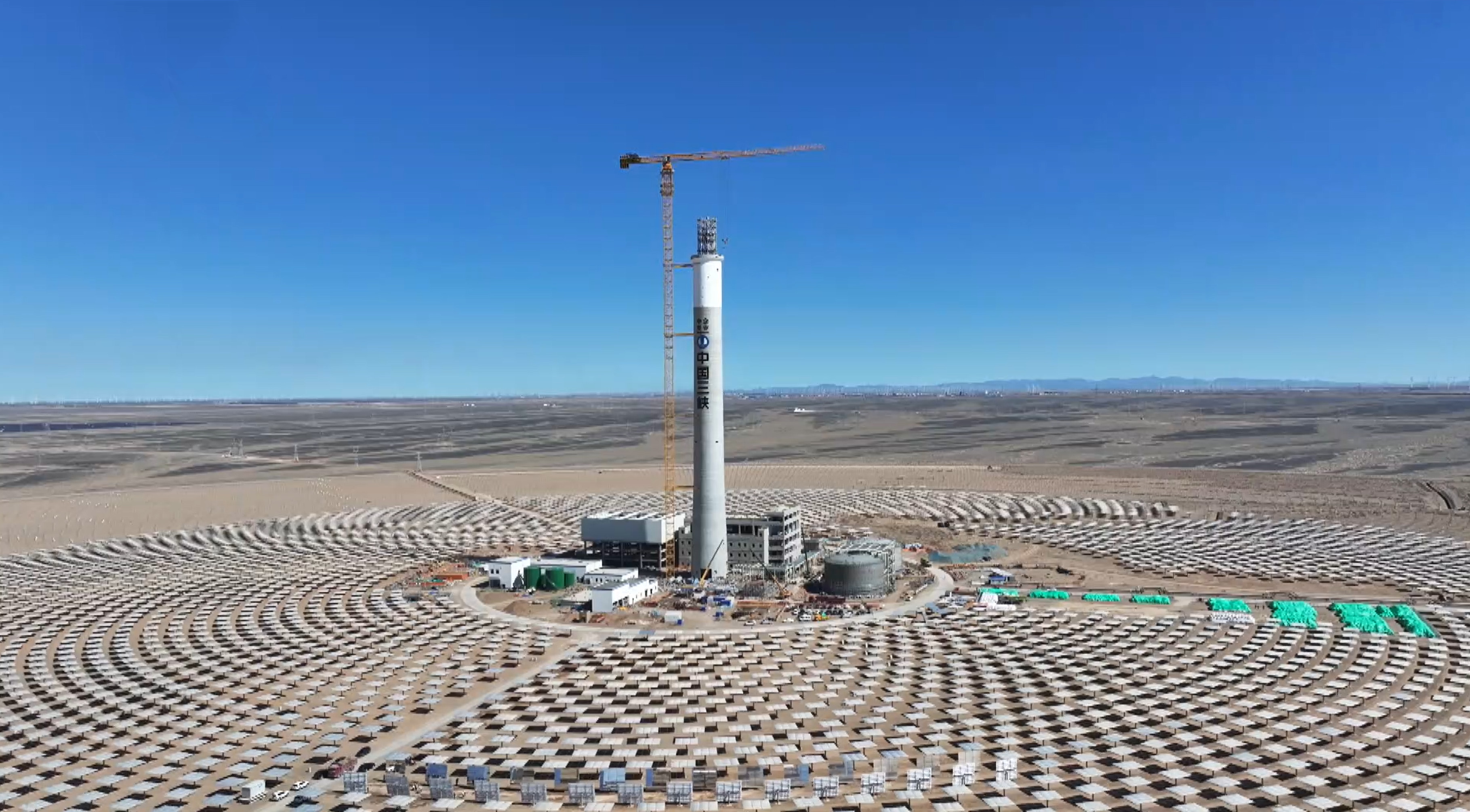
China Three Gorges Corp., a state-owned power company particularly known for its role in the development and operation of large-scale hydropower projects, is pioneering an impressive project—the world’s first dual-tower solar thermal plant in Guazhou County, northwest China’s Gansu Province.
The two towers each stand 200 meters tall, with nearly 30,000 ground-mounted mirrors. These mirrors form two large, overlapping circles that concentrate sunlight onto each tower. In the morning, the mirrors focus sunlight on the eastern tower, then automatically adjust to target the western tower in the afternoon. The mirrors, made from special materials, achieve a reflection efficiency of 94 percent.
Similar to traditional coal plants, the concentrated sunlight heats water to generate electricity. Unlike other solar power plants, this design can produce power even at night.
The towers store molten salt, which acts as a thermal battery, retaining extra heat collected during the day and releasing it at night to keep the generators running continuously.
According to the company, the innovative design isn’t limited to the two towers, and has the potential to incorporate multiple towers for even greater efficiency gains.
The project, which exemplifies China’s commitment to green energy efforts, is expected to become operational by the end of this year. It is part of a larger clean energy complex that includes solar, thermal and wind power plants, collectively generating over 1.8 billion kilowatt-hours of electricity each year and saving 1.53 million tons of carbon emissions.
This year, China’s new energy industry has frequently captured global attention, especially as some Western countries, like the United States, have raised concerns about “overcapacity” in China’s new energy sector, using it as a pretext to impose additional trade and economic restrictions on China.
Despite the external discordant voices, China remains steadfast in its pursuit of green development. The country’s new energy industry is making sizeable contributions not only to domestic growth but also to global efforts in combating climate change and achieving a green transition.
As a major country in energy consumption and related technology exports, China and its photovoltaic (PV) industry are poised to become leading forces in energy transition, Liu Hanyuan, Vice Chairman of the All-China Federation of Industry and Commerce, told Beijing Review in an interview. Liu is also chairman of the Board of Directors of Tongwei Group, a private technology-based company specializing in agriculture and new energy.
A growing sector
As of late June, the installed capacity of renewable energy in China had reached 1.653 billion kilowatts (kw), a 25-percent year-on-year increase, accounting for 53.8 percent of the country’s total installed capacity, according to a press conference hosted by the National Energy Administration (NEA) on July 31. Among the total, the installed capacity of hydropower, wind power, solar power and biomass power was 427 million kw, 467 million kw, 714 million kw and 45.3 million kw, respectively.
According to the conference, the combined installed capacity of wind and solar power, which totaled 1.18 billion kw, surpassed that of coal power, which stood at 1.17 billion kw. “The generation of renewable energy has steadily reached new milestones,” Pan Huimin, an official with the NEA, told the conference.
According to a July 29 report in newspaper Economic Daily, China has abundant wind and solar energy resources, and is committed to a strong green and low-carbon development strategy. Through long-term research and persistent efforts, several new energy technologies and equipment manufacturing levels have achieved a globally leading position.
The country has established the world’s largest clean power supply system and its new energy vehicles, lithium-ion batteries, and PV products have gained strong competitive advantages in the international market. New energy vehicles refer to vehicles completely or mainly driven by new energy sources, including battery electric vehicles, plug-in hybrid vehicles and fuel cell vehicles. All in all, the development of new energy has already established a solid foundation.
Addressing energy supply shortage is another factor driving China’s development of its new energy industry.
Currently, China’s dependence on imported oil and natural gas stands at approximately 70 percent and over 40 percent, respectively. As a major oil and gas importer, China is vulnerable to price fluctuations in the global market.
Over the 20 years starting in the early 1970s, the world experienced three consecutive oil crises, each of which led to a spike in oil prices. In response to these threats to energy security, developed countries were the first to adopt new energy sources that are more abundant and stable.
China is abundant in renewable energy sources and proper development of those sources can reduce impact to the environment and also resolve the county’s energy supply shortage, Sun Chuanwang, a professor of energy economics at Xiamen University, wrote in an article on financial news portal Yicai.com.
Economic booster
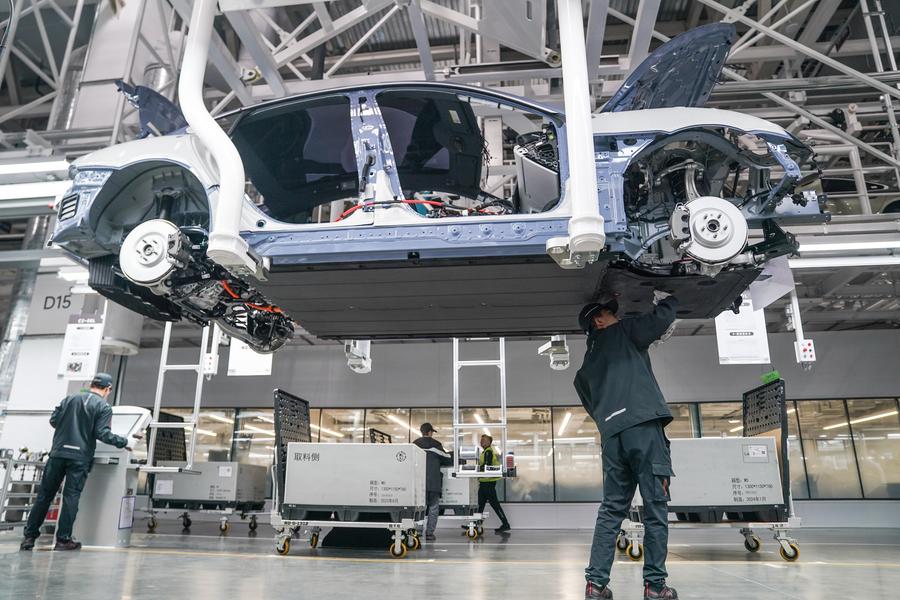
Over 1,000 years ago, silk, porcelain and tea introduced China to the Western world. Today, China’s new energy products are causing global astonishment. The country has established the most competitive new energy industrial chain in the world. The production capacity and export scale of China’s “new three products” in energy—electric vehicles (EVs), PV products and lithium-ion batteries—continue to grow.
Yiwu in east China’s Zhejiang Province is known as the world’s largest hub for small commodities and a global benchmark for small commodity trade. While the bustling trade in traditional small goods, such as buttons, toys and apparel continues, there is a palpable shift toward a new frontier—the new energy sector.
In March 2023, Yiwu International Trade City, the primary wholesale market complex in Yiwu, launched the country’s first specialized market dedicated to showcasing and trading new energy products.
Overseas buyers can find nearly every type of new energy product, from solar lamps costing a few dozen yuan (a few U.S. dollars) to EVs worth hundreds of thousands of yuan (tens of thousands of U.S. dollars). A stroll through the market offers a glimpse into the global popularity and dynamic market for these new products.
According to local statistics, the output of Yiwu’s PV industry reached 87.23 billion yuan ($12.13 billion) as of 2022, accounting for over 30 percent of the total output of the PV industry in the province. It’s projected that by the end of 2025, the total output of Yiwu’s PV industry will reach 100 billion yuan ($14 billion), with five leading enterprises each exceeding 10 billion yuan ($ 1.4 billion) in output value and several others surpassing 1 billion yuan ($140 million) each.
According to the Economic Daily report, China’s new energy industry is continuously reducing costs and improving efficiency through technology upgrades. In 2023, the price of PV modules in the country dropped to less than 1,000 yuan ($140) per kw, a 90-percent reduction compared to 2010.
Today, the levelized cost of electricity from wind and solar power is more competitive than that from coal-fired power. The cost of lithium-ion batteries has also decreased by 90 percent, accelerating the adoption of EVs.
Technological innovations and competition have enabled Chinese new energy companies to steadily surpass their international counterparts.
Data from the NEA show that in the first half of this year, national energy investments continued to grow rapidly. Investments in key energy projects across the country exceeded 1.2 trillion yuan ($167 billion), a year-on-year increase of 17.7 percent.
“Major energy projects are vital for consolidating and strengthening the foundation of the economy,” Sun told the People’s Daily website in an August 6 report. He noted that
accelerating the completion and production of these projects not only helps stabilize investment and growth in key areas, but also stimulates the development of upstream and downstream industries in the energy sector, supporting job creation and income growth, and injecting strong momentum into overall economic development.

Green commitments
On July 31, China introduced a new set of guidelines to ramp up the country’s green transition in all areas of economic and social development.
The guidelines outline key objectives, including achieving remarkable results in green transition by 2030 and establishing a green, low-carbon and circular economic system by 2035. By this time, the goal of a Beautiful China will also be largely realized.
The National Development and Reform Commission underscored that these guidelines come at a time when China has already made historical achievements in green and low-carbon development since the 18th National Congress of the Communist Party of China in 2012. For instance, in 2023, the nation’s energy consumption and carbon emission intensity per unit of GDP dropped by more than 26 percent and 35 percent, respectively, compared to 2012.
The guidelines also emphasize the importance of promoting green consumption by encouraging people to adopt green and healthy lifestyles. They propose measures to expand the scope and scale of government procurement of green products, support trade-in programs to boost consumer spending on green products, and develop marketing campaigns for new energy vehicles and green home appliances, especially in rural regions.
In 2020, China proposed the national dual carbon goals of peaking carbon emissions before 2030 and achieving carbon neutrality before 2060.
“The goals receive widespread praise from the European Union and countries around the world. And developing renewable energy sources, such as solar and wind power, has become a key strategy for China to fulfill this international commitment, to demonstrate the international responsibility of achieving energy conservation, emission reduction, and green sustainable development,” Liu told Beijing Review. “There is confidence China will reach its dual carbon goals as scheduled,” he added.
Renewable energy technologies, like solar and wind power, are the key to reducing emissions in the electricity sector, which is currently the single largest source of carbon emissions. In the pathway to net zero, almost 90 percent of global electricity generation in 2050 will come from renewable sources, with solar PV and wind power together accounting for nearly 70 percent of that total, according to a 2021 report by the International Energy Agency.
Different countries should set aside protective measures and genuinely come together to address the environmental and climate challenges that humanity faces. The world must team up to accelerate the development of the renewable energy industry and expedite the global energy transition, Liu added.