Collective Action Needed to End Poverty Post-COVID
 Facebook
 Twitter
 Linkedin
 Google +
Up to 124 million people were pushed into extreme poverty last year because of the COVID-19 pandemic, reversing decades of progress. With vaccination programs yet to begin in many developing nations, could ending extreme poverty be the biggest casualty of COVID-19?
For more than two decades, the global battle to eradicate extreme poverty has made steady and effective progress.
Despite a number of serious environmental and economic “black swan” events that threatened to perilously throw efforts off course, for the past 25-years the number of people living in extreme poverty – registered as people surviving on less than $1.90 a day according to the World Bank – has dropped to record levels.
In 2019, less than 10 percent of the world’s population were living in extreme poverty, and there were hopes that a continued reduction in 2020 would keep world leaders on track in their mission to eradicate extreme poverty – number one of the key Sustainable Development Goals by 2030 agreed at the United Nations General Assembly in September 2015.
The impact of the COVID-19 pandemic over the past year has however proved one black swan event too many, causing for the first time this millennium a rise in the number of people living in extreme poverty. The World Bank estimates that up to 124 million people were pushed into extreme poverty last year because of the pandemic, with a further 39 million expected to be added by the end of this year.
Escaping the clutches of poverty has now become increasingly tethered to how quickly developing countries can deal with COVID-19. Manage it effectively, and countries might just mitigate the worst of the damage. Prolong its spread, and face the realisation of decades of hard recovery.
With most developing nations yet to fully begin inoculating their populations, chances of a quick recovery appear at a minimum, something the United Nations has warned could contribute to more than 207 million people being pushed into extreme poverty by the end of the century.
These are therefore extremely difficult times for people living in extreme poverty, with the pandemic acting not as “the great leveller” that some have stated, but as an inequality virus that pushes the poorest and most vulnerable even closer to the limit.
It is in times like this however that countries should look to others not only for help but also inspiration, that even from the most extreme and adverse set-backs, victory can still be achieved.

From 700 million to zero
In the field of eradicating extreme poverty, those eyes should be drawn squarely towards China. Though its efforts may not have begun with the weight of a global pandemic pressing on its shoulders, it too faced a monumental challenge when attempting to end extreme poverty for good.
Having been plagued by poverty at a scale and level unseen anywhere prior to its establishment in 1949, it began its poverty eradication efforts at a time when weak foundations and uneven development characterized its system. Over 700 million people inside the country lived on less than $1.90 a day, while towns and villages lacked basic amenities and opportunities for growth, making life a constant struggle.
According to a recently released white paper on China’s poverty alleviation efforts titled Poverty Alleviation: China’s Experience and Contribution, in 1978 China had “a large rural impoverished population base and a high incidence of poverty”, as well as a stagnated economy. Its GDP at that time was as low as $194.80 billion– lower than the size of Brazil’s during the same period.
Yet over the course of the next four-decades, the country was able to fundamentally reverse its fortunes, lifting every impoverished citizen out of extreme poverty. From the sweeping hills of southern Yunnan, to the northern plains of Inner Mongolia, uniquely-tailored poverty alleviation programs were introduced, programs that took China’s vast geographical and cultural differences into account.
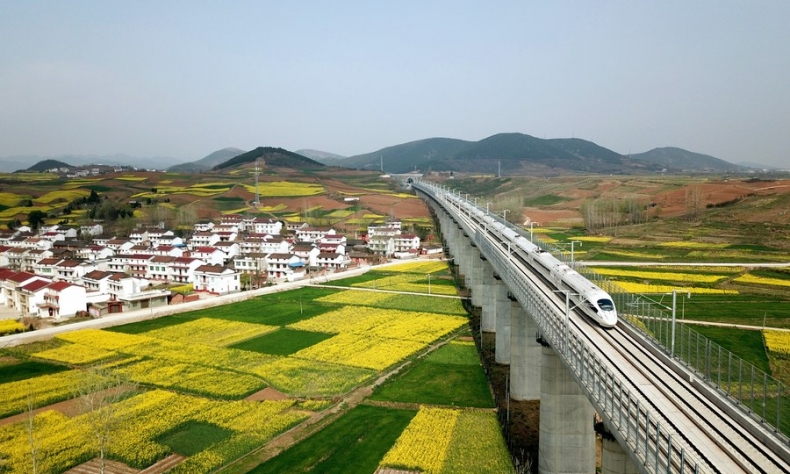
Where lives could be improved through new infrastructure – both traditional and digital – highways, high-speed rail lines and internet connections were built, helping boost tourism, trade and commerce. Where communities were deemed too isolated and cut off from modern life for people to properly prevail, brand new housing and job opportunities were provided in new locations at no expense. And where education and social services were found wanting for those most vulnerable, schools, hospitals and care for the elderly were quickly established.
Together, these policies helped China reduce the size of its extremely-impoverished population to zero, with Chinese President Xi Jinping officially declaring the feat achieved on February 25 this year.
Providing hope …
China’s experience offers a real-life example that eradicating extreme poverty can be done even in the most extreme circumstances. Yet it should be noted that despite their effectiveness, its poverty alleviation methods are not necessarily suitable or possible to replicate elsewhere.
China’s vastly different political systems, social make-up and cultural history compared to other nations, as well as the different reasons countries struggle to lift their citizens out of poverty, can make its policies difficult to transfer to other areas of the world.
China, for example, did not have the burden of crippling debt repayments that many impoverished countries need to manage, a factor that makes expensive policies such as infrastructure projects unattainable.
It does not mean however that countries in a similar position cannot look to China for – if not answers – then hope that living with extreme poverty is neither pre-conditioned nor a full gone conclusion. Extreme floods, devastating earthquakes, financial crashes and even the early onset of COVID-19 didn’t derail China’s efforts – and it shouldn’t be allowed to derail other countries’ efforts either.
… and action
To do that however would require developed nations to step-up, something they have historically failed to do.
The World Bank has long lobbied form the cancelation of debt from developing nations which would free-up funds for them to spend on projects that can provide tangible assets to those most in need. Ensuring developing nations receive reciprocal access to vaccines has also been championed by the World Health Organisation as the best way to end the pandemic, as well as the disproportionately negative consequences a prolonged pandemic brings to those in poverty.
Whether such action can be achieved is unclear, but China has already proved it is willing to lead in this endeavour, suspending loan repayments to 77 developing countries as of June last year, and donating millions of COVID-19 vaccines to 53 developing nations.
Action such as this is the only way countries will be able ensure the impact of COVID-19 does not define the futures of those countries with large populations in extreme poverty, and give them a fighting chance of eradicating extreme poverty by the end of the decade once and for all.