Deciphering Shifting Dynamics
 Facebook
 Twitter
 Linkedin
 Google +
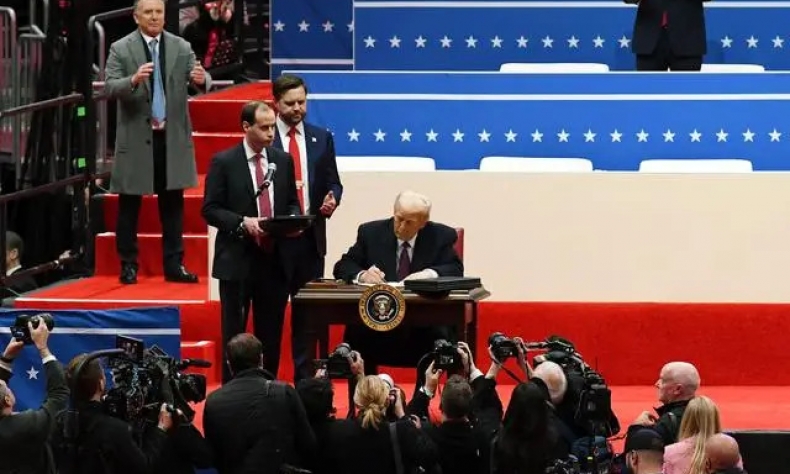
Good coordination between China and the U.S. could yield positive results in areas like trade, climate change and global security. The key question is whether President Trump can bring the statesmanship necessary to rise to the occasion.
Warwick Powell, an adjunct professor at Queensland University of Technology in Australia and senior fellow at Taihe Institute in Beijing, China, spoke with Liu Yunyun, Associate Editor in Chief of Beijing Review. During their conversation, they explored Sino-U.S. relations and discussed potential pathways for rebuilding trust and improving ties during newly inaugurated U.S. President Donald Trump’s second term. Powell also addressed Australia’s role in navigating the complex dynamics between China and the United States. Edited excerpts from the interview follow:
Beijing Review: During Donald Trump’s first presidential term (2017-21), China and the U.S. experienced diplomatic tensions. What do you believe are the main lessons learned from that period?
Warwick Powell:?The key lesson from that experience is the importance of understanding the root causes of concerns on both sides. When President Trump, throughout his first term and even his reelection campaign, advocated for policies like tariffs, he was responding to what he perceived as critical issues. From his perspective, the main problem is the economic situation in America, where traditional manufacturing jobs have been declining for many years. He believes that revitalizing this sector is crucial for rebuilding employment, and tariffs have been his chosen tool to achieve that goal.
However, the experience of Trump’s first term, as well as the Joe Biden administration’s handling of tariffs, has shown that tariffs alone have not brought jobs back to America. Instead, they have increased costs for American households and disrupted global trade flows. Yet, it appears that tariffs remain a key focus for President Trump. The first step in moving forward, therefore, is to clearly understand the problem he aims to address and explore alternative initiatives that could actually work—ones that also create mutual benefits for both nations.
Do you see any specific opportunities for collaboration in this context? And given the sometimes confrontational rhetoric, how can both countries rebuild trust and improve relations in the Trump 2.0 era?
An interesting opportunity emerged during the recent election campaign. (Last March,) at a rally in Dayton (Ohio State), Trump made headlines by criticizing what he called a “bloodbath” caused by Chinese vehicles entering the U.S. market. While that statement received widespread media attention, less reported was his suggestion of inviting Chinese companies to set up manufacturing plants in the U.S.

If Trump’s primary objective is to create American jobs, this could be an area where Chinese companies can collaborate. Establishing factories in the U.S. not only aligns with his goal of boosting employment but also opens up new market opportunities. When workers earn more, their purchasing power increases, which could help ease some of the tensions between the two countries.
In December 2024, Trump stated that China and the U.S. “could probably solve all the world’s problems together.” Do you think this reflects his genuine diplomatic intentions or is it more of a rhetorical flourish? Given the current geopolitical landscape, how feasible is such?cooperation?
It’s a bit of both. There’s certainly a theatrical element to such statements, but they also suggest a potential opening—if not a window, then at least a crack. It’s worth exploring what opportunities might exist for mutual benefit, not just for the people of China and the U.S., but for global stability and leadership.
Despite Trump’s often dramatic style, he does seem to have a sense of responsibility for his mission to “make America great again,” particularly by rejuvenating manufacturing and employment. That said, while the idea that two countries could solve all the world’s problems is unrealistic, it’s true that coordinated efforts between major powers can address significant challenges. However, the fundamental difference lies in approach. China sees global governance as requiring input from all nations, not just two. Still, good coordination between China and the U.S. could yield positive results in areas like trade, climate change and global security. The key question is whether President Trump can bring the statesmanship necessary to rise to the occasion, which was perhaps lacking in his first term. There’s an English saying: “Cometh the hour, cometh the man.” It means that sometimes a person rises to meet the challenges of a particular moment, even when it wasn’t initially expected. For Trump, rising to the occasion would mean addressing the broader framework of global security comprehensively.
This involves tackling issues in Europe, Asia and beyond—such as nuclear proliferation, missile treaties, artificial intelligence and even security in space and the Arctic. Doing so would require a willingness to reshape the global governance framework to reflect current realities rather than the post-World War II balance of power. In essence, it means rewriting the rules of global?governance.
This will be challenging because it involves acknowledging that the world order of the past 75 years—the Pax Americana—is over. American primacy is no longer sustainable. However, if the global architecture is refashioned, Trump could position himself as a key architect of a multipolar peace, claiming credit for helping to shape a new era of global governance.
How do you perceive Australia’s role in navigating the complex relationships between China and the U.S.?
Australia has a unique position in its relationship with both China and the U.S. The bilateral relationship with China, which celebrated its 50th anniversary in 2022, has a trilateral dimension—one that involves the U.S. as the third player. The influence of the U.S. fluctuates depending on the circumstances, but it is a constant presence in Australia’s dealings with China.

From China’s perspective, Australia is often seen as excessively influenced by the U.S. Critics view this influence in negative terms, but others see it as part of Australia’s heritage and strategic interests. The mindset here is that Australia’s interests in Asia, and its relationship with China, are best served by preserving American primacy in the region.
However, American primacy in Asia is no longer what it once was, and this presents a dilemma for Australia. While once it was about maintaining that primacy, now the focus is on whether the U.S. can reclaim it or slow its decline. This creates a contradiction in Australian foreign policy: Australia wants to benefit economically from its ties to Asia but is reluctant to engage with the region on security matters. This tension has been a key feature of Australian policy for the last 14 years, and it will likely come to a head over the next 10 to 20 years.
The new Trump administration could exacerbate this. When people think of Australia-U.S. relations today, AUKUS—particularly the submarine deal—often comes to mind. (AUKUS is a trilateral security pact between Australia, the UK and the U.S.—Ed.) However, it’s becoming clear that the U.S. might not be in a position to deliver the submarines as promised, given broader issues in its military strategy. If Trump prioritizes American interests over Australia’s, the submarine issue will bring Australia’s security assumptions into question.
In Australia, there is an ongoing debate about whether the country can build its national defense strategy based on the assumption that the U.S. will always be there. Given the changing nature of American military capacity, especially under a potential Trump administration focused on a more inward-looking policy, many are beginning to question the reliability of the U.S. as a long-term security partner.
Beyond just reliability, there are concerns about whether the U.S. has the capability to meet its security commitments in the region, especially as issues like the submarine delays highlight broader gaps in American military capacity.
If these assumptions about American support and capability are uncertain, Australia will need to reconsider its approach to national security. A key question is how Australia can ensure its security in Asia, not just from it.