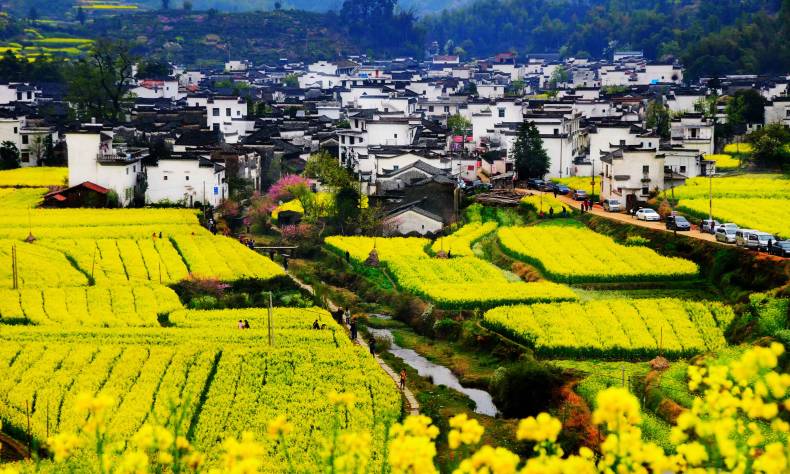
Developing Rural Areas By the Rural Vitalization Strategy
 Linkedin
 Google +
Why is “integration” better than “unified management”? What are the policies that find favor with farmers?
By Chen Ming
Why is “integration” better than “unified management”? What are the policies that find favor with farmers?
General Secretary Xi Jinping proposed a rural vitalization strategy in the report of the 19th?National Congress, saying that “issues relating to agriculture, rural areas, and rural people are fundamental to China as they directly concern our country’s stability and our people’s well-being. Addressing these issues should have a central place on the work agenda of the Party, and we must prioritize the development of agriculture and rural areas.” This is the first time that the Rural Vitalization Strategy has featured in a Central Committee document, and it is a vital strategy for the future development of China’s rural areas.
The strategy put more emphasis on the coordination between agriculture and the governance of rural areas, and on promoting integrated urban-rural development.
Compared with former strategies such as the Construction of New Socialist Countryside, the Construction of Beautiful Countryside, and Industry Nurturing Agriculture and Cities Supporting Countryside, the Rural Vitalization Strategy plans for greatly improved agricultural productivity and competitiveness. It is an essential to the modernization of agriculture and rural areas when the progress of industrialization and urbanization have reached a certain stage.
There are three major problems and challenges facing China’s rural development: first, the market still does not play a sufficient role in the allocation of production factors such as farmland; second, agriculture needs to be more competitive in terms of quality; third, the integration of urban-rural social governance has not yet been accomplished.
These problems undermine China’s rural development; they are also key points in applying the Rural Vitalization Strategy. The strategy aims at building three modern agriculture systems – industrial, production, and business operations – and improving measures like rural governance by advancing reform of the rural land system, so as to speed up the integration of urban-rural development and modernize agriculture and rural areas.
The rural areas slow development is a challenge facing many parts of the world. The rural vitalization strategy also represents China’s contribution to?the ideas and pathways for the effective and sustainable development in the rural areas of the world.
Integrated Urban-rural Development
The former strategy of promoting urban-rural development through unified management was open to misunderstanding. Some believed that the priority of the strategy was the urban development, and that we could drive the development of the countryside through the development of urban areas. Such a stubborn city-centric thinking is undoubtedly?erroneous which not only widened the “center-margins” gap between urban and rural areas, but also hampered urban-rural integration.
The report pointed out that “ we must prioritize the development of agriculture and rural areas. To build rural areas with thriving business, pleasant living environments, social etiquette and civility, effective governance, and prosperity, we need to put in place sound systems, mechanisms, and policies for promoting integrated urban-rural development, and speed up the modernization of agriculture and rural areas.”
How, then, should we understand concepts like integrated urban-rural development, urban-rural integration and the unified management of urban and rural areas?
Generally speaking, urban-rural integration is the final goal of the evolution of the urban-rural relationship. Unified management of urban and rural areas was the path to this goal. The integrated urban-rural development proposed in this report is intended to replace and upgrade the concept of unified management. Thus the final goal remains unchanged, but the means and the methods to achieve it are more integrated.
The new features of the integrated urban-rural development approach are as follows:
- First, it puts more emphasis on the equal position of urban and rural areas. It is not partial to either; urban and rural areas will coexist in a mutually beneficial relationship;
- Second, it puts more emphasis on the interaction of urban and rural factors. It is not a one way interaction, rather, it promotes free flows of market?resources and factors between urban and ? rural areas;
- Third, it put more emphasis on the physical integration of urban and rural areas. It does not involve to the urbanization of the countryside, or the ruralization of cities, but the creation of an integrated space with no obvious border line.
According to experience from other countries around the world, integrated urban-rural development usually requires the following conditions:
- First, a high level of industrialization and urbanization, with a shrinking impoverished population in rural areas, and the incomes of professional farmers reaching the middle income level of the cities;
- Second, highly developed agricultural productivity, and a much lower share of the output value of agriculture in total GDP;
- Third, a basic unified market in place, especially themarket?of factors,?the equal transaction of land in rural areas and in urban areas has been realized.
- Fourth, integrated urban-rural governance provides the fiscal support for full public services in urban and rural areas.
General Secretary Xi Jinping had already spoken about the idea of integrated urban-rural development some time ago. At a routine group study session among the members of the Political Bureau of CPC on April 30, 2015, he made a key statement about promoting integrated urban-rural development, highlighting that we should manage industry and agriculture, cities and countryside as a unified entity, and promote the integrated and common urban-rural development in areas like planning and layout, factor allocation, industrial development, public services and ecological protection.
Rural Land Contracts will be Extended for Another 30 Years
?“Rural land contracting practices will remain stable and unchanged on a long-term basis; current round of contracts will be extended for another 30 years upon expiration.”?This good news quickly spread among the public.
The CPC had stated that existing rural land contracting practices would remain stable and unchanged on a long-term basis at the Third Plenary Session of the 17th?National Congress, and restated it again at the Third Plenary Session of the 18th?National Congress.
However, the precise meaning of “a long-term basis” was not specified, which led to several questions: farmers were afraid that the policy might be changed later, which slowed the pace of scaled-up land use and the progress of related supporting reforms.
The precise duration was specified in the report this time as “the current round of contracts will be extended for another 30 years upon expiration”. This has given farmers much-needed reassurance. The statement will be vital to reforms such as enabling land ownership and contract rights to be used as security for mortgages, and standardizing the transfer process of land management rights.
However, a correct understanding of the statement is also needed. One key question is whether an adjustment to contracted land after the second round of land contracts expires is needed or not. If there is none, it will be unfair to farmers who gave up the chance to contract the land because of the agricultural tax at the beginning of the second round; but if there is, then the achievements attained in the implementation of the separation of the three rights – ownership, contracting and management – which came at great expense, will be lost, and the results of land policy reform achieved in these years will be put at risk.
To remedy this problem, our suggestion is that a round of contracting land adjustment should be allowed before the confirmation of the three rights, so that the “initial equal right” to contract lands can be ensured. By doing so, there will be no need to adjust the land when the second round of land contracts expires.
On this basis, if the confirmation work is carried out in the next two years, then the duration from now to the expiration of the second round contract will be almost ten years, and adding “another 30 years”, there will be stable and clear conditions for China’s farmland property rights for at least a 40-year horizon. This will certainly create beneficial conditions for the development of China’s agriculture and the implementation of China’s overall strategy.
By Chen Ming, research fellow of Institute of Sociology, Chinese academy of Social Sciences