Infinity and Beyond
 Linkedin
 Google +
The past five years have seen China step further into the mysteries of the sky and the sea. Micius and the Monkey King, a Dragon and a Heavenly Palace—this legendary sounding group somewhat surprisingly has nothing to do with Chinese history or mythology, but everything to do with science.
By Yuan Yuan
Micius and the Monkey King, a Dragon and a Heavenly Palace—this legendary sounding group somewhat surprisingly has nothing to do with Chinese history or mythology, but everything to do with science. With more than 170 satellites orbiting in space and a submersible in the farthest depths of the ocean, scientists are asking questions of the sky and the sea, and from their replies they are unveiling the mystery of these unfamiliar worlds.
Arcane particles
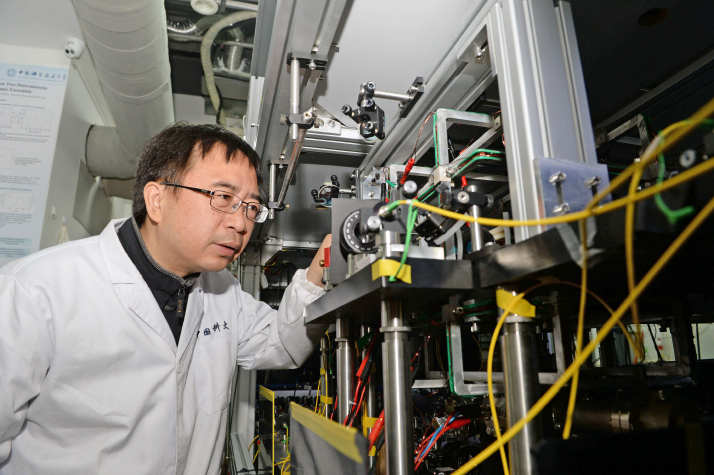
Pan Jianwei has become a renowned figure over the past two years for his labors in quantum communication, a field that sounds as if it were straight from the pages of science fiction.
The academician of the Chinese Academy of Sciences (CAS) and professor at the University of Science and Technology of China is the architect behind the world’s first ever attempt to send a quantum communication satellite—Quantum Experiments at Space Scale (QUESS)—into space, which could transform the way in which we transmit information in the future.
Albert Einstein had a profound effect on Pan during his early years studying of physics, “but my study has gradually proved that most of Einstein’s quantum theories are wrong,” he said.
One of the great mysteries of science, the quantum world is beyond layman’s description for many physicists. “What is the quantum world like? It is something we use every day and yet we cannot feel its existence,” Lu Zhaoyang, a member of Pan’s team, said. “If you could shrink down to the height of one 10,000th a hair’s diameter, you would see a world beyond your imagination.”
Erwin Schr?dinger, the Nobel Prize-winning Austrian physicist who developed a number of fundamental results in the field of quantum theory, proposed in 1935 his famous thought experiment which used the example of a cat simultaneously both alive and dead to explain the concept of a quantum superposition.
“In our present world, a person can only be here or there,” Pan said, “but in the quantum world, a person can be both here and there. This is what we call entanglement.”
Such an explanation only serves to make quantum mechanics more incomprehensible to the uninitiated. Yet China has taken the lead in turning this knowledge into practical use, launching a satellite for quantum communication in August 2016.
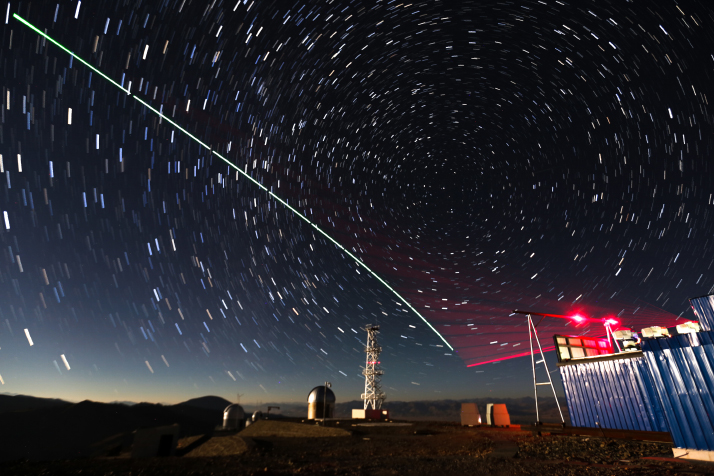
The QUESS satellite is named for Micius, a 5th-century B.C. Chinese philosopher, in homage to his seminal early writings on the theory of optics. Five ground stations have been built across China to cooperate with the Micius satellite, which orbits the Earth at an altitude of 500 km.
Pan’s team has worked on this project for more than 10 years. Unlike conventional means of transmitting information that rely on optical fibers, the quantum transmission of information is new, fast and impossible to intercept. “Quantum information can be transmitted from one particle to another in a distant location without actually sending the original particles themselves,” Pan said in a speech delivered at the Hong Kong University of Science and Technology (HKUST) in September 2016.
Along with the information, it sends the key to encode and decode the message. Only the sender and receiver can access the key and any outside attempt to view the content of the communication will be flagged by the system. When this happens, a new key will be sent out to replace the original until the receiver gains access securely. According to Pan, this will be the most secure means of transmitting information as it eliminates the possibility of messages being heard by eavesdroppers.
This form of communication was previously limited to a distance of just few hundred kilometers due to the loss of signal within optical fibers or interference from terrestrial free space. The launch of the satellite has made long-distance quantum communication possible by beaming the entangled photons between space and various ground stations on Earth.
In August 2017, the satellite used quantum cryptography to send data to Earth. On September 29, it was used to facilitate the world’s first ever quantum video call between the CAS in Beijing and the Austrian Academy of Sciences in Vienna, locations 7,600 km apart.
The video call, lasting 75 minutes, was described by the journal Physical Review Letters on January 19 as “laying a foundation for building a global quantum-secured communication network.”
Pan revealed that they plan to launch higher-orbit satellites in the future in order to increase coverage for a more efficient quantum network.
“These results represent an important breakthrough in the quest for quantum communications over long distances” the academic journal Nature commented. “This goal is very challenging and new, and it represents a significant advancement of the realization of quantum communication schemes.”
Pan, who has been called the “Father of Quantum in China” was included in the 2017 Nature‘s 10—the journal’s annual list of 10 people who matter in science each year—and was awarded the 2018 Willis E. Lamb Award for Laser Physics and Quantum Optics on January 11.
In his speech delivered at the HKUST, Pan referred to his favorite childhood book Journey to the West, a legendary novel and one of the Four Classics of Chinese literature. The Monkey King, or Sun Wukong, the hero of the novel, awed Pan with his supernatural powers of body duplication and teleportation.
“The development of science and technology will prove that such powers will one day be real,” Pan said.
Scanning the cosmos
Like Micius, Sun Wukong is another figure of Chinese lore who finds himself in space. He is there for another of his magical abilities, the superhuman vision that can see through everything and perceive disguised evil.
Prior to the launch of Micius, Wukong, a Dark Matter Particle Explorer (DAMPE) satellite named after the Monkey King, was sent into the space, to detect dark matter, the invisible “ghost” of space.
Dark matter, a term coined by French mathematician Henri Poincaré in 1906, refers to matter in the universe that is invisible but that can be perceived through its gravitational effect on other objects. The elusive substance is believed to make up 85 percent of all mass in the universe and 27 percent of everything in it including matter and energy, while the normal matter that makes up stars and galaxies accounts for just 5 percent of this grand total.
However for now, these are only theoretical projections, for this mysterious matter has so far never been observed.
“Unlike quantum mechanics, which we are on the brink of harnessing, dark matter remains a mystery to human beings,” said Chang Jin, the leading scientist of the DAMPE team. “This is where Wukongcomes in.”
In space Wukong‘s eyes are four major detectors comprising of 76,000 minor detectors, each with an extremely high level of accuracy.
Designed in the shape of a 1-cubic-meter box weighing 1.9 metric tons, Wukong is expected to be in service for three years, relaying around 20 GB of data to Earth every day, which is then analyzed by a special computer. The theory behind the mission is that dark matter, should it be made of particles, will occasionally annihilate and decay, with both processes giving off perceivable energy.
The DAMPE team, made up of more than 100 researchers from China, Switzerland and Italy, published their first results in Nature on November 29, 2017, explaining that the data may cast light on “the annihilation or decay of particle dark matter.”
“Proving the existence of dark matter takes a lot of time. Now we have worked out the most precise spectrum, but we are not 100 percent sure that this can lead us to the location of dark matter,” Chang said.
“If we can confirm it is dark matter after collecting more data, it will be very significant,” Bai Chunli, President of the CAS, said at a briefing in Beijing on November 30, 2017. “If not, it is even more significant because they could be new particles that no one has predicted before.”
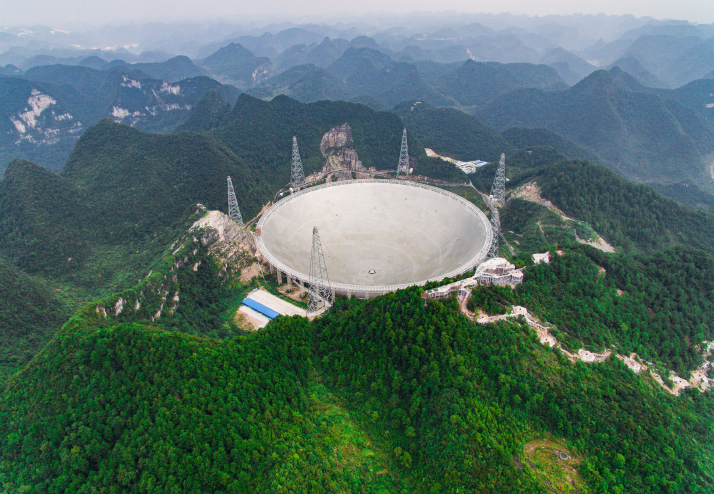
Wukong is not alone in detecting dark matter. FAST (Five-hundred-meter Aperture Spherical Radio Telescope), known as Tianyan, is a telescope rooted on the Earth that has been staring the universe square in the face without reprieve since September 2016.
Located in a deep and remote karst depression in southwest China’s Guizhou Province, it is the world’s largest radio telescope and can see up to 10 billion light years away.
With a diameter of 500 meters, it has an area equivalent to 30 football pitches, scanning the universe in search of pulsars, phenomena that can be used to confirm the existence of gravitational radiation and black holes as well as help solve other major questions in physics.
As of December 12, 2017, the National Astronomical Observatories of China (NAOC) announced that FAST, which is still in its trial operation period, has identified a total of nine pulsars so far.
Li Di, chief scientist of the NAOC Radio Astronomy Division, predicted that when FAST starts formal operations in 2019, it will discover more than 100 pulsars each year.
Fourteen days before FAST began operation, Tiangong-2, or Heavenly Palace-2, the first domestically developed space laboratory was sent into orbit in a momentous step toward China’s aim of building a permanent manned space station by 2022.
Taikonauts Jing Haipeng and Chen Dong spent a total of 33 days aboard the space lab in the longest-ever Chinese manned space mission.
The mission transported personnel and materials between Earth and Tiangong-2, as well as conducting aerospace medical experiments, space science investigations and in-orbit maintenance.
Recently there have been other new arrivals to the growing cohort of Chinese objects in space. On January 12, China launched twin satellites aboard a single carrier rocket, as part of efforts to enable its BeiDou navigation and positioning system, named after the Chinese term for the Big Dipper constellation, to provide services to countries along the Belt and Road routes by the end of 2018.
Initiated in 1994 by the China National Space Administration, the first BeiDou satellite was launched in 2000. In the past two decades, the system has constantly upgraded its technology making China the third country after the United States and Russia to have its own satellite navigation system.
Now the location services provided by BeiDou are serving more than 200 countries and regions worldwide, according to an announcement by China North Industries Group Corp. Ltd. (NORINCO) on February 8. The launch of more satellites is set to follow throughout the year.
A research report released in 2016 composed by a group of scientists from the CAS estimates that the government will invest no less than 5.9 billion yuan ($910 million) in space science research during the period of the 13th Five-Year Plan (2016-20).
“This funding means we are likely to launch 15 to 20 scientific satellites, if not more, by 2030,” said Wu Ji, Director of the National Space Science Center.
Down to earth
If space seems out of reach to most ordinary people, then a large passenger airliner commuting back and forth across the skies marks a return to the realms of accessibility.
In May 2017, the C919, China’s first homegrown narrow-body twinjet airliner embarked on its maiden flight from Shanghai to the Yanliang testing base in Xi’an, northwest China’s Shaanxi Province, covering a distance of 1,300 km.
Comparable in size to the updated Airbus 320 and Boeing’s new-generation 737, the C919 combines a state-of-the-art design and engine with cutting-edge entertainment and technology.
As a country whose aerial capacity has hitherto been limited to military aircraft and small-scale commercial jets, the successful test flight of a large passenger aircraft marks a significant breakthrough.
“For China’s high-end manufacturing, the development of a large airplane serves as a key index to assess the country’s industrial and technical manufacturing capacity,” said Lin Zhijie, an aviation industry analyst and columnist at Carnoc.com, China’s leading civil aviation Web portal. “The successful flight of a large passenger aircraft indicates that we will be able to make more significant breakthroughs.”
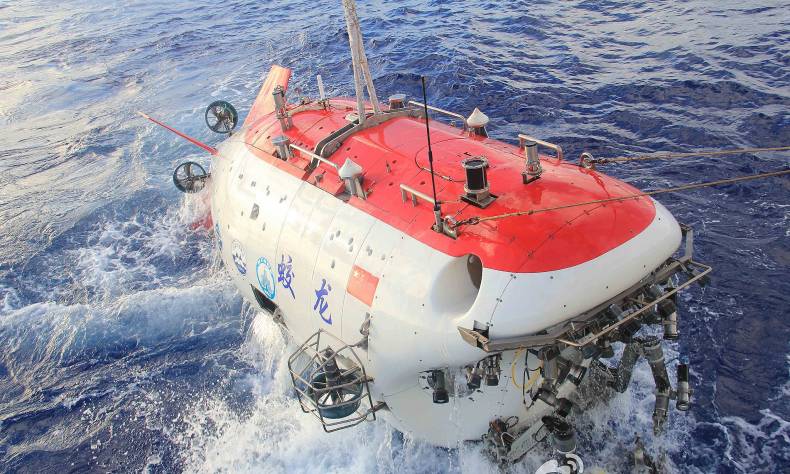
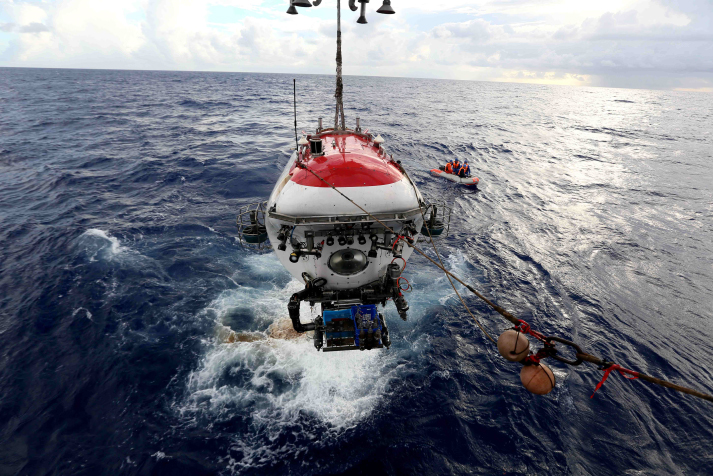
The deep sea is another frontier at which Chinese scientists have been busy. Jiaolong, a submersible named after a mythical aquatic dragon of Chinese mythology, dived to a record-setting distance of 7,062 meters in the Mariana Trench in June 2012.
Since then, Jiaolong has made various successful dives, returning samples of seawater, rock and marine life, helping scientists to understand the origins of life on Earth.
Liu Feng, Secretary General of the China Ocean Mineral Resources R&D Association (COMRA), revealed plans to develop two deep-sea manned submersibles capable of reaching a depth of 11 km by 2020.
A branch of the Qingdao-based National Deep Sea Center will be built in south China’s Hainan Province as a collection center for oceanic samples and a base for the monitoring of the deep ocean.
“China also plans to develop four other hi-tech devices for deep-sea exploration to promote sustainable oceanic development,” Liu said.
The advances that China has made in science and technology are the results of the country’s efforts in recent years to boost capacity in homegrown innovation.
“Innovation is the primary driving force behind development; it is the strategic underpinning for building a modernized economy,” Chinese President Xi Jinping said while delivering a report at the 19th National Congress of the Communist Party of China last October, adding that China will improve the national innovation system and boost the scientific and technological strength to build “a digital China and a smart society.”
Copyedited by Laurence Coulton
Source: Beijing Review
The article reflects the author’s opinion, and not necessarily the view of China Focus