Intensive Efforts to Address Climate Change
 Facebook
 Twitter
 Linkedin
 Google +
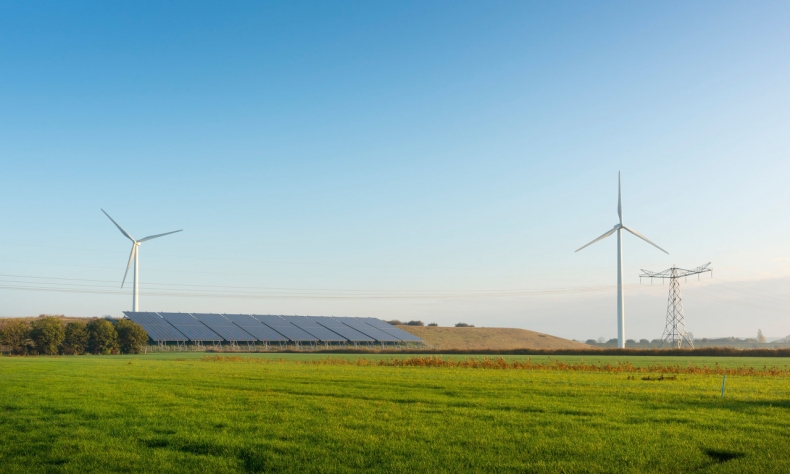
Joint efforts to address climate change will help open new windows for win-win ecological cooperation based on mutual trust, effective coordination, shared results and participation by all.
In his statement at the General Debate of the 75th Session of the UN General Assembly in September 2020, President Xi Jinping reiterated China’s determination to have carbon dioxide emissions peak before 2030, and for the first time announced the goal to achieve carbon neutrality before 2060. Since then, China has elevated its efforts to tackle climate change to a new level. The two goals have also become a core around which the country’s economic and social development unfolds.
On March 15, a meeting of the Central Committee for Financial and Economic Affairs underlined the importance of the two goals to the sustainable development of the Chinese nation and to China’s global vision of a community with a shared future for humanity.
For this purpose, China has adopted an array of measures.
The first is policy support for green development. The Outline of the 14th Five-Year Plan (2021-25) for National Economic and Social Development and the Long-Range Objectives Through the Year 2035 has laid out plans for peaking carbon emissions and becoming carbon neutral, in an effort to speed up climate-friendly transition of social and economic development activities. China is pushing forward a low-carbon energy revolution, the creation of green and low-carbon industrial systems and also low-carbon urbanization. It is also investing heavily in renewable energy, new energy, and sustainable infrastructure, in a bid to accelerate the building of a fossil-free circular economic development system.
The second is to promote green development through green finance. Banks are restricted from lending to big carbon emitters while being urged to boost financial support for low-carbon sectors. Fiscal and other policies have been made to facilitate the development of carbon taxation and trading regimes.
The third is to enhance scientific and technological innovation. While pressing ahead with the low-carbon renovation of industrial projects, China is also developing the digital economy, intelligence economy, renewable economy and new energy through the implementation of state-of-the-art technologies.
The fourth is to expand international cooperation. This includes China’s participation in international activities related to climate change, the formulation of international standards and the building of a green silk road under the framework of the Belt and Road Initiative.
The ongoing green and low-carbon transition in China is unprecedented in human history and will require China to do more than what has previously been done by developed countries. Here are Q&As that may help our readers better understand what is happening:
Question: There are arguments that since China is a major greenhouse gas emitter and also the second largest economy in the world, the principle of common but differentiated responsibilities is thus unfit for China. Why are they unjustified?
Answer: To reach international consensus, it’s important to identify the cause of climate change and the nature of this problem. Both historically and currently, greenhouse gas emissions mostly stem from the developed economies. Once released, the major factor, carbon dioxide, may still remain in the atmosphere after up to 200 years. In this sense, the developed countries have larger responsibility for the historical emissions.
It has been only a few decades since China began its process of industrialization, a much shorter time span than that in developed countries. Meanwhile, the per-capita carbon dioxide emission in China is also much lower than their levels. China is not the one that should take the main accountability for global climate change. It is not obligated to pay the price for a problem that was caused by other countries during their individual industrialization processes.
Global warming is an accumulated problem over decades, centuries even. So when discussing the issue of carbon dioxide emissions, people should look at not only the aggregate but also the per-capita figures, not only the current but also the historical amounts, not only production but also consumption. Thus, sticking to the principle of common but differentiated responsibilities is a basic precondition for global efforts to address climate change. It is a fairer and more practical principle, one acceptable to the vast majority of developing countries.
Is it possible for China to hit the goal of peaking carbon dioxide emissions and reaching carbon neutrality as scheduled?
China is already economically and technologically prepared and capable of hitting the goal of peaking carbon emissions before 2030. By the end of 2019, China’s carbon intensity, or carbon emissions per unit of GDP, had been slashed by 48.1 percent compared to 2005. Non-fossil energy accounts for 15.3 percent of current energy consumption. During the 14th Five-Year Plan period, China will accelerate its transition to green development. Energy consumption and carbon emissions per unit of GDP are set to drop by 13.5 percent and 18 percent, respectively.
If these goals are achieved as scheduled, we can move up the peak of carbon dioxide emissions, thus laying the foundation for carbon neutrality. The process of achieving the carbon peaking and neutrality goals is not only a far-reaching energy, technological and industrial revolution, but also a tough process of restricting carbon output.
Will the decarbonization process slow down China’s economic growth?
The goals of maintaining the pace of China’s economic growth and achieving carbon neutrality are not contradictory to one another. China’s new vision for development underlines the importance of green and low-carbon industries, such as the digital economy and new energy, which also create new economic growth points.
China is building a fossil-free circular economic development system, as well as a clean, low-carbon, efficient and safe energy production and consumption system. As the only major economy to realize positive economic growth in 2020, China has a clear sense of responsibility to lead the world economy toward green recovery.
How has China’s carbon trading market developed?
Carbon trading is a widely recognized method of cutting greenhouse gas emissions. China launched a pilot program in seven provinces and cities, including Beijing, Shanghai and Guangdong Province in 2011. Its first carbon exchange was established in Shenzhen, Guangdong, in 2013. By the end of 2020, eight carbon exchanges had been set up around the country. On February 1, a set of interim rules for carbon emissions trading management became effective.
By December 31, 2,225 power plants around China will be included in the national carbon emissions trading scheme. On this basis, more industries such as petrochemical, construction materials, steel, non-ferrous metals and aviation will join in a phased manner.
What are China’s stands on international cooperation in terms of carbon peaking and neutrality?
To tackle global climate change, China is cooperating with the international community in the fields of green finance, carbon trading, carbon reduction, capture and removal technologies, as well as new and renewable energy.
Joint efforts to address climate change will help open new windows for win-win ecological cooperation based on mutual trust, effective coordination, shared results and participation by all.