Manila Bolstering U.S. Pivot to Asia-Pacific Will Make More Troubles in South China Sea
 Facebook
 Twitter
 Linkedin
 Google +
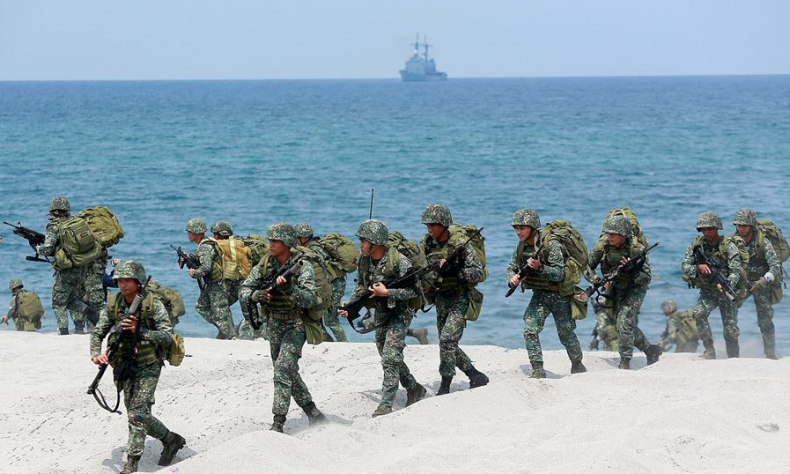
There is no question that the U.S. is promoting tensions in the South China Sea region.
The United States, Japan, Australia and the Philippines have?conducted a joint military exercise in South China Sea last week, which is another worrying?sign that Manila is shifting from the friendly policy toward China to following the U.S. Asia-Pacific strategy against China.
Near four decades?after Washington deposed Philippine President Fernando Marcos, his son “Bongbong”, the current president, succumbs to U.S. influence. While the father adopted an independent policy, the son embraces United States expansion in the Asia-Pacific and pushes controversial territorial claims.
Bogged down in the Iraq (2003-2011) and Afghan (2001-2021) wars, U.S. foreign policy elites in 2005 reached a consensus on updating Cold War strategy. China was rising and Russia was returning, so a revised approach to the “containment” of the Eurasian landmass was adopted.
Thus, when Barack Obama became president, the so-called “Pivot” policy, later called “Rebalancing”, was implemented. The policy called for a renewed emphasis on the Asia-Pacific and deploying some 60 percent of U.S. military assets to the region. The Trump administration continued the policy and so has the Biden administration.
The “rebalancing” included a geopolitical concept, the “Quad”. The U.S., Japan, Australia, and India were?members of the Quad. Former Japanese Prime Minister Shinzo Abe called it the “diamond” strategy. During the Trump Administration, the U.S. Pacific Command (PACOM) was renamed the “Indo-Pacific Command”?and Biden administration announced Indo-Pacific Strategy in February 2022.
The U.S. had formal defense treaties with Japan and Australia and sought closer defense relations with India. New Delhi, however, preferred a more independent stance and did not want to harm its traditional relations with Russia nor did it want unduly to impair relations with China.
Given this situation, Washington now has taken a different approach. Instead of the Quad as the main geopolitical strategy, now under Biden it is the Australia-UK-U.S. (AUKUS) grouping at the core. This core is now in the process of being enhanced by a special U.S.-Japan- South Korea grouping. But in addition to this the Philippines is slated to play a key role given its significant geographic position.
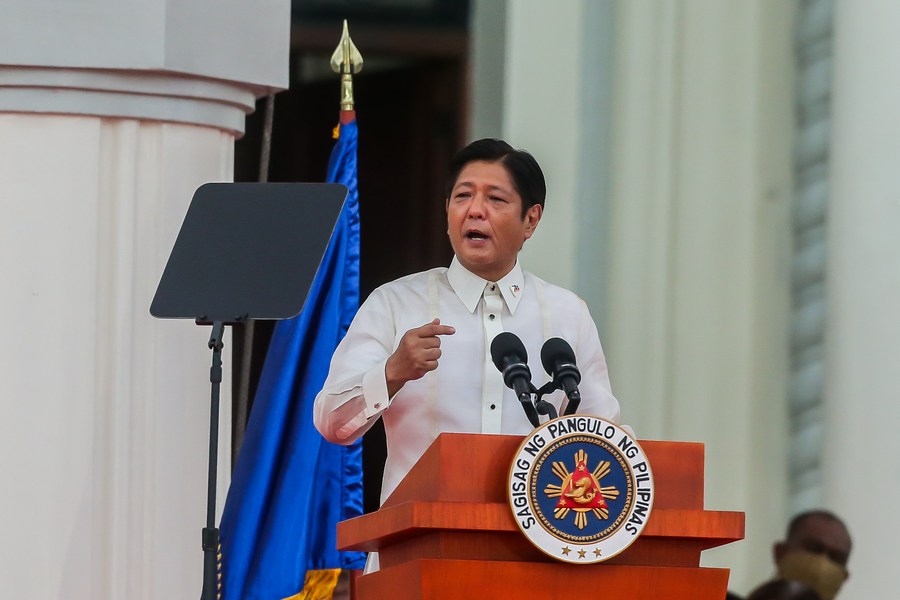
Manila welcomes more U.S. military presence
Around four?decades ago, under then President Ferdinand Marcos, military relations with the U.S. were restricted. Marcos, as noted, had an independent streak and he forced the closing of U.S. military bases and withdrawal of U.S. military personnel.
In recent years, however, Washington has been able to work its way back into the Philippines. The pretext for this is the so-called “China threat”. Nowadays, conflict over?China’s Taiwan Island is highlighted and the proximity of the Philippines to Taiwan is emphasized.
In February 2023, a new agreement was reached allowing the expansion of U.S. military presence in the Philippines. Four new sites for military facilities were added to five earlier sites. The “facilities” are not called “bases” which would imply a permanent presence.
The U.S. will station military equipment and build “facilities” in nine locations. There are five existing sites to which the U.S. has access. These are: Cesar Basa Ar Base and Fort Magsaysay near Manila; Mactan-Benito Ebuen Airbase in Cebu province; Antonio Bautista Air Base in Palawan and the Lumbia Air Base.
Four new sites were announced in April. They are: Camilo Osias Navy Base and Lai-lo airport both in Cagayan province; Camp Melchor Dela Cruz in Isabela province; and the island of Balabac off Palawan.
These locations are especially strategic as Cagayan and Isabela provinces face north towards Taiwan Island. Palawan is near the contested Nansha (Spratley) Islands in the South China Sea.
Philippines caught in U.S. neocolonial policy
As a result of Washington’s new found imperialism in the war against Spain, the Philippines became a U.S. colony from 1898 to 1945. Washington’s policy of imperialism and neo-colonialism had strong opposition at home but it was not sufficient to overcome the war lobby. It is interesting to note that the Democratic Party in its 1900 presidential election platform denounced imperialism. Not so today.
Today, while the trend of the times is toward peace and development, the U.S. and its NATO partners seek to maintain a hegemonic position worldwide. The containment and suppression of China and Russia are the main Western geopolitical objectives.
But the international constellation of forces is changing and a new multipolar international environment is rapidly emerging. The recent expansion of BRICS to eleven members is a case in point. Next year, the organization is expected to make significant new additions to its membership.
It is difficult to understand Manila’s seeming lack of prudence in its new embrace with Washington. It is no secret that the U.S. is increasing its Asia-Pacific presence and activity. Such provocative policy raises tensions in the region and undermines stability. Given its present foreign policy, Manila cannot avoid being drawn into any U.S.-NATO conflict against China.
One might not have expected such behavior on the part of the Philippines particularly under the rule of Marcos. Oddly, Bonbong Marcos appears to have forgiven Washington for deposing his father and for sending his parents to exile in Hawaii.
The story goes that when there were large anti-Marcos disturbances in the streets in Manila, the U.S. offered to evacuate President Marcos and his wife to safety. The U.S. told them that they would be flown north to Luzon for safety. President Marcos accepted the offer but the couple was deceived and, in effect, kidnapped. At the end of their suspiciously long flight in an aircraft with armed personnel and blacked out windows they found themselves landing in Hawaii.
Opposition forces in the Philippines are critical to?the strong tilt to the Washington. These are patriotic elements who oppose neocolonialism but they have been insufficient to dissuade the President from this tilt policy.

Washington fuels tensions over Nansha Islands issue
There is no question that the U.S. is promoting tensions in the South China Sea region. Pouring weapons into?China’s?Taiwan Island is one example and a war could be sparked as a result. Building up a military presence in Australia to include nuclear weapons capable submarines is another example.
But the Nansha Islands are a bone of contention. The islands may contain major oil and natural gas reserves and are well known for their abundant fisheries. According to a Chinese study in the 1980s, the islands consist of: 14 islands or islets, 6 banks, 113 submerged reefs, 35 underwater banks, and 21 underwater shoals. These small islands and reefs are claimed by: China, Vietnam, Malaysia, Brunei, and the Philippines.
Manila asserted claims only in 1968 and 1970 and stationed troops on three islands. A major discovery of oil in 1976 off the coast of Palawan which is near the Nansha Islands heightened Manila interest. Since then, these discoveries came into production which is significant to the Philippines economy.
It is said that old U.S. naval charts of the Philippines when it was a U.S. colony do not show that the Nansha Islands were part of Philippine territory. Apparently, the Philippines made no claims to the islands from before 1968.
At the end of World War II, China recovered sovereignty over the Nansha Islands from Japan and announced that. When the KMT regime was defeated in China’s civil war and retreated from the mainland to Taiwan province in 1949, its leadership continued the claim of the Nansha Islands. The leadership of the Peoples Republic of China since?1949, for its part, continued the claim.
Sorting all this out is not a simple matter but it should be done peacefully through patient diplomacy. There is no reason to believe?that Beijing and Manila could not work out a mutually beneficial diplomatic solution?over time. Actually, China and other countries to the disputes keep dialogue over the disputed islands. As early as in 2002, China and all ASEAN (the Association of Southeast Asian Nations) countries signed the Declaration on the Conduct of Parties in the South China Sea (DOC). Since then, China and ASEAN have been negotiating the Code of Conduct in the South China Sea (COC)?to solve the territorial disputes peacefully.
The problem, however, lies in Washington. By fueling tensions in the South China Sea, the United States interferes with regional diplomacy. Washington must drop its cynical policy of promoting tension and destabilizing the South China Sea region.
The article reflects the author’s opinions, and not necessarily the views of China Focus.