Merkel’s Diplomatic Legacy
 Facebook
 Twitter
 Linkedin
 Google +
For five consecutive years, from 2016 to 2020, China was Germany’s largest trading partner. And even the pandemic could not interrupt the deepening of economic partnership.
In October 2018, German Chancellor Angela Merkel already announced that she would not participate in the elections taking place this year in September and would step down at the end of her fourth term.
As her 16-year-long leadership tackled the promotion of gender equality, the curbing of climate change, and several Donald Trump-induced tribulations, Germany’s forthcoming post-Merkel era raises much discussion among politicians and academics alike. What will be her legacy?
Rising global role
Germany has gradually grown into a major player in multilateralism and global governance during Merkel’s chancellorship.
The culture of restraint, a preference for multilateral solutions, dialogue and a rejection of military force as the ultima ratio, or last resort, had strongly featured in Germany’s diplomacy since the end of World War II.
The turning point emerged in February 2014 when decision-makers proclaimed the Munich Consensus. In this document, Joachim Gauck, then German President, then Foreign Minister Frank-Walter Steinmeier, and then Defense Minister Ursula von der Leyen announced that the country was ready to assume more responsibility in international security affairs. The country then gained increasing recognition in the international arena as being more proactive.
Though Germany did not succeed in facilitating the process of making itself a permanent member of the UN Security Council (UNSC), it did achieve a lot in terms of multilateral diplomacy. The Paris Agreement, the Iran nuclear deal, as well as the Minsk Agreement between Russia, Germany, France and Ukraine to cope with the Ukraine crisis in 2015, all were Germany’s contributions under Merkel’s headship.
Against the backdrop of both the Brexit and former U.S. President Trump’s reluctance in dealing with international affairs, Germany further became a forerunner among Western countries in participating in global governance. While holding the rotating presidency of the Group of 20 (G20) and being a non-permanent member of the UNSC, it played a leading part in shaping international agendas.
Synergizing its own core interests with global governance, Germany has been advancing cooperation on issues concerning Africa, immigration, gender equality and climate change. It has sought to spearhead international efforts to promote multilateralism. During this process, the role taken on by Merkel, once viewed by Western media outlets as “the last defender of liberal and democratic values,” should not be underestimated.
Practicing multilateralism is a major concern of Germany and the EU at large, as well as a common value they share. Following the spread of COVID-19, global governance has been impeded while the intensifying major-country competition further put the core concept of multilateralism at stake. Germany must, coming in either from its own interests or from the global perspective, work to bridge disputes, rather than take sides.
Adapting to global changes
For Germany, one standout certainty seems to be the consideration of itself as sharing a common destiny with the EU, subsequently adapting to global changes based on its European policy. The logo of Germany’s presidency of the Council of the EU between July and December 2020 was a M?bius strip, a loop with only one side and one boundary curve. Its shape symbolizes unity and connectedness in Europe, despite differing interests and a high level of diversity.
Under Merkel, Germany’s role in the EU gradually has risen above that of the reluctant hegemon, one whose economic leadership was recognized but politically contested. Since the onset of the eurozone sovereign debt crisis in 2008, the so-called “Franco-German engine” propelling forward integration stalled with France struggling to make its own ends meet. Germany, on the contrary, expanded its influence in economic affairs in the EU and began to manifest itself in political ones, becoming an actual leader of the bloc.
The 2007 Treaty of Lisbon, an international agreement that amends the two treaties which make up the constitutional basis of the EU, was promoted by Merkel to reform the running of the then 27-member bloc and injected new impetus to its integration.
On the other hand, as Germany and the EU had been focusing solely on managing emergencies such as the Ukraine crisis and challenges in absorbing millions of Middle East refugees, they neglected their long-term planning, posing uncertainties to the European integration process. Moreover, Germany’s firm actions in coping with crises had other members worried.
With a looming Brexit dampening the process, Merkel remained overcautious in responding to the reform plans proposed by French President Emmanuel Macron. The tense transatlantic relations during Trump’s administration, too, had weakened one of the pillars of diplomatic security of Germany and the EU. Multiple challenges, including a widening internal divergence on policy issues and a lack of competence to deal with major external crises saw Merkel, her country and the EU perplexed.
Despite the imperfections of the EU’s internal governance getting exposed as it struggled to cope with COVID-19, new opportunities for the promotion of integration were also showing. The approval of the Recovery and Resilience Facility (2021-26), a 750 billion-euro ($890-billion) COVID-19 response plan, marked a new milestone. Germany compromised on some clauses during the negotiations to facilitate its adoption.
Against the backdrop of increasing competition between China and the U.S., Germany—the EU, even—has refrained from picking sides. Though there are different interpretations of the EU’s pursuit of strategic autonomy, tackling global change with the power of EU integration remains the broadest common ground for cooperation within the bloc.
Major-country diplomacy
Handling relations with major countries is essential in Germany’s foreign policy.
Germany-U.S. relations have seen the best of times, and the worst of times. Huge common interests existed in diplomacy, security and trade between both countries with close people-to-people exchanges consolidating bilateral ties. However, after Trump came into power, he riled up disputes, even putting out explicit contradictions. Merkel in retort gave a speech saying “we Europeans must really take our destiny into our own hands” in May 2017.
After President Joe Biden came into office this year, the two sides witnessed a warming of ties. However, both parties still have their disagreements in several aspects, including the Nord Stream 2 pipeline project that is designed to transport natural gas from Russia to Germany through the Baltic Sea. Only a future-oriented attitude can now reshape Germany-U.S. relations and strike a new balance built on consensus.
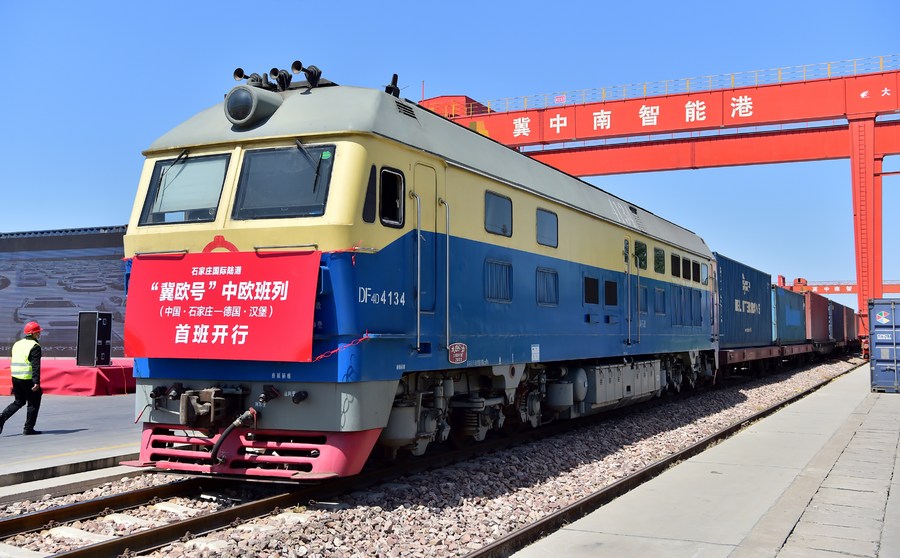
China-Germany relations have been on the constant up and “have seen their best times ever in history,” Shi Mingde, former Chinese Ambassador to Germany, said in 2017. For five consecutive years, from 2016 to 2020, China was Germany’s largest trading partner. And even the pandemic could not interrupt the deepening of economic partnership.
In 2014, the two countries issued a joint program of action on cooperation, with the theme of shaping innovation together. This proved a master plan on mid- to long-term innovation cooperation and a sure sign of forward-looking relations.
Merkel is arguably one of the Western leaders who understand China best, as she has visited China no fewer than 12 times. When the China-EU relationship faced uncertainty, Merkel helped sustain healthy and stable ties with a positive attitude. Since the COVID-19 pandemic arose, she and Chinese leaders have continued their communication on various occasions via video link, which also reflects the resilience and potential of these bilateral ties.
Her hallmark style of solving problems through middle-way solutions has been the No.1 feature in Merkel’s policymaking. This might be her most valuable legacy passed onto her successors, as well as the road Germany and Europe at large must travel amid today’s global change.
The author is a researcher with the China Institute of International Studies.










