Open Cooperation, Opposing Space Hegemony
 Facebook
 Twitter
 Linkedin
 Google +
Space should be a shared treasure for all humanity, never a stage for geopolitical competition.
For millennia, the starry night sky has inspired a shared human desire to explore outer space. Today, activities in space such as satellite navigation, deep-space exploration and manned spaceflight are becoming increasingly frequent and widespread. The peaceful use of outer space is crucial to shaping a new pattern of development and a new security architecture.
Upholding open cooperation and firmly opposing space hegemony is not only a basic position of the Chinese Government in fulfilling its international moral obligations but also reflects the shared interests of countries working together to realize the dream of space exploration. This stance is vital for the sustainable development of future space endeavors.
Cooperation or zero-sum game?
As the global space landscape evolves, open cooperation and zero-sum competition are often seen as two divergent paths. Some major space powers, leveraging their dominance in launch technology, satellite manufacturing and in-orbit operations, have imposed strict export controls and technology-sharing restrictions, so as to lock advanced space technologies within a small circle of allies and thereby establish a de facto “space hegemony.”
For example, the U.S. Arms Export Control Act (AECA) of 1976 and the International Traffic in Arms Regulations (ITAR) imposed strict controls on the export of space-related products and technologies to prevent sensitive space technologies from reaching “competitors” of the U.S. In February 2024, the U.S. Space Command released its updated strategic vision, continuing its longstanding stance by listing the maintenance of U.S. dominance in space as a key objective. Such unilateral technological blockades intensify friction within the international community and create barriers for emerging space nations, forcing them to concede or compromise.
However, the nature of space activities requires a high degree of system integration and collaboration. Orbital resources are limited, and the accumulation of space debris in low-Earth orbit is becoming an increasingly serious issue—no single country or alliance can manage these challenges alone.
As stated in Article I of the Outer Space Treaty of 1967, “The exploration and use of outer space, including the moon and other celestial bodies, shall be carried out for the benefit and in the interests of all countries, irrespective of their degree of economic or scientific development, and shall be the province of all mankind.”
There is no end to space exploration. China is willing to work with all countries to strengthen exchange and cooperation to jointly explore the mysteries of the universe, make peaceful use of outer space, and promote space technology to better benefit people around the world, Chinese President Xi Jinping said in a congratulatory letter to the United Nations/China Global Partnership Workshop on Space Exploration and Innovation, held in Haikou, Hainan Province, in November 2022.
Guided by such an open cooperation philosophy, China has signed over 100 intergovernmental space cooperation agreements with more than 50 countries and international organizations, promoting the sustainable and secure use of space resources.
Since its reform and opening up began in 1978, China has consistently advocated for the peaceful use of outer space to benefit humanity. In major projects such as the BeiDou Navigation Satellite System (the Chinese GPS equivalent), the Tiangong space station, and lunar and Mars explorations, China has opened its doors to the international community.

It has signed data and technology cooperation agreements with multiple countries and reached consensus on interconnectivity between the world’s four major satellite navigation systems BeiDou, GPS, Galileo and GLONASS, providing global users with multi-frequency signal services. Tiangong, the first space station in history to be open to all UN member states, has already selected nine scientific experiments from 17 countries and 23 entities for research purposes to be carried out on board.
In 2022, China released interim measures for the administration of international cooperation in civil satellite remote sensing data. The document sets out the principles of equality and mutual benefit, peaceful use and inclusive development, providing a legal and operational framework for international exchange, sharing and services of civil satellite remote sensing data.
With the international consensus on open cooperation growing, the notion of space hegemony is finding little room to thrive. But the U.S. has continued its attempt to undermine trust by distorting and stigmatizing China’s space activities. A recent U.S. State Department memo urged its allies to ban operations by Chinese satellite companies, claiming these activities could help China gather sensitive intelligence. In reality, such baseless suspicions can never diminish China’s sincere engagement with the international community.
Only through cooperation based on equality, fairness and mutual trust can international space partnerships truly mobilize global resources. This will enable the expected synergistic effects across technology research and development (R&D), funding, talent cultivation and industrial coordination, injecting sustainable momentum into the space endeavors around the world.
Satellite R&D and applications
The satellite industry chain spans the entire lifecycle—from design and manufacturing to launch, in-orbit operation, and application services. Different countries excel in various areas: Some specialize in high-precision, long-lifespan satellite manufacturing, while others have advanced capabilities in rocket launching and in-orbit services. International cooperation can thus maximize their complementary strengths, achieving optimal outcomes in cost, efficiency and performance.
One successful example is the China-Brazil Earth Resources Satellite (CBERS) program launched in 1988. Thanks to the reliable Long March launch vehicles developed by China, and Brazil’s contributions in satellite application and commercialization, the program has significantly improved deployment and observation accuracy. It has also delivered impactful results in disaster monitoring and environmental assessment, provided valuable remote sensing data to affected areas, and offered free data to international organizations such as the UN Platform for Space-based Information for Disaster Management and Emergency Response.
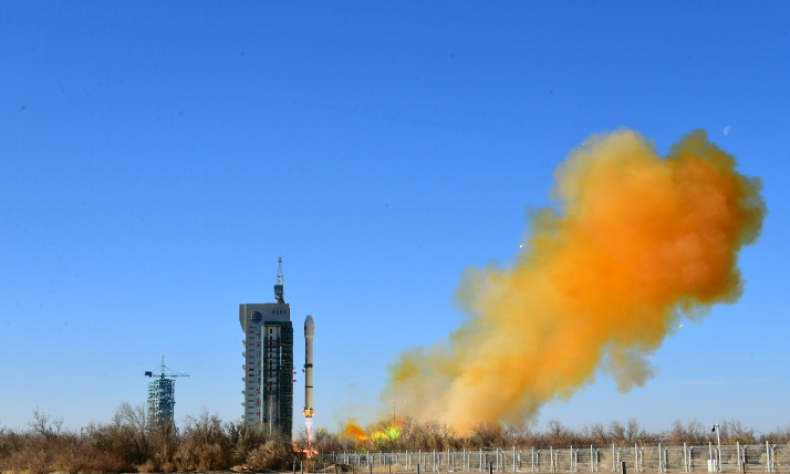
Egypt, the first country to cooperate with China on joint satellite development under the Belt and Road Initiative—a China-proposed initiative to boost connectivity along and beyond the ancient Silk Road routes—has collaborated with China on space science since 2014. The two nations have signed an agreement covering satellite design, launch, applications, telemetry and data sharing. On December 4, 2023, China launched a remote-sensing satellite for Egypt, achieving a new feat in the two nation’s space cooperation. The MisrSat 2 satellite is a small optical remote-sensing satellite tasked with obtaining data for Egypt’s land and water resources development and agricultural operations.
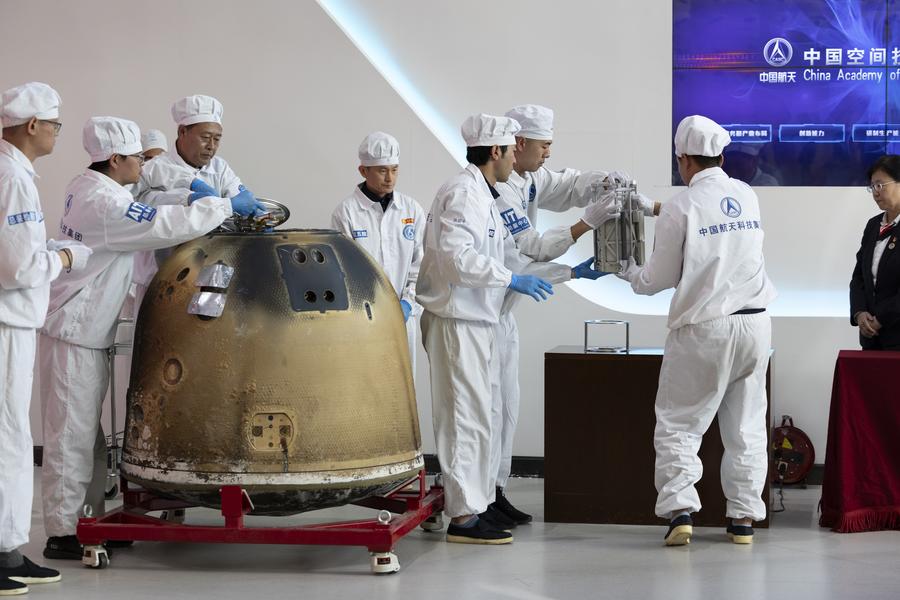
In 2024, China’s Chang’e 6 probe successfully brought back the first samples from the far side of the moon. During the mission, Chang’e 6 carried four international payloads from France, the European Space Agency (ESA), Italy and Pakistan for different tasks, with each nation bringing its strengths to contribute uniquely to the cause of space exploration.
Data sharing
Remote sensing data from satellites, which offer broad coverage and frequent updates, are vital for monitoring climate change, early warning of natural disasters and environmental protection. However, differing national data-sharing policies have resulted in low efficiency of global data utilization despite their high value.
To address this, countries and multilateral organizations are taking action.
The Asia-Pacific Space Cooperation Organization (APSCO) launched a remote sensing data sharing and service platform in 2012, offering cataloging, browsing and downloading of available satellite data across member countries through a unified interface. The International Charter: Space and Major Disasters—an international cooperation mechanism for disaster reduction established by the space agencies of Europe, France and Canada in 2000 and now joined by some 10 international space agencies—also provides open access to satellite data, supporting disaster-stricken countries in rapid response and risk assessment.
China’s national platform for remote sensing data and application services was established in 2022 as a central repository, integrating massive Earth science datasets with cloud-based algorithms, high-performance computing, and scientific research tools. This enables one-stop collection and sharing of data and results, promotes interdisciplinary integration and deep data mining, and enhances scientific knowledge?dissemination.
Additionally, the abovementioned interim measures of 2022 also clarify the legal boundaries and technical standards for data exchange and sharing, providing institutional support for both public-interest and commercial cooperation under various international frameworks.
Through international cooperation projects that share research and data, countries can drive technological progress and foster mutual understanding and friendship.
Facing the realities of space security and sustainable development, the international community must continue to deepen collaboration, jointly establish and adhere to codes of conduct for space activities, and resist extremism and hegemony. Space should be a shared treasure for all humanity, never a stage for geopolitical competition.
Co-creating and co-building a peaceful outer space is not only the natural choice of human civilization but also a solemn commitment to our future generations.
Xiao Junyong is executive director of the Research Center of Science and Technology and Human Rights, Beijing Institute of Technology; Liu Hao is an assistant researcher at the center.