Resisting Economic Coercion
 Facebook
 Twitter
 Linkedin
 Google +
It is imperative to modernize international dispute settlement mechanisms to prevent trade and ideological differences escalating into economic warfare.
Professor Alena Douhan is a Special Rapporteur for the United Nations and a human rights lawyer. She visited China in May as part of her mandate to investigate the humanitarian consequences of the unilateral coercive measures imposed on China. ‘Unilateral coercive measures’ are what other people tend to call sanctions – or trade embargoes or punitive tariffs.
During her visit, Professor Douhan met Government officials, representatives of the legislative and judicial branches, members of the diplomatic community and academia, and stakeholders from business and non-governmental organisations.
Her conclusion – at a final press conference in Beijing – was unequivocal: “States should lift sanctions against China.” They should also “take strong action to curb sanction over-compliance by businesses and other actors under their jurisdiction.” Fearful of the unknown costs and penalties associated with sanctions, people overreact to them, exacerbating their humanitarian consequences.
Professor Douhan listed the direct and indirect effects of sanctions: “Decline in business activities and the significant loss of global markets, … job losses, with consequent disruptions in social protection schemes.” She said that the most vulnerable were disproportionately affected: “women, older persons, and all those in informal employment.”
When Donald Trump was elected U.S. president, he declared, in his inaugural address, that ‘from this day forward, it’s going to be only America first!’
His gripe was that ‘we’ve made other countries rich while the wealth … has dissipated over the horizon … One by one, the factories shuttered and left our shores.’
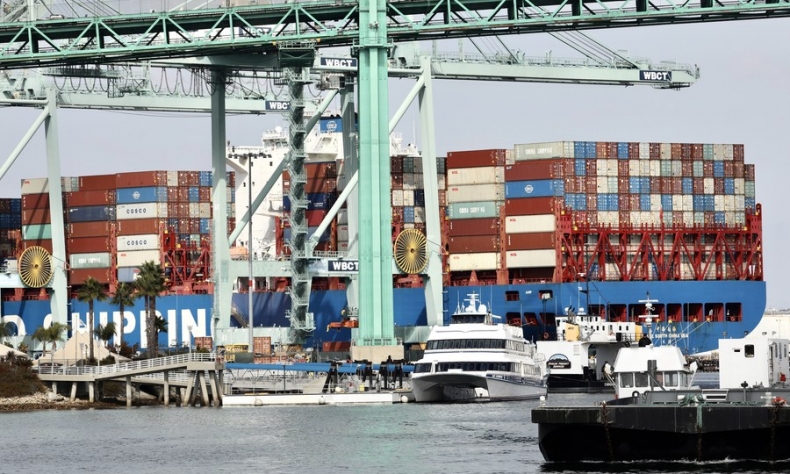
He reacted by imposing import tariffs of 25 percent on steel imports and 10 percent on aluminium. China responded by defensively imposing tariffs on 128 products. The next day the U.S. announced tariffs on more than 1,300 different kinds of Chinese goods.
It is not just tariffs that the U.S. has implemented, seemingly to hold back China’s development. Chinese companies have been singled out and prevented from trading in the U.S. or with U.S. companies or, contentiously, with enterprises of other countries. Chinese public officials and other citizens have been named, their assets in the United States frozen, and their global travel curtailed.
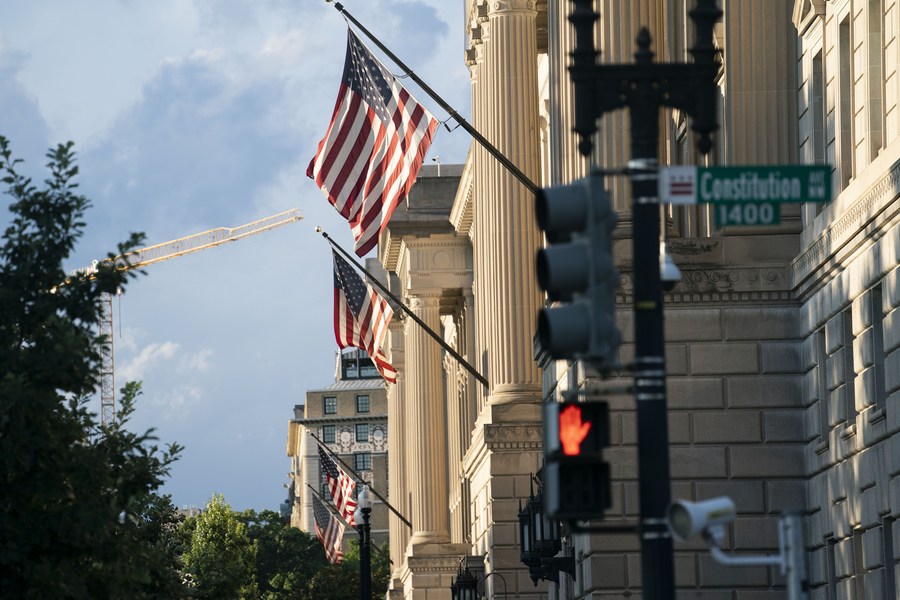
It is not often realized that these sanctions are based on U.S. domestic legislation which legislators have determined should have force in other countries and be subject to U.S. litigation. This is termed ‘extraterritoriality.’
The reasons given for these unilateral actions have been various and often unspecific. Chinese companies have been accused of trading with Iran and Russia. Individuals have been sanctioned for ‘undermining Hong Kong’s autonomy.’ Many Chinese companies and individuals have been sanctioned for alleged human rights abuses in Xinjiang.
Sanctions can be imposed without definitive evidence, based on assertion. In conflict with natural justice, to escape sanctions victims must prove that they have done nothing wrong. And this can only be done through recourse to the U.S. legal system or U.S. administrative procedures – extraterritoriality again.
If all this seems unfair, then the United Nations Human Rights Council would agree. In Resolution 27/21, they call ‘upon all States to stop adopting, maintaining or implementing unilateral coercive measures not in accordance with international law.’
This raises the question of whether the measures imposed on China are lawful. But, before addressing this question, it is important to explain why the UN Human Rights Council should be interested in this topic.
One reason is that unilateral coercive measures have negative humanitarian consequences. U.S. sanctions on Venezuela curtailed food imports, creating malnutrition for around 20 percent of under five-year-olds. Ratcheting up sanctions on North Korea in 2017 is estimated to have caused 1,900 deaths.
Moreover, as the American scholar Ethan Kessler explains, some humanitarian suffering has been intentionally engineered by the U.S.; it was anticipated that sanctions against Cuba in 1960 and Iran in 2010 would cause social distress to foment political protest toppling their respective governments.
The research evidence also demonstrates that sanctions, especially those imposed unilaterally, are rarely effective in changing the behaviour of governments. Even so-called ‘smart sanctions’ aimed at known culprits, implemented with UN approval, negatively affect those targeted only 10 per cent of the time, according to analysis published in the?Journal of Peace Research.
What sanctions can do is degrade economies – even when this is not intended. This is demonstrated by a large scale study, published in the?European Journal of Political Economy, covering 160 countries of which 67 were sanctioned between 1976 and 2012.? The GDP (gross domestic product) of countries targeted characteristically fell by two percent annually and by 25 per cent over 10 years.
Syria’s economy declined by 57 per cent between 2010 and 2015. Moreover, modelling suggests the sanctions impact on GDP quickly, and that economies typically fail fully to recover.
Kessler advises governments wanting sanctions to be effective to target weak states. China, of course, is not a weak state either politically or economically. The robustness of China’s economy makes it difficult to determine the negative consequences of U.S. sanctions.
China’s cutting-edge industries have been targeted. As such, sanctions are likely to slow rates of recruitment of highly skilled personnel, adding to unemployment among recent graduates and reducing wage growth.
The concentration of high-tech industries in more densely populated urban areas will have localized negative impacts. Not only component manufacturers will be affected, but also local retail sectors that service the consumption needs of high-tech employees.
This, in turn, will impact on migrant workers, cutting remittances, and placing a brake on the revitalization of rural areas. These?spatial multiplier effects, though difficult to measure, are likely to be real.
Returning to the matter of legality, the International Law Commission has prepared a set of articles on the responsibility of states for internationally wrongful acts, the ‘ARSIWA.’ Among the legitimate uses of sanctions are the prevention of war, the protection of human rights, hindrance of the proliferation of nuclear and mass-destructive weapons, the restoration of sovereignty, and the freeing of kidnapped citizens. Sanctions can also be used in retaliation provided that the response is proportional.

Sanctions should not be employed in pursuit of regime change or to alter the government structures of another state. That would contravene the long-established right to national sovereignty. Nor should sanctions be punitive.
Sanctions must also be justifiable on a case-by-case basis and prescribe the precise conditions under which the target nation or individual can be ‘de-sanctioned’ and the sanctions removed.
The reasoning behind the initial imposition and continuation of unilateral tariffs by the U.S. is explained in an official government report published last year, the 2022 Report to Congress on China’s WTO Compliance. It explains that the U.S.?cannot accept ‘China’s state-led, non-market approach to the economy and trade’ and?sought ‘solutions independent of the WTO.’ The WTO is the World Trade Organization, the intergovernmental body established in 1995 to mediate international trade disputes.
The same report explains how the U.S. ‘launched an investigation into China’s acts, policies and practices relating to technology transfer, intellectual property and innovation’ and that ‘this investigation led to substantial U.S. tariffs on imports from China.’
The?2021 Strategic Competition Act?similarly refers to ‘the challenges posed by the People’s Republic of China (PRC) to our [US] national and economic security.’
Legal textbooks do not cite economic competition as a valid reason for the imposition of sanctions. Yet the U.S. would appear to be using domestic legislation to ensure that economic competitors are defeated so that U.S. ‘economic security’ is assured.
Sanctions imposed by the U.S. for ‘undermining Hong Kong’s autonomy’ smack of an illicit attempt at regime change. While this might seem farfetched, it is difficult to believe that U.S. attachment to the concept of ‘liberal democracy’ was not a motivation.
China has frequently refuted accusations of human rights abuses occurring in Xinjiang, notably in its 2022 report to the UN High Commissioner for Human Rights. Yet, in March this year, the U.S. was enforcing 117 punitive sanctions against 95 Xinjiang companies, officials, and government agencies.
The centrality of Xinjiang to China’s leadership of green technology, and its location as a gateway to the Belt and Road corridors, raises suspicions that the human rights sanctions imposed on local entities have more to do with geoeconomics than with the protection of human rights.?
It is unlikely, therefore, that the U.S. sanctions are legal whereas China’s proportionate response appears to be consistent with ARSIWA requirements.?
Conversations suggest that many Chinese people no longer see the U.S. as a trusted business or research partner. This is likely to weaken global collaboration and prevent further development of an open trading environment that can deliver sustainable growth, increase global incomes and enhance human wellbeing. Increasingly people also view global politics with suspicion and fear.
Should protectionist U.S. strategists attribute this to the success of sanctions, a weakened adversary, they risk a world more dangerously divided than it already is. As a minimum, it is imperative to modernize international dispute settlement mechanisms to prevent trade and ideological differences escalating into economic warfare.??
Better still, the world should unite behind Human Rights Council Resolution 27/21 and abolish the unlawful use of sanctions.