Rethinking Heritage
 Facebook
 Twitter
 Linkedin
 Google +
Culture is in fact part of an underlying system of social governance, one that relies tremendously on something similar to soft power.
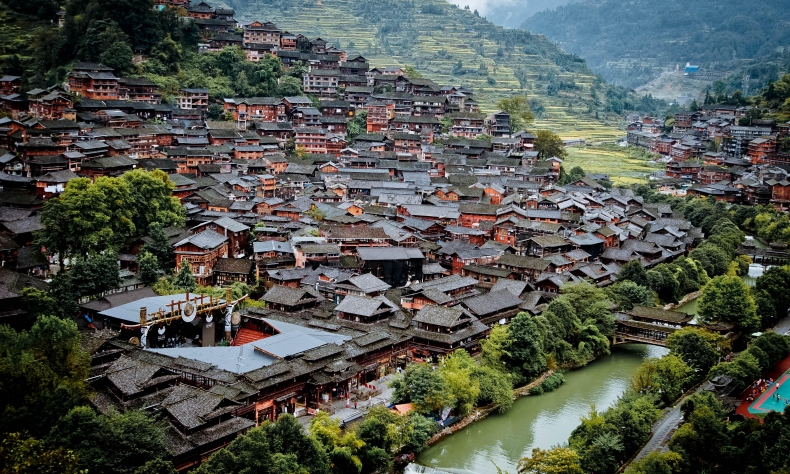
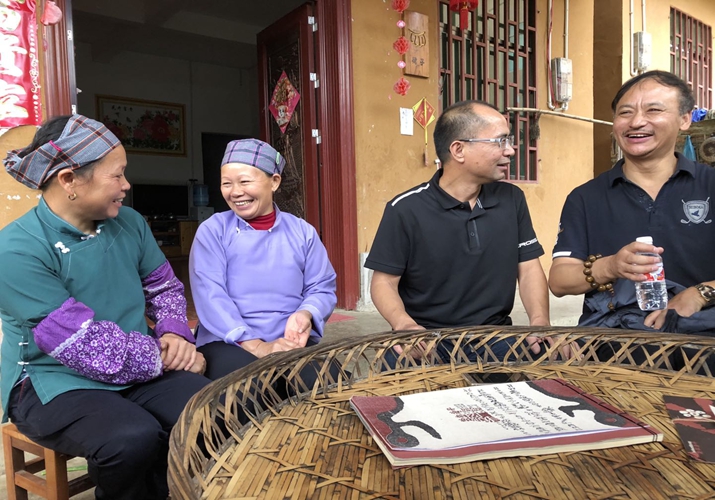
In Poya?Village in Funing County, on the southern border of Yunnan Province, just a few kilometers north of China’s border with Viet?Nam, two?“successors”?remain, both of the Zhuang minority–the last true singers of the “Poya songbook.”
“Mountain songs” like the Poya have long been popular in Yunnan. Whether sung by one or more, they’re a form of dialogue, typically between a man and woman, covering the pleasures and hardships of rural life, including the vicissitudes of love, longing and desire.
Reviving a legacy?
But there are three things remarkable about the Poya. First, it only became known to a wider audience in 2006, when were still?20?singers alive who could sing the songs by heart. Now recognized formally as intangible cultural heritage (ICH), only two remain.
Second, while the lyrics belong to an oral tradition, researchers were shocked to find the Poya used a previously unknown form of proto-writing to reference the songs in local culture.
Third, while the 81 songs cover a wide range of topics, they are freely improvised with any melody or pitch to match the singer’s mood, and therein lies much of the art, but consist of 21 distinct tones.?(Imagine the challenge of mastering the four tones of?standard Chinese?and then multiply it five times!)
China today is in the midst of long-term, multi-year project to catalogue and preserve ICH. Such efforts are happening worldwide, and many national and international organizations, like UNESCO, are supporting these kinds of efforts.
In China, this work overlaps with broader initiatives aimed at preserving, recovering and sometimes reimagining traditional Chinese cultural practices and values. On the one hand, the basic aims are clear: preserve and recover if possible before forever lost. On the other hand, there is also a desire to tap into heretofore neglected cultural resources, including lessons from the past that might help address contemporary challenges and, for better and worse, to commodify and capture with intellectual property rights when possible.
Furthermore, per the communique of the?Fifth Plenary Session of the 19th?Communist Party of China Central Committee in October, Chinese leaders have promoted further developing?China’s cultural sector in order to promote better social etiquette and civility and to strengthen soft power in ways that reinforce the development of a “modern socialist nation with Chinese characteristics.”
All of these objectives are at work in the Funing County seat, where a touring group has been assembled and taught the Poya songs, and that has now traveled extensively domestically and internationally, with inevitable trade-offs. The original versions were generally sung solo, or among women while working, with no special dress or performance. But a touring group requires costumes and choreographed dances. But the biggest difference is that the touring group only sings some of the songs–the more salacious are omitted–but more strikingly, those that remain have been reworked and limited to 10 tones.
Ten is still a remarkable number, and the spectacle is lovely, but even to the untrained ear, the incredible subtlety?of the original versions is diminished. One can describe the calming effect of rolling waves on a peaceful beach, or the same in the choral interludes of Bach’s Mass in B-minor, both correctives for the exhausted industrial spirit, and the same is true when those women sing in the village.
Of course, one must master and market what one can, and the traditional versions are both too difficult to learn and, aside from their inverse relationship, have little directly to do with the modernity the group’s singers hope to purchase through their cultural labors.
A way?of?thinking
Two very influential theorists of culture in modern times, the anthropologists Ward H. Goodenough and Clifford Geertz, argue that culture is quite different from what we often perceive it to be. According to Goodenough, “Culture is not a material phenomenon; it does not consist of things, people, behavior, or emotions. It is rather an organization of these things. It is the forms of things that people have in mind, their models for perceiving, relating, and otherwise interpreting them.”?Similarly, Geertz writes, “Culture is best seen not as complexes of concrete behavior patterns–customs, usages, traditions, habit clusters–as has, by and large, been the case up to now, but as a set of control mechanisms–plans, recipes, rules, instructions–for the governing of behavior.”
If we follow Goodenough and Geertz, then culture is in fact part of an underlying system of social governance, one that relies tremendously on something similar to soft power. The concept of soft power was first introduced by Joseph Nye, describing a type of externally projected power that aim to influence others.
This meaning was reflected in part in a speech given by?President?Xi Jinping in 2014, when he said, “We should enhance China’s soft power and better present China to the world.” But it’s also been conceptualized as an internal development, one that aims to improve cultural values and practices domestically, and to do so in ways that help resist malign forms of foreign soft power while promoting better cultural practices that suit national development—which also keenly interests?the Chinese Government, particularly as China’s younger generations have grown up in an increasingly globalized culture driven by technology and market values.
Therein lies a common tension found in efforts to recover and promote ICH. To a large extent, the tendency is to do so with values and practices that might now be local but are in fact culturally foreign. This risks negating the authentic intangibleness of traditional culture, and merely reducing it to the commodity form.
Before Chinese modernity, when Chinese thinkers spoke of the “way”?or?dao, they did so primarily through a way of thinking that was fundamentally different from the logic underpinning today’s world. Whether Confucius or Laozi, whether the Chinese Buddhists who synthesized the Lotus?Sutra with Daoism, or the Shang?Dynasty (1600-1046 B.C.)?before them all,?yinyang?thought, or what some call “correlative thinking,”?was culturally and discursively?dominant.
This understanding was not lost on Chinese Marxism. When Chinese scholars first studied Marx’s texts in the aftermath of the May 4th Movement?in 1919, they found in Marx’s dialectic a way of thinking that was not too distant from China’s deeply rooted tradition. Indeed, this epistemological relationship appears quite important to Mao Zedong, and its resonance is even stronger today as China finds itself on the threshold of accelerating its development as a socialist nation from a market society in the vanguard of a globally devastating pandemic—a crisis that has intersected with many others.
One of the major academic developments in China over the last few years has been the reinvigoration of Marxism. Some see this as anachronistic or merely a play at propaganda without substance. Conversely, there are those elsewhere, in Washington for example, who portray it as part of a Beijing-led conspiracy for global domination, despite real Marxism being literally the antithesis of such thinking.
Marx’s dialectical method provided him with a solution to the problem of “immanent critique,” insomuch as the dialectic offered a logic quite different from the radicalized linear form that emerged in Europe and produced the Enlightenment sciences and social sciences, along with normalizing capitalism and nationalism that are predicated ontologically on the same.
For Chinese Marxists, it provided a cultural bridge between Chinese traditional thought, which was more dialectical, and the linear analytical forms that were necessary to accelerate national development and solve the existential crises that confronted China from the mid-19th century onward.
Those crises have now largely been solved, and we are now in a “new era,” as China likes to say. And in this new era, looking backward, what should be salvaged, what should be carried forward, particularly as new existential crises mounting today are precisely those that have emerged from the excesses associated with Western ways of thinking? Perhaps via Marx, and onward to the Chinese dialectic, the answer seems clear, even if it’s sung in a marketable version with only 10 tones.
The author?is professor of politics at East China Normal University in Shanghai.