Rice to Riches: Building a Global Community the Chinese Way
 Facebook
 Twitter
 Linkedin
 Google +
China’s call for building a community with a shared future for all mankind is not a cynical slogan to expose the self-seeking nature of Western hegemony.
China feeds a fifth of the world’s population from only one tenth of the world’s arable land.
The need to feed its population has always been a concern of China’s rulers. As early as the Tang (618–907CE) and Song (960–1279CE) dynasties, the Imperial government was encouraging people to expand food production beyond the fertile lowlands into the mountains.
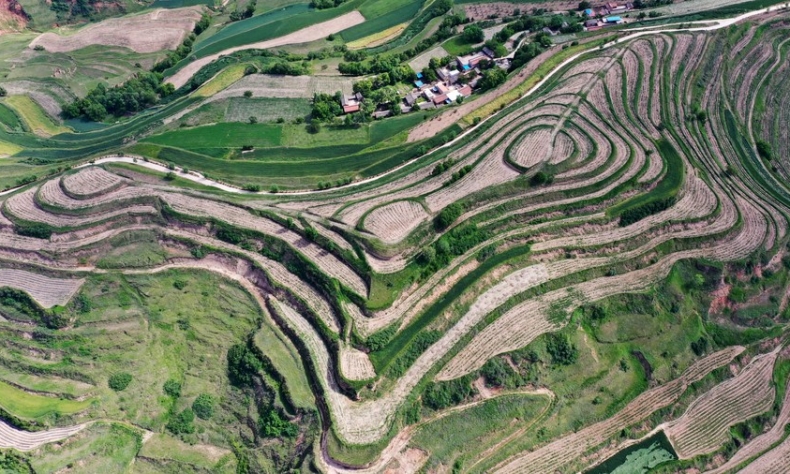
For areas growing rice, a semi aquatic plant needing rooting in clear water, the technical challenges were formidable. Yet, by the time of the Northern Song Dynasty (976-983CE), there is documentary evidence of well-watered paddy fields carved step-like into mountain slopes as steep as 40 degrees. The spectacular rice terraces of Ziquejie (Hunan Province) are known to date from this era. However, it is a reasonable supposition that the techniques of rice growing developed centuries earlier.
Even more remarkable than the early date at which forest covered hillsides were terraformed into productive paddy is the fact that the terraces remain productive today. They represent a unique example of sustainable development with the same soils nourishing crops continuously for over a millennium. Moreover, there is nothing inevitable or accidental about the terraces. They are a marriage of farming expertise and hydrological engineering that is surprisingly sophisticated even by today’s standards. Equally, they serve as a “perfect example of the harmonious coexistence between man and nature, promoted by traditional Chinese philosophy”, a reasoned assessment offered by Professor Li Yunpeng and his team at China’s Institute of Water Resources and Hydropower Research.
Professor Li Guiyuan and colleagues, writing in the usually austere American Journal of Water Science and Engineering?in 2018, similarly waxed lyrical about the science underpinning the Ziquejie Terraces. They describe “a magical landscape of … purple and sinuous fields” and liken it to the Heavenly Jade Pool of Chinese mythology. What they see as most remarkable is that good harvests can be ensured irrespective of marked year-to-year variation in rainfall. Excess water is channeled away while fields are automatically irrigated in times of water shortage all without exogenous water storage.
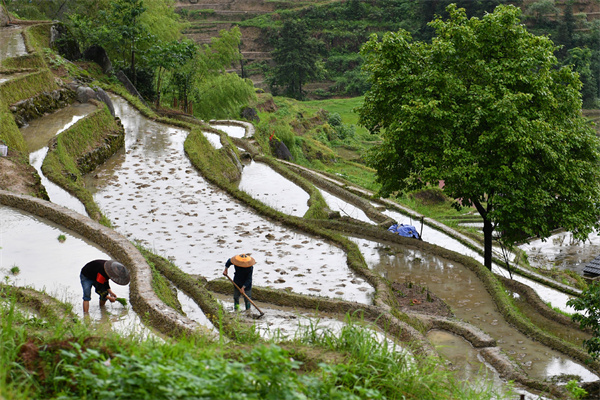
The scale of the Ziquejie Terraces – about 4,000 hectares of planted rice spread over more than 10,000 hills covering about 93 square kilometers and ranging in height from 450 meters to 950 meters above sea level – speaks to collective endeavor. Not only does rice cultivation demand twice the labor resources as needed to grow wheat, it also demands daily collaboration that must be sustained season after season.
Water needs to be shared, repeatedly used with minimal loss and zero pollution. Elaborate irrigation channels must be dug and maintained to distribute water resources. Water levels have to be retained even when the land is fallow to ensure that earth dams and field partitions do not dry out and crumble. Rice planting, weeding, and harvesting all require multiple hands to ensure the optimal timing demanded to maximize yields and to maintain the quality of the crop.
While the Ziquejie Terraces still yield high quality rice and are recognized as a World Heritage Irrigation Structure, they are under serious threat.
The success of China’s economic development has lifted minimum living standards to a point where they exceed the incomes that can be generated by growing rice in traditional ways, even allowing for the customary mixing of rice with fish and duck farming on the same paddy. With the mean width of the rice terraces being only 1.75 meters – and just a fifth of a meter wide at their narrowest – the scope for increased mechanization is limited. Currently, rice-growing on the Ziquejie Terraces is subsidized and there is hope that their spectacular beauty will attract tourism.
Rice still provides the staple diet for 65 per cent of China’s population. Moreover, strong evidence is emerging that rice cultivation has not only fed the population but has also forged Chinese philosophy and culture, shaped the national character, and even facilitated the development of China’s unique form of democracy. Indirectly, rice may, in time, also foster international peace and global accord.
In 2014, the Scientific American?magazine posed the question “Does rice farming lead to collectivist thinking?” The answer, based on pioneering work by Chinese and American researchers, suggested that it did. Led by Thomas Talhelm, the team interviewed and tested over a thousand individuals living in diverse locations in China. Those living in rice growing areas in southern China were more interdependent and holistic in their thinking than respondents in the wheat-growing north. The latter expressed attitudes that were individualistic and pursued thought processes that were analytic, focused rather than embracing.
These differences in attitudes were persistent. It made no difference whether people had grown up in the countryside or spent their lives in a large city. Other work suggests that people from collectivist rice areas are likely to be less risk-adverse than those from individualistic regions.?This is because the former can presume that others will assist if things go wrong.
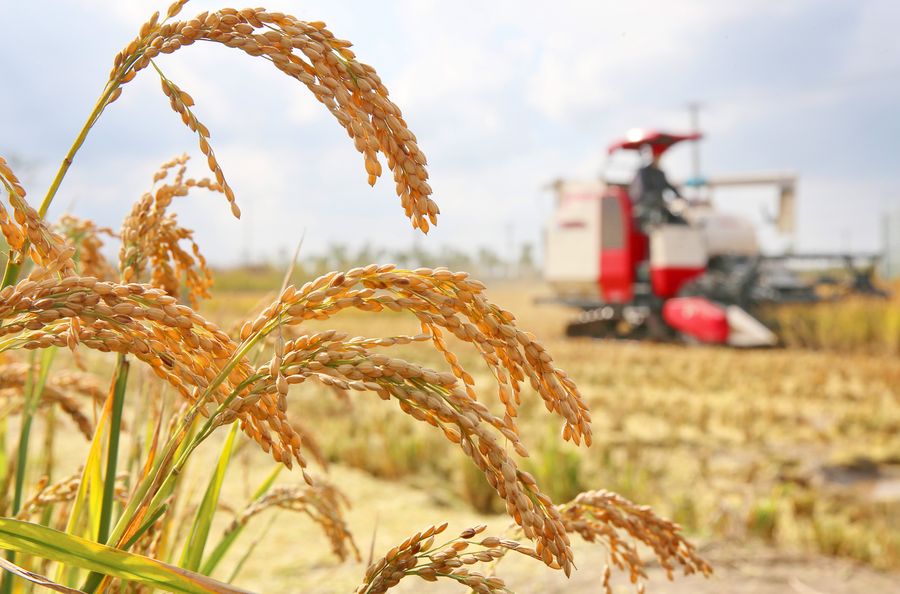
Subsequent studies have shown that such differences are repeated globally. Populations in countries devoting more cultivated land to paddy rice have tighter social norms than elsewhere, with citizens pressured to fulfil their social expectations. This is so even when taking account of historical and economic development, urbanization, and environmental threats.
The combination of tight norms and collectivism is not conducive to the development of Western style democracy. This, as Professor James Ang and colleagues have demonstrated empirically, requires “a civic commitment to individual choice and autonomy derived from self-expressionist values that prioritize individual liberty over collective discipline and civic autonomy over state authority.”
However, the same configuration of norms is strongly supportive of China’s “whole-process people’s democracy”. This is based on collaboration between nine national parties committed to agreed long-term goals that are achieved by following sequential five-year development plans.
While there is some suggestion that people in rice growing regions may be individually less innovative and even, due to constant self-evaluation within a tightly bonded group, less happy, rice-based norms point to a positive response to global challenges. Sharing a planet, the world’s people must work consistently together to counter the systemic threats posed by climate change, depleted resources, and global inequality.
Rice farmers, such as those tending the Ziquejie terraces, have demonstrated the possibility of maintaining a delicate balance between the needs of the people and the environment over successive centuries. It is no surprise, therefore, to learn that rice growing provinces in China are currently leading the transition to green investment addressing pollution and other environmental challenges.
Likewise, the evidence points to persons in rice-growing areas excelling in adaptive creativity, responding to change but also persisting with incremental innovation. In this regard, China’s unwavering support for the UN’s Sustainable Development Goals and the COP Climate Change Conferences can be recognized as grounded in Chinese rice-based culture.
China’s goal of achieving common prosperity by 2050 may be similarly understood. Successful rice cultivation is a collective enterprise rewarding the entire community, not just those coming first in market competition. Hence, rice farmers on the Ziquejie terraces are supported financially while a communal response is found to the challenge of rural revitalization.
Likewise, China’s call for building a community with a shared future for all mankind is not a cynical slogan to expose the self-seeking nature of Western hegemony. Rather it reflects a generosity of spirit born out of the collective experience of turning hostile mountains into paddy fields. All can prosper but only by working together to ensure?that nature’s riches benefit everyone.
The article reflects the author’s opinions, and not necessarily the views of China Focus.