Space Synergy: China’s Partnerships and Innovations
 Facebook
 Twitter
 Linkedin
 Google +
China will continue to deepen its space collaboration with other countries, actively participate in the formulation and implementation of international regulations, and promote the sustainability of international space cooperation.
With a flourishing global space industry, cooperation in space security and development has provided a pathway to global consensus and common effort with regard to outer space exploration and utilization.
Over the past decades, China has been deepening independent innovation in space technology, enhancing its comprehensive national strength. It has also engaged in space cooperation with other countries, extending the benefits of space exploration and utilization to more nations and regions, and exploring an important way to build a community with a shared future in space for humanity.
Seeking peaceful utilization
Space is critically important for a nation’s military, economic and social development, making it a main frontier in modern global competition. Space technology plays a big role in military operations, improving reconnaissance, communication and command capabilities. It also underpins industries like satellite remote sensing, navigation and communications, all of which contribute to the steady advancement of a nation’s strategic objectives. With major global powers increasingly venturing into space, it has become a new strategic high ground in international competition.
In pursuit of its goal to become a space power, China continues to promote space cooperation and strengthen partnerships through peaceful diplomacy, creating a “circle of friends” in space.
However, the global space landscape remains largely dominated by the United States, thanks to its strong space situational awareness and large satellite fleet. Building on this advantage, the U.S. adheres to an “America First” policy, seeking to form exclusive blocs and alliances while disregarding the United Nations framework. The U.S. has sought to exclude dialogue and cooperation with nations like China and Russia, attempting to establish rules for space governance that reinforce U.S. dominance and promote a hegemonic vision for space.
For example, the U.S. Wolf Amendment, passed in 2011, banned the conduct of any China-U.S. joint scientific research related to the National Aeronautics and Space Administration (NASA) or coordinated by the White House Office of Science and Technology Policy without explicit authorization from the Federal Bureau of Investigation and U.S. Congress, and banned all NASA facilities from hosting “official Chinese visitors,” thereby blocking China-U.S. space cooperation.
In response to such practices, China seeks space cooperation within the UN framework to safeguard its national security and protect its space interests. Additionally, it aims to overcome the “isolation” imposed by certain countries.
Joining hands
In 1977, a delegation of Chinese space technology experts visited French aerospace research institutions, marking the end of China’s long-standing “isolation” in the field of space and laying a solid foundation for future cooperation between the two countries.
In March 2021, China and Russia signed the Memorandum of Understanding on Cooperation in Construction of International Lunar Research Station, officially launching lunar exploration cooperation.
At the Global Space Exploration Conference in June 2021, the two countries jointly released the International Lunar Research Station Roadmap (V1.0) and the Guide for Partnership (V1.0), providing a detailed introduction to the concept, scientific goals, pathways and opportunities of the International Lunar Research Station—a set of experimental research facilities created on the surface and/or in the orbit of the moon, potentially involving other countries, international organizations and partners.
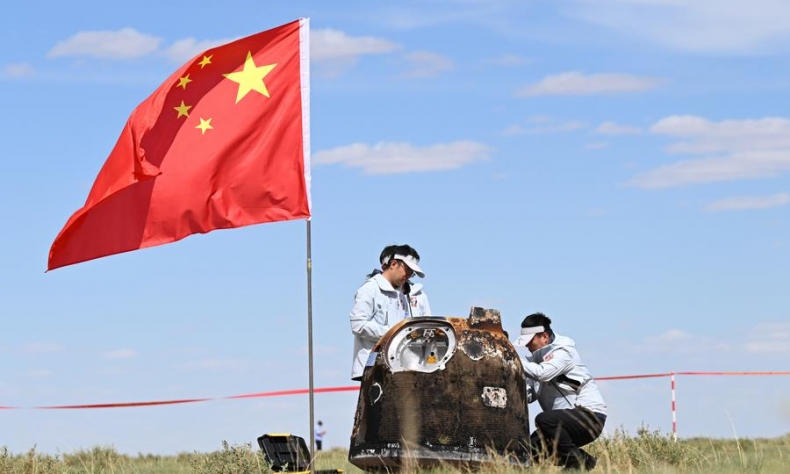
In 2024, China’s Chang’e 6 probe successfully brought back the first samples from the far side of the moon. During this mission, Chang’e 6 carried four international payloads from France, the European Space Agency (ESA), Italy and Pakistan for different tasks.
China also engages in joint research and development (R&D) of space science and technology with other countries and shares the outcomes. For instance, China and Brazil established the China-Brazil Joint Laboratory for Space Weather to study the patterns of outer space weather changes in 2014. In 2017, two quantum science research teams from the Chinese Academy of Sciences and the Austrian Academy of Sciences used China’s quantum satellite Micius to achieve quantum key distribution between the two countries, laying a foundation for building a global quantum-secured communication network.
Today’s space security is confronted with many challenges, including the militarization and weaponization of space, the rapid accumulation of space debris, and increasingly congested orbits. These issues highlight the need for China’s active participation in international space governance.
To address these challenges, China engages in discussions within the UN framework on topics such as the long-term sustainability of outer space activities, the development and utilization of space resources and the prevention of an arms race in space. China also contributes to the introduction of new initiatives, such as space exploration and innovation, and works to advance the UN Space 2030 Agenda—a roadmap aimed at achieving the Sustainable Development Goals, a set of 17 global objectives established by the UN in 2015 to tackle the world’s most pressing trials, through the use of space-derived data, technology and innovative products from space exploration and utilization.

Empowering progress
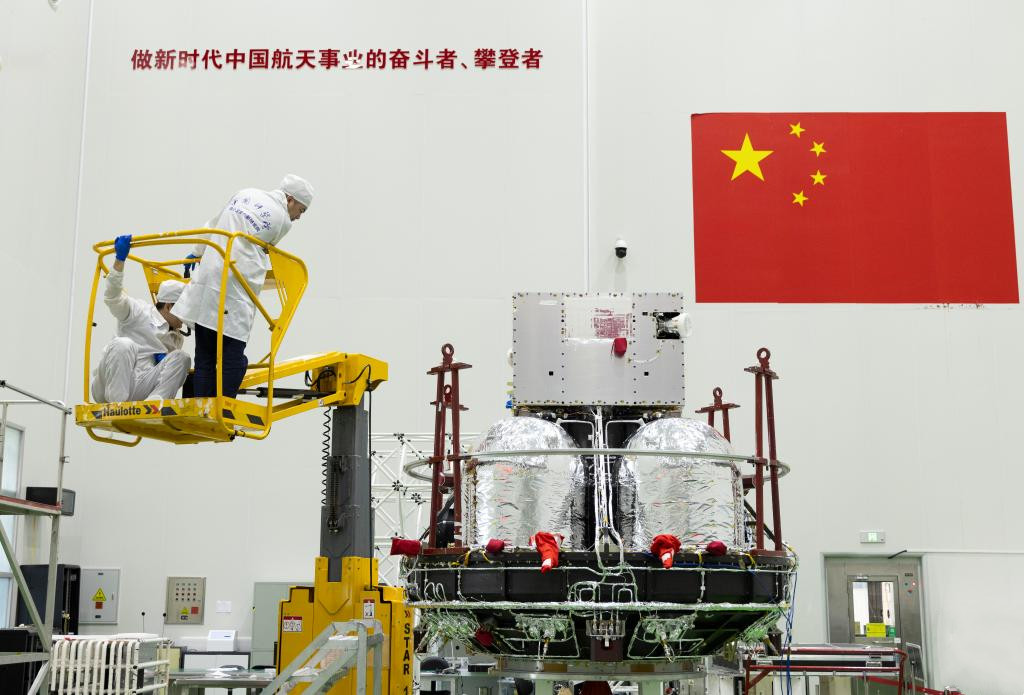
Strengthening space technology cooperation helps reduce costs and mitigate risks in space exploration, thereby enhancing project success. For example, in China’s Tianwen-1 mission, the country’s first Mars exploration project, China collaborated with the ESA on engineering technology and with Austria and France on payloads. Additionally, it established a Mars probe data exchange mechanism with the U.S. and launched international payload cooperation for its asteroid mission.
As of 2024, China had signed over 200 space cooperation agreements with more than 50 countries and organizations.
At the same time, China’s space industry is flourishing, with aerospace products and services expanding internationally. From 2019 to 2023, the scale of China’s commercial space market grew from 800 billion yuan ($109 billion) to 1.9 trillion yuan ($260 billion).
In 2023 alone, China launched commercial carrier rockets 13 times and initiated around 170 financing cases in the commercial space sector, with total disclosed investments exceeding 18.5 billion yuan ($2.52 billion).
In addition, China supports many countries and regions with less advanced space technology through international cooperation. For instance, it has set up an emergency support mechanism for disaster prevention and mitigation using the Fengyun meteorological satellites, whose data are now used in 132 countries and regions.
In emergency monitoring for major disasters, China has consistently extended its assistance to affected countries. For example, during the severe drought in Afghanistan and the dam collapse in Laos in 2018, as well as the cyclone that struck Mozambique in 2019, China offered essential monitoring services. These services provided fundamental data for disaster prevention, mitigation and emergency rescue efforts in the impacted regions.
China has also helped developing countries train professionals. Through the Regional Center for Space Science and Technology Education in Asia and the Pacific (China) affiliated to the UN, it has trained some 2,000 space-industry professionals for more than 70 countries, and established the Belt and Road Aerospace Innovation Alliance and the Association of Sino-Russian Technical Universities. It has also promoted personnel exchanges in remote-sensing and navigation technology through an international training program, amongst other channels.
Looking ahead, the country will continue to deepen its space collaboration with other countries, actively participate in the formulation and implementation of international regulations, and promote the sustainability of international space cooperation.
At the same time, it will increase investment in the space sector to drive ongoing innovation in space technology, making greater contributions to space security and its peaceful use, as well as the overall wellbeing of humanity.
Xiao Junyong is executive director of the Center for Science, Technology and Human Rights at the Beijing Institute of Technology; Zhou Shilin is a research associate at the center.