The Cold War is not Taking Place and Should not Take Place
 Linkedin
 Google +
Taken together, these developments indicate that China has provided an official, public assessment that acknowledges American Cold War intentions but disagrees with them, and prepares for the worst but hopes to avoid it.
In 1991, during the first Gulf War, French critical theorist Jean Baudrillard published a series of controversial essays later collected and published in English as The Gulf War Did Not Take Place (1995). While many found the essays frustrating, his arguments were threefold.
First, this was not really a war—this was a massacre masquerading as war. Second, the U.S. so effectively controlled the images and narratives of the war in real time that viewers were hostage to Washington’s propaganda, which diverged significantly from reality. Third, the American version of the war nonetheless became “history,” as a counterfactual account of American righteousness, superiority and victory.
America’s “victory” in the Gulf War is important because it took place as the Cold War between the U.S. and the Soviet Union was ending, and it appeared to reinforce the American narrative that was already emerging and that gathered steam as the Soviet Union dissolved. First, that both wars, Cold and Gulf, represented “good” vs. “evil,” and that the U.S., the champion of the “good,” had defeated both the “evil” Soviet Union and Iraq. Second, that the U.S. was now the leader of a “new world order” at the “end of history,” and that those who challenged this authority would be policed accordingly.
Wars are complicated macro-historical events that directly impact millions of individual lives. In many respects they are always impossible to understand in either the broadest or narrowest senses. Of course, contrary to Baudrillard’s thesis, one can assert that the Gulf War did take place and that his arguments rest largely on semantics.
One should also acknowledge that a Cold War did take place, that it was frequently hot, that despite an incomplete and unreliable history, it culminated in some respects with the collapse of the Soviet Union—whether or not the U.S. was primarily responsible for this “defeat”—and that the U.S. then embraced its role as the sole global superpower.
A critical lesson
But a key lesson from history is that the way war is remembered often directly relates to whether wars are repeated, and in retrospect, should lead us to question whether they ever stopped or took place at all. For example, the U.S. rarely acknowledges or even remembers the Soviet Union’s outsized contributions against the Nazis in World War II, or the same from China against the Japanese.
Instead, America’s national World War II Monument in Washington, D.C. claims to have saved the world from evil, a narrative that is both repeated and negated, just a few hundred meters away by memorials for America’s wars on the Korean Peninsula and in Vietnam, and one wonders where they’ll put memorials for the so-called “War on Terror.”
The same is true of how the Cold War is remembered by Americans. Indeed, as the U.S. today pushes the world toward Cold War 2.0 and fosters support at home, one can see the extent to which Donald Trump’s administration is gratuitously repackaging the American mythos of previous conflicts.
Unfortunately, with President Trump, Vice President Mike Pence and Secretary of State Mike Pompeo dusting off the now sacrosanct prose, postures and props of Ronald Reagan’s Hollywood ending, the prospect of a Cold War sequel seems to appeal to Americans who appear increasingly nostalgic for that moment, whether it was real or not, when everything seemed to be going their way.
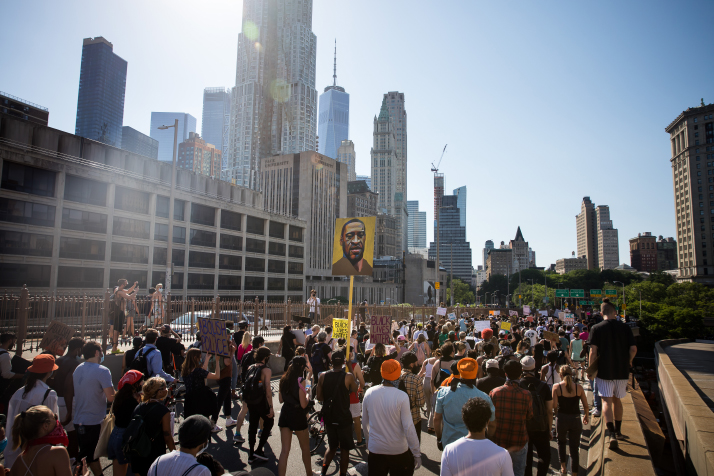
One can almost forgive Americans for this, given how awfully things are going currently, with tens of millions having lost their jobs, the economy having contracted by a third during the most recent quarter, ongoing protests and social instability related to police brutality and racial injustice, more than 170,000 dead from the novel coronavirus disease (COVID-19), an education “system” that is in various states of collapse, a postal system that is collapsing with implications for democracy, and so on.
One can even sympathize with America’s elderly generation, many unable to face the difficult truths of their pasts, or the middle aged, many of whom were devastated by the American-instigated global financial crisis of 2008, by opioid addictions, and increasing suicide rates. In fact, all of these have stark parallels with China’s decline following the opium wars in the 19th century.
But one might also ask whether or not the first Cold War really ended ever, whether the U.S. remained in a Cold War mindset as it moved onward through time, to the gulf wars, to the even more questionable “War on Terror,” the torture and black prison sites, the assassinations and regime changes, and its ongoing “pivot toward Asia” and increasingly dark fixation on China as an enemy.
All of these developments have taken China and many others around the world by surprise. On the one hand, increasing U.S. animosity toward China has been driven forward in shocking and unbelievable ways, promoting gross mischaracterization of China with concerted misinformation campaigns repeatedly promoting debunked conspiracy theories and often resorting to blatantly Orientalist and racist depictions of China, its people and culture, and its political system.
One could hardly imagine this happening except of course it had frequently and perhaps always happened before and was already happening in the U.S. itself as Trump and his ilk bullied blacks, maligned Muslims and Latinos, targeted immigrants and their children, and attacked his political opposition as un-American and anti-American.
Upholding peace
On the other hand, one could hardly be faulted for believing, for wanting to believe, that this was all just a nasty bit of political theater on Washington’s part, the type that often surfaces during election cycles, or that it was simply Trump’s way of creating leverage for trade talks. And even if one was not so na?ve, one could hardly predict how deliberately destructive Trump would be toward China-U.S. relations, how quickly they would decline, and how COVID-19 would accelerate matters.
While China under President Xi Jinping’s leadership has long acknowledged that it was in a new era of global change and adjustment, that China faced an increasingly challenging environment as it transitioned from being a major country to a major power, as it transitioned from an export-led growth model toward one that fostered domestic demand and cultivated new international markets and development, particularly through the Belt and Road Initiative, it did not anticipate, publicly at least, this level of accelerated and sustained U.S. animosity.
Consequently, while China has never been truly na?ve about the U.S. as an innocent or “good” power, one might say it was drawn nonetheless over the past few years by Washington into an unsustainable “diplomacy” of reactionary, tit-for-tat reciprocations without acknowledging the extent to which relations had degraded or the possible true path China-U.S. relations were taking.
All of this has come to a head recently. And the head, so to speak, belongs to Yang Jiechi, a member of the Political Bureau of the Communist Party of China (CPC) Central Committee and Director of the Office of the Foreign Affairs Commission of the CPC Central Committee. In an article made significant by its signature and candor, Yang openly acknowledged the current difficulties and castigated some U.S. leaders for embracing a Cold War mentality and a zero-sum approach that risks irreversible damage to China-U.S. relations.
Yang also called on readers to remember correctly the progressive, positive history of China-U.S. relations over the past several decades, to assert that China will continue to protect that memory and promote constructive engagements with the U.S. and with others in the world.
Simultaneously, there have been multiple reports of China’s military being ordered to prepare vigorously for self-defense but to avoid firing the first shots, as the U.S. increasingly threatens what China views as destabilizing and increasingly risky encounters vis-à-vis the South China Sea, Taiwan and Hong Kong.
Taken together, these developments indicate that China has provided an official, public assessment that acknowledges American Cold War intentions but disagrees with them, and prepares for the worst but hopes to avoid it.
And it is in this context that one should consider that China understands, perhaps better than most, why the Soviet Union collapsed, and managed to transcend the first Cold War and its precarious aftermath, even up to the present, crafting a historically unprecedented national rejuvenation along the way, even surviving and thriving in the aftermath of COVID-19 while the U.S. flounders and self-destructs.
In other words, this is a Baudrillardian moment in China—one that understands that the Cold War as America remembers it did not take place, and that the Cold War America wants with China will not and should not take place. It probably also understands that despite America’s capacity for destruction, it has no hope of actually winning a war, whether hot or cold. Indeed, when was the last time the U.S. actually won a war, and for that matter, actually won as it likes to remember?
The author is professor of politics at East China Normal University in Shanghai