The coronavirus-hit world needs solidarity and cooperation more than ever
 Facebook
 Twitter
 Linkedin
 Google +

The spread of the coronavirus is showing us that what we share is much more powerful than what keeps us apart. Fundamentally we are fighting for the same cause.
The global effect of the novel coronavirus disease (COVID-19) pandemic seems to be spiraling. Data from the World Health Organization (WHO) daily pandemic report shows that as of 16:00 on May 7 (Beijing time), more than 3.72 million cases had been reported globally. The death toll exceeded 260,000. These numbers are not mere figures. They involve lives and families and bring profound sadness to millions of households across the world who have lost their loved ones.
Among all the affected countries, the U.S. has set a grim record: the highest confirmed coronavirus death toll in the world. As of May 7, the U.S. had reported more than 1.22 million confirmed cases, with the death toll exceeding 73,000. In some cities the numbers are doubling every 2-3 days, according to data compiled by the Center for Systems Science and Engineering at Johns Hopkins University. Compared to wars and disasters that the majority of living Americans can remember, this pandemic is on pace to set a new death record.
The COVID-19 pandemic is clearly not just a public health crisis. Preventative measures such as social distancing, school closures, lockdowns and production suspension are causing economic pain worldwide. According to the UN Conference on Trade and Development, the COVID-19 shock will cause a recession in some countries and could depress global annual growth this year to below 2.5 percent, the recessionary threshold for the world economy. There is little disagreement among economists on the assumption that the economic shock brought by COVID-19 will become the biggest slump since the Great Depression or even exceed that traumatic experience, as loss of customer and investor confidence might be followed by a combination of asset price deflation, weaker aggregate demand and a worsening income distribution that could cause a more vicious downward spiral.
Sadly, these challenges are made starker by the continual parade of jingoistic remarks and stigmatization in some countries. This is a different kind of virus, a mental virus which is as damaging as or even worse than the tragedy brought by COVID-19. The assault on human health will be temporary, yet the political and mental virus it has unleashed could last for a long time, and are grave impediments to the global unity the world has to achieve to survive this pandemic.
COVID-19 is a significant pathogenic enemy and implacable adversary confronting all mankind today. We must resist the temptation to blame, to turn away or to take pleasure in others’ misfortunes. We need rational, calm and wise voices as well as actions to rise to the common challenge.
A silver lining
Many brilliant minds are fully aware of the importance of global solidarity and international cooperation, especially between the world’s two largest economies, to fight the novel coronavirus pandemic.
A group of 100 Chinese academics sent an open letter to the U.S. media in early April, calling on the U.S. to end the political blame game and work together with China to defeat the virus that has infected millions of people worldwide and paralyzed the global economy. On the other side of the Pacific, there has also been a growing call for the U.S. leadership to join hands with China to contain the outbreak. Around 100 former high-ranking government officials and elites in the strategic community, including former U.S. Secretary of State Madeleine Albright and former National Security Advisor Susan Rice, have all stressed that no effort against the coronavirus will be successful without cooperation between the U.S. and China.
CNN host Fareed Zakaria in his April 5 television coverage of COVID-19 and the economy observed that “we will not be able to get back to anything resembling normal life unless the major powers in the world can find some way to cooperate and manage these problems together. The centerpiece of any global effort would have to be close cooperation between the U.S. and China.”
Many medical experts have emphasized that no country is immune to the threat of the virus, and no one can be safe and secure until everyone is safe and secure. In an opinion piece published in The Guardian, Richard Horton, Editor in Chief of medical journal The Lancet, said, “China’s rapid and rigorous work was an urgent warning to the world. Washington should work with Beijing to contain the virus, showing global leadership amid the crisis.”
Worldwide, in the Extraordinary Group of 20 (G20) Leaders’ Summit on COVID-19 in March, all sides agreed that no country could face this pandemic alone, and the international community needs solidarity and cooperation more than ever. WHO has called for national-level unity as well as global solidarity in the battle against the coronavirus. UN Secretary General António Guterres issued a report on March 31 entitled Shared Responsibility, Global Solidarity: Responding to the Socio-economic Impacts of COVID-19, emphasizing that “this human crisis demands coordinated, decisive, inclusive and innovative policy action from the world’s leading economies and maximum financial and technical support for the poorest and most vulnerable people and countries.”
Learning from history
A review of history shows that addressing severe challenges and overcoming obstacles unprecedented in magnitude and global scope must ultimately be coupled with a global collaborative vision and program for both immediate needs and longer-term objectives for global wellbeing.
Over the past four decades and more, the international community, especially China and the U.S., have overcome various difficulties and challenges by working in synergy and making concerted efforts. During the 2008 international financial crisis, China and the U.S. joined hands and, together with other countries, turned the G20 group into the premier forum for crisis management, thereby playing a key role in steering the world out of the crisis. When Ebola broke out in 2014, China and the U.S. both sent medical teams to Africa and, again with other countries, successfully stemmed the global spread of the virus. The two countries have also worked closely in recent years on nuclear nonproliferation, counterterrorism and energy security.
History teaches us that China-U.S. cooperation is the viable way forward, be it in fighting a common enemy of mankind or in resolving bilateral differences and frictions.
Throughout history, nothing has killed more human beings than the viruses, bacteria and parasites, not even natural disasters like earthquakes, volcanoes or wars, for pathogens are self-replicating and microbes evolve 40 million times faster than humans do. Since ancient times, the “smokeless war” between human beings and plague has never stopped, and COVID-19 marks the return of a very old and familiar mass killer following the severe acute respiratory syndrome (SARS), the Middle East respiratory syndrome (MERS), Nipah, Zika and swine flu.
In this war of human vs. virus, China stands shoulder to shoulder with other countries in the world. China well remembers friends in so many countries and regions who lent a helping hand in its most difficult time in the COVID-19 combat, and stands ready now with other members of the international community to roll back the scourge.
With a population of 1.4 billion, China still faces enormous pressure from a possible domestic rebound of the outbreak and imported cases from abroad, yet the Chinese people, out of humanitarian spirit and with the belief in building a community with a shared future for humanity, have been doing all they can to extend assistance to the world, U.S. people included, in the fight against the virus. The Chinese Government and non-government actors have sent and are providing many shipments of urgently needed pharmaceutical ingredients, daily necessities, medical and protective equipment and materials to over 140 countries and international organizations. China has sent 15 batches of medical expert teams totaling 149 members to 16 countries to assist the fight against COVID-19. China has also been supportive of the leadership of WHO, of stronger international cooperation, and of intensified global governance and greater assistance to developing countries with weak public health systems.
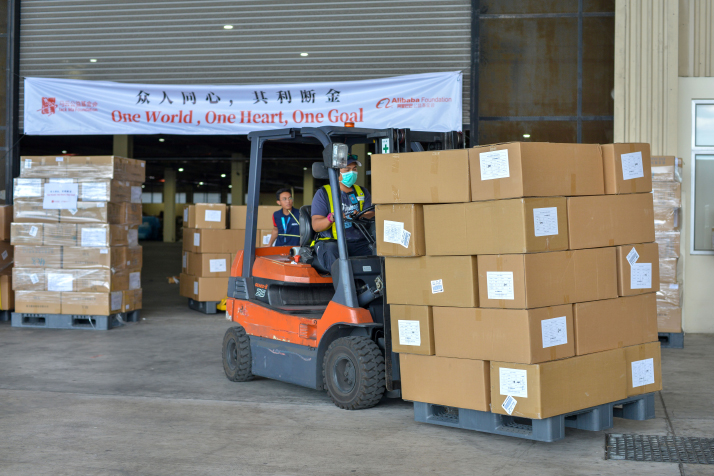
China has been sharing information and experience with the U.S. without reservation and has been seeking closer bilateral medical and health cooperation in the same spirit. Local governments, companies and non-governmental organizations (NGOs) have been donating medical supplies to the U.S. Companies are working around the clock to produce and deliver the medical supplies on the U.S. purchase list. The Jack Ma Foundation and the Alibaba Foundation have sourced through various channels 500,000 coronavirus test kits and 1 million face masks for the U.S. people. On April 4, New York Governor Andrew Cuomo expressed his thanks three times for the 1,000 ventilators donated by the Joe and Clara Tsai Foundation. Joe Tsai is co-founder of Chinese e-commerce giant Alibaba. Even though the case of Huawei’s Meng Wanzhou has not been resolved, the company has donated a large amount of medical supplies to the worst-hit state of New York, including 10,000 N95 respirators, 20,000 protective suits, 50,000 sets of goggles and 10,000 gloves.
All these are testimony of China’s empathy for the U.S. Clearly, the relationship between China and the U.S. is as much about ties between the two societies and peoples as it is about the two governments. The strong, time-honored friendship between the two peoples has always been an inherent driving force for a stable bilateral relationship.
At this crucial moment, Chinese President Xi Jinping and U.S. President Donald Trump have pointed the way forward for China-U.S. cooperation. Speaking on the phone on March 27, they agreed to enhance sharing of information and experience on epidemic prevention and control, and accelerate cooperation in scientific research against the disease.
Xi said, “The current situation calls for solidarity and cooperation. China is well aware of the current difficulties the U.S. faces, and is willing to help as its ability permits. The China-U.S. relationship has reached an important juncture, where cooperation is the only right choice.”
In response, Trump said he would make sure the U.S. would work with China to fight the outbreak without interference. He thanked China for providing medical supplies to the U.S. and for enhancing bilateral medical and health exchanges, and tweeted later, “Just finished a very good conversation with President Xi of China. We are working closely together. Much respect!”
If the Trump administration follows through with concrete steps to push forward cooperation, and if China’s rapprochement is reciprocated in good faith by the U.S., global unity could be enhanced.

Cause and cure
The current coronavirus crisis reminds us of the interconnectivity of our globe, and the cure also lies in this interconnectivity. Now is not the time for ifs and buts, but it’s the time to cooperate on a global response, to make concerted efforts to wrestle this invisible mugger into the floor. Priorities must be established worldwide to manage the crisis in tandem with building the future.
First, it is imperative to stop the counterproductive blame game based on disinformation and refrain from making hostile remarks and groundless accusations. The novel coronavirus neither plays zero-sum games, nor can it be swayed by the so-called Thucydides trap, the talk of decoupling, the trade war or the tech war, let alone a war of words. Such acrimony will not only undercut the much-needed cooperation between nations, but also sow seeds of suspicion and confrontation that could put the world in grave danger. Still less should we allow new tensions and divisions to be created as a result of politicization of this deadly virus.
Second, much attention should be focused on building consensus on the need to pool international anti-pandemic efforts to flatten the peak and suppress the disease, by coordinating policy tools and collaborating at the central and local levels and between disease control departments, medical institutions, pharmaceutical companies, professional associations and NGOs. International collaborative research on treatments and vaccines should be intensified. Physicians and scientists should share pharmaceutical technologies and new research information on vaccine and therapeutics development.
Third, we should strive to heal the wounds and fire up the engine of the world economy. The war against COVID-19 is a multi-front one. Winning the war requires defeating the virus but that’s not enough. The fight on the economic front is just as important. Macroeconomic policy coordination needs to be strengthened to stabilize markets. Protectionist policies and other decoupling moves should be avoided and the global industrial and supply chains should remain open, stable and secure. The key challenge now is business continuity, otherwise insolvencies will rise and lasting damage will be done to production capacity, which presents a dilemma for governments in controlling the outbreak and maintaining economic development.
Forth, we should stand firm by multilateralism, by the UN-centered international system and by the goals and principles of the UN Charter. We need to champion the approach of consultation and cooperation for shared benefits in governance, support international organizations in playing active roles and contribute to global public health security. At this crucial moment in
humanity’s joint fight against COVID-19, any attempt to undercut WHO’s authority and obstruct its role will be most ill-timed. In view of the weaknesses and inadequacies exposed during this crisis, we also need to enhance global public health governance to ensure that when the next virus emerges, we’ll catch it faster, perhaps even snuff it out.
Fifth, all countries should be encouraged to fight the pandemic in ways suitable to themselves. The international community should mobilize resources and enhance policy coordination, especially to help developing countries with fragile public health systems to be better prepared. Programs should also seek to ameliorate the effects of impending chaos on the world’s most vulnerable populations.
Looking into the future
The world is witnessing multidimensional global challenges, and is undergoing profound changes: The U.S.-launched trade wars, the paralysis of the World Trade Organization’s dispute settlement mechanism, and the deadlocked international cooperation on climate change, just to name a few, are Interwined with waves of anti-globalization represented by populism and trade protectionism. Divisions have been spreading from trade to politics, technologies, religions and ideology. The war against COVID-19 is a most powerful adding element reshaping our world.
People are wondering what the world would be like after COVID-19. Debate is unavoidable, but the picture is quite clear.
China believes that COVID-19 will not change the theme of the times which remains to be peace and development. It will not cut short the historical trend toward multipolarity and globalization, and still less will it deter humanity from its firm pursuit of civilization and progress.
The outbreak of COVID-19 has forced the whole world to slam on the brakes for a while. Nonetheless, life will come back to normal in the end. Yet never can lessons learnt from it be forgotten. Should we step up with grit and guts or evade responsibility by pinning blame on others? Should we let science and reason prevail or create political divisions and social split? Should we boost cooperation across borders or isolate through decoupling? Should we promote multilateralism or practice unilateralism? By answering these questions in a way that stands the test of history, the world could move toward a brighter future.
The spread of the coronavirus is showing us that what we share is much more powerful than what keeps us apart. Fundamentally we are fighting for the same cause.
The author is an op-ed contributor to Beijing Review and a senior expert on international studies.