The GGI Serves Humanity (Including Americans)
 Facebook
 Twitter
 Linkedin
 Google +

The GGI—espousing the purely positive principles of sovereign equality, abiding by international rule of law, multilateralism, the people-centered approach, and taking real actions—is not formed in opposition to the existing international system or even the U.S. itself.
As China moves forward with the introduction of the Global Governance Initiative (GGI) it is encountering criticism from Washington that it aims to change the international system merely to suit itself. This raises the question of whether China should be labeled a “revisionist state” or whether it’s pursuing a more inclusive and equitable global order, one that upholds the spirit and principles of key institutions in the existing global governance system, including the United Nations. The GGI focuses on the direction, principles and pathways for reforming the global governance system.
China has offered repeatedly to work hand in hand with other states to reform the elements of the global governance system that have failed to live up to the world’s needs and expectations. It has done so in response to a situation in which accelerating changes and challenges are intersecting, risking tipping points and cascade effects. These include climate change, the global pandemic, paradigm shifting technologies and the ascent of the Global South.
Revisionist v.s. reformist
While Western scholars have debated for more than two decades whether China is a revisionist state, from the official U.S. point of view, including strategic security and defense doctrines, China has been labeled “revisionist” since 2017. Generally, a revisionist state is defined as one that seeks to change or end the current international system, and stands in opposition to a “status quo state,” i.e., one that wants the existing system to remain the same.
On the one hand, let’s acknowledge straightaway that “revisionist” is usually understood to be a pejorative term in two senses. First, those seeking to change the system, to disrupt global order, are generally considered to be “revisionist troublemakers” who often spark tensions and even world wars, with scholars pointing to Nazi Germany and the country’s prior period under Kaiser Wilhem II from 1888 to 1918, as textbook examples. To be sure, it would be immoral to defend German aggressions in either of these examples, and yet, we must ask: Do we also want to defend the status quo of the imperialist global order within which Berlin then competed, with Germany seeking to secure and advance its own sovereignty and security by trying establishing its own hegemony? Second, separately, among Marxists, “revisionist” is also a negative term, used to describe a fundamental alteration if not betrayal of one’s core values and commitments, sharply distinct from reform-driven theoretical and practical adaptations designed to address the inevitable changes or differences in material conditions.
On the other hand, scholars also have debated whether such a dichotomy—first developed in the wake of the Treaty of Versailles and later popularized as the Cold War heated up in the 1950s—is still valid or whether it always exemplified lazy and self-serving theorization. One might argue that it’s true the U.S. is undermining and abandoning the global governance system—which is absolutely revisionist behavior—and does so to perpetuate what it imagines to be the status quo of its hegemony. Meanwhile, while China remains committed to multilateralism and promotes global governance reform rather than replacement, it also opposes the “status quo” of U.S. hegemony and unilateralism. Does that mean that both states are partly revisionist, and partly status quo? Or does it mean that Chinese efforts like the GGI are opposed to both revisionism and the status quo?
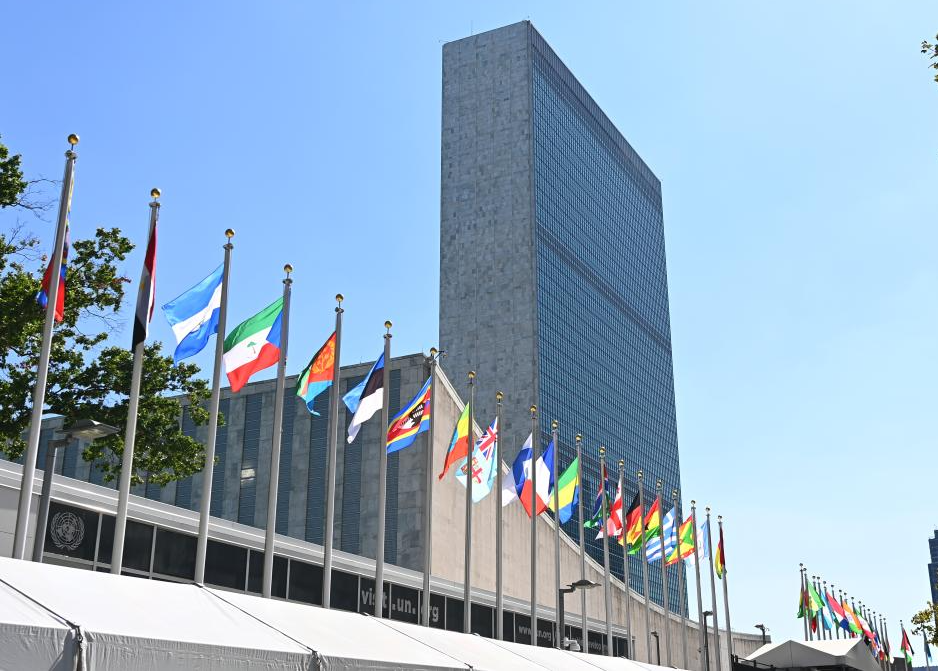
Let’s state the obvious straightaway: The U.S. is a double-revisionist state. It’s not only abandoning and violating the international system it helped create but also betraying the fundamental theory and values it long claimed were vital for global peace and development. Furthermore, although the U.S. is trying to sustain its hegemony, one can’t reasonably argue it is a status quo state. This is because U.S. hegemony has already eroded to such a point that its position as the status quo power has already been lost. Consequently, while the U.S. tries to behave in unilateral and unipolar ways, while it’s trying to recover the power it once held, we already live in a multilateral and multipolar world.
Furthermore, it should be noted that this is not the first time that we have lived in such a world. Indeed, the international governance system was founded in the multipolar conditions prevailing after World War II. Thus, multilateralism was designed as the handmaiden of multipolarity and the desire to minimize potential conflict. From this historical vantage point, we can note that the U.S. rising as the world’s sole superpower in the 1990s, then declaring a new world order and fashioning itself as the world’s policeman, embarking on decades of illegal invasions, regime changes and military occupations, and doing so while sometimes deceiving, sometimes strong-arming, and sometimes ignoring the UN, was completely out of step with the post-war global governance system that aimed from the beginning to prevent precisely these kinds of destructive excesses.
China, a reformist state
Let’s also be clear: China is a reformist state. It’s neither revisionist in either meaning of the word nor foolishly embracing the status quo. In short, China is not betraying the principles of the international system but aims to strengthen them, as the GGI makes clear. Furthermore, because we’re living in a period of accelerating changes, because contradictions around the world are overdetermined, in this era more so than others, none can expect to survive very long by sticking with the status quo. More to the point, China rejects the status quo for two reasons: First, the status quo is always impossible to sustain; second, what passes at the status quo today is existentially perilous.
For example, China rejects the status quo of proxy wars between fossil fuel-dependent economies fighting over energy markets and how energy is paid for, above all because such struggles are trying to recover and reinforce old paradigms of hegemony and do so to the detriment of global ecology. China rejects the status quo of the U.S. building military alliances and proliferating weapons of mass destruction anywhere in the world, but most especially in Asia. China rejects U.S. policies like vaccine diplomacy or abandoning the global public health system. China rejects the status quo of the U.S. meddling in China’s internal affairs or the affairs of others. China rejects the status quo of the U.S. exercising abusive fiscal and monetary policies and externalizing those costs globally through gross domestic financial mismanagement and failed governance. China rejects the status quo of America’s ability to manipulate the global financial system and pursue antagonistic policies like a global trade war. And by the way, all of the pillars of the existing global governance system, including the UN, the World Trade Organization, the World Health Organization and the Paris Agreement, were likewise formed to oppose these kinds of bad behavior.

On the other hand, a status quo state is one that likely enjoys systemic privileges, typically at others’ expense, and often does so asserting the “end-of-history” narrative. In a global governance system that is supposed to be equitable, systemic privileges are either abuses or temporary aberrations, and all the more so because we know the “end-of-history” thesis is metaphysical nonsense. We know history never stops, and those who pretend it do get left behind, fuming and blaming others for their own?failures.
Interestingly, among social scientists, those who are devoted to the status quo are frequently prone to irrationalism, a type of cognitive bias, one literally called “status quo bias.” One might argue Washington is thusly afflicted, not simply because conservative ideologues are especially prone to such problems, as research also reveals. Rather, it’s because ongoing U.S. attempts to bring the world to heel are merely accelerating American declines—falloffs that have been observed for the past quarter century at least.
Furthermore, no expert worth their salt believes such policies will return the U.S. to former glories or contribute meaningfully to a shared future for humanity. But to again note the obvious, this irrationalism is found precisely in the revisionist tactics the U.S. now pursues to sustain a status quo that’s already past—a status quo that was always predicated on a zero-sum game with others, but is playing a zero-sum game with itself, unable to accept the reality of a new, multipolar world, deploying its armed forces domestically in a dark dance with itself, reeling from the whipsaw effects of herky-jerky polarization and trying to export the same abroad.
The GGI—espousing the purely positive principles of sovereign equality, abiding by international rule of law, multilateralism, the people-centered approach, and taking real actions—is not formed in opposition to the existing international system or even the U.S. itself. While the GGI is reformist, it’s neither revisionist nor committed quixotically to an unsustainable status quo. Rather, it’s dedicated to strengthening the architecture of global governance to serve the interests of all nations, including the U.S. It aims to rejuvenate the global governance system, again by recapturing and reinforcing the very principles and spirit that led to its creation in the first place. With such clarity and dedication, Beijing understands this is the only way for humanity to move forward together, and no amount of shock, denial, anger or bargaining will change this simple fact.
The author is a professor of politics and international relations and director of the Center for Ecological Civilization at East China Normal University in Shanghai. He is also a senior research fellow with the Institute for the Development of Socialism with Chinese?Characteristics at Southeast University in Nanjing.