Those Who Seek to Demolish Rule of Law Can’t Be Appointed as Keepers of Law
 Facebook
 Twitter
 Linkedin
 Google +
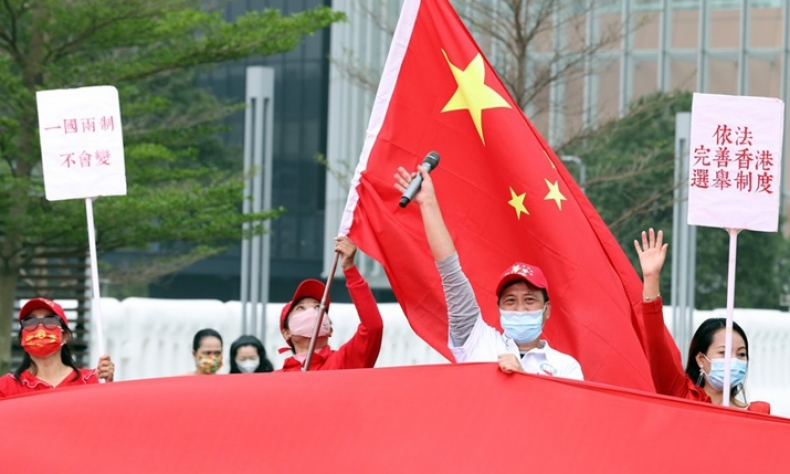
One cannot uphold the rule of law by including in governance those who wish to tear down the rule of law.
By most historical accounts, China began to emerge as a nation-state with the Xinhai Revolution in 1911. The struggle was to transform from a civilization-state to a nation-state, per the model imposed then by the hegemony of Western political models.
Those initial efforts were not successful, with major setbacks to come in negotiations on the Treaty of Versailles in 1919, sparking the May Fourth Movement and also further opening the door to more Japanese aggression as Tokyo took control of Shandong Province in east China and extended its reach elsewhere in China until Japan’s defeat in 1945.
A new national threshold was reached in 1949, when communist victory in China’s civil war initiated the People’s Republic of China. Since then, a major preoccupation of the Chinese Government has been securing those areas that present vulnerabilities to national security and sovereignty and the strategic exercise of that sovereignty for the greater national good.
It ought to be clear that the communists have never forgotten that their political legitimacy, past and present, is founded first and foremost on having solved and continuing to solve the “national problem.” This included completing the transition from the dynastic feudal system to the modern nation, reestablishing and maintaining sovereignty, and then ensuring the nation remains capable of preserving itself by keeping pace with emerging potential threats.
Altogether, being a responsible steward of the national interest has been and remains a key indicator of the government’s legitimacy, and arguably, the biggest risk to its power can come from domestic critics if they believe it has failed in this responsibility, or if international competitors manage to exploit it in existentially threatening ways or new weaknesses.
This basic understanding is at the root of many hot-button issues, whether security in Xinjiang Uygur Autonomous Region in the northwest, the boundary dispute with India, the Diaoyu Islands dispute with Japan, or the issue of “patriots governing Hong Kong.”
The first principle
Some in Hong Kong Special Administrative Region and certainly the United Kingdom have long chafed at the idea that Hong Kong is part of China. Their sentiments predate and postdate the return of Hong Kong in 1997.
Perhaps no other country in the world is more responsible than the United Kingdom for initiating China’s “century of humiliation,” a period that saw the British effectively seizing control of Hong Kong and other areas and opening the door for other foreign powers to do the same. The return of Hong Kong was supposed to help heal that difficult history in part. After making British sovereignty the driving principle of Brexit, doesn’t London understand Beijing’s similar position?
The true irony here is that the UK, by many historical accounts the first modern nation-state, was the nation that first foisted competitive nationalism on China, which in turn forced China to radically transform itself in ways that ran fundamentally contrary to traditional culture. Is it not completely reasonable that the issue of sovereignty over Hong Kong specifically is of importance to China, and that the UK itself is deeply responsible for this historically?
It’s a mistake to assume that “one country” and “two systems” are co-equal concepts, just as it’s a mistake to assume that China does not have and will not exercise sovereignty over Hong Kong, or to assume that Hong Kong and the mainland won’t change and grow together through time.
Consequently, if Hong Kong’s system takes a path where it undermines the principle of “one country,” then that system will be reformed. Additionally, when the “one country, two systems” concept was created, it was not imagined that the mainland and Hong Kong were “separate,” rather, the?opposite; nor was it assumed they would not grow together.
Furthermore, when the Basic Law of the Hong Kong Special Administrative Region of the People’s Republic of China came into effect in 1997, Article 5 stipulated “the previous capitalist system and way of life shall remain unchanged for 50 years.” The belief was that both the mainland and Hong Kong would be changed so much and likely grow together and be closer by then that the future leaders would face the task of figuring out how to move forward.
The idea in part was the mainland was developing in ways that would make it more like Hong Kong, and that Hong Kong would develop in ways that would make it more “Chinese.” In fact, there were specific objectives in place that aimed to foster these transitions, but they met increasing resistance among some parts of the population in Hong Kong, who were in turn championed by some foreign supporters, including some foreign governments officially, like the U.S. and the UK.
This led to spiraling social unrest, chaos and destruction, exceeding by far the Capitol invasion unleashed by Donald Trump supporters in Washington, D.C. earlier this year.
In response, the Central Government did not mobilize its troops. It did not impose martial law. Rather, Hong Kong police battled these elements legally and order was finally restored. Since then, Hong Kong’s legal system, including its chief executive, Legislative Council, and courts, have used the rule of law to maintain security and focus on other pressing challenges, like responding to the COVID-19?pandemic.
But the key point—maintaining “two systems”—first requires maintaining “one country.”
Other problems
To be sure there are other problems in Hong Kong that have motivated some protesters. These include high costs of living, especially related to housing, which have put a heavy burden on young people, as well as the working and middle classes.
There are other issues, like the lingering influence of Hong Kong’s oligarchy, a relic of British rule when tycoons were closely consulted by an appointed British royal governor. The extent to which the election reforms recently authorized at the annual session of the National People’s Congress, China’s top legislature, dilute the influence of those economically powerful people in Hong Kong will be an index of how these reforms actually promote democracy and address entrenched economic interests that are substantially responsible for some of the economic hardships others face.
Major government-led initiatives, like stalled land reclamation efforts that would help alleviate housing costs, can move forward only with a secure political system and adequate public security.
Rule of law
The word patriot is always double-edged. A patriot is by definition loyal to one nation, over and above others. In contemporary Chinese, there is no ambiguity about the meaning of this term, aiguo zhe.
But according to the Hanyu Da Cidian, the Chinese equivalent of the Oxford English Dictionary, the word first appeared in the Annals of the Warring States, composed?c. 200 B.C. At that time, the modern concept of nation-state did not exist. Rather, the term guo, which today is generally translated as nation, referred to a state or fiefdom. The larger construct of identity was civilizational as opposed to how we conceptualize national identity today.
This is to say that the Chinese insistence on patriotism among Hong Kong’s elected and appointed officials, in the modern sense, has less to do with Chinese tradition than Western impositions the Chinese adopted in order to survive the existential crises of foreign domination. It is therefore logical that those who are opposed to Chinese sovereignty in Hong Kong, who wish to undermine Chinese sovereignty, and above all, those who either conspire with foreign powers or serve their interests indirectly, cannot be permitted to hold power.
That ought to be reason enough but there is another point, a deeper corollary at work. One cannot uphold the rule of law by including in governance those who wish to tear down the rule of law.
Consequently, and contrary to some Western accounts, the Hong Kong election reforms are well-grounded legally and mark an important step toward moving past Hong Kong’s political crises. More deeply, the proposed improvements represent a codification of reality, which is the material threshold upon which the rule of law becomes possible and meaningful.
The author is professor of politics at East China Normal?University in Shanghai.
The article reflects the author’s opinions, and not necessarily the views of China Focus.