Trump’s Protectionism Can Drive China and Africa Closer
 Facebook
 Twitter
 Linkedin
 Google +

The ‘America first’ approach of the U.S. president risks giving rise to a ‘global first’ trend under which countries will look for alternative markets.
President Donald Trump has long harboured trade and tariff concerns. Almost four decades ago, Trump wrote, “The world is laughing at American politicians as we safeguard ships that are not ours, carrying oil that is not ours, destined for allies who will not support us … We have to make other people pay for our huge deficits.” As Trump returned to the White House, he implemented what he said almost four decades ago, and has imposed tariffs like never before. Based on his conviction that?“tariffs are about making America wealthy again,” some people think he has turned trade policy into a blunt economic weapon.
His decision has affected the U.S. economy, the global economy, as well as China-Africa cooperation. The implications for the U.S. are that while trade policy watchers seem relatively calm about the prospects of an economic revival, it’s important to note that with trade policy uncertainty soaring to an all-time high, U.S. policy has become a leading source of risk. Trump promised to lower prices and revive manufacturing. However, his maximalist approach to tariffs undermines both efforts, contributing to inflated prices and long-term inflation expectations. It should also be noted that Trump’s approach to these?“others” he mentioned in his letter above will not only include China, but will encompass all nations in the world as well, thereby impeding the administration’s stated priorities and undermining the economic dynamism and security of the U.S.
Negative consequences for the U.S.
Even though Trump has repeatedly argued that tariffs will boost U.S. manufacturing and protect jobs, it is, in fact, incorrect to believe that tariffs are paid by foreign countries and not by U.S. citizens, as the analysis of U.S. trade officials suggests. He has insisted that tariff increases did not cause prices to increase and that tariffs are a point of leverage and power over others. Meanwhile, economists generally agree that Trump’s tariffs, which tax imports paid by consumers and businesses, will slow growth and raise prices. Some economists say that middle-class American households would face $1,700 a year in higher costs, while others estimate a much bigger impact. There have already been sharp consequences as investors have begun to question the U.S.?economic exceptionalism. Consequently, the administration’s global levies on steel and aluminium have started to undermine the U.S.’s manufacturing revival. Trump’s similar tariffs, which were enacted in 2018, were responsible for creating just 1,000 steel jobs, while costing 75,000 jobs in steel-using industries.
As a result of the new, more comprehensive tariffs, 80,000 jobs may be supported in the U.S. steel industry. But in turn, they threaten a portion of 12 million jobs in industries that utilise steel and aluminium, indicating turbulence rather than a renaissance in the U.S. manufacturing sector. Since tariffs were raised, several major currencies have declined in value against the dollar, equity markets have plunged, consumer and business confidence have plummeted, and analysts have cut growth forecasts. The investment bank JP Morgan has affirmed that it now sees a 60 percent chance of the global economy entering recession by the end of the year, up from 40 percent before. Earlier this month, the European credit rating agency Scope issued a warning that prolonged trade conflicts could diminish global trust in the U.S. dollar.?

This could lead to a downgrade of the dollar’s credit rating and challenge the dollar’s dominance in global finance. The president has promised trillions of dollars in revenue and unprecedented job creation, making?“a little disruption” worthwhile in the long run. However, Trump’s recent tariff hike, which attempts to reset the global trade order, particularly against China, undercuts both his declared economic priorities as well as America’s economic strength. The result has been a radical and disruptive shift, creating a lot of economic adversity, global uncertainty, and domestic blowback in a variety of sectors, and the consequences have been felt across the globe.
Trump’s tariff policies have significantly impacted the global economy, affecting inflation, trade relations, financial stability, and international relations. The Organisation for Economic Co-operation and Development (OECD) has warned that Trump’s tariffs will slow global economic growth and reignite inflation if they continue to be implemented. The OECD has downgraded the growth forecasts for the U.S., Canada, and Mexico, citing the adverse effects of increased trade barriers as one of the reasons. Due to higher import costs, the U.S. economy is expected to experience a slower growth rate, accompanied by inflationary pressure. As a result of tariffs, global supply chains have been disrupted, particularly in sectors such as automotive and electronics. Due to the U.S. tariffs on Chinese imports, China has imposed its own tariffs on imports, affecting industries that are dependent on cross-border trade.
In addition to hampering production efficiency, this disruption also increases costs for businesses and consumers all over the world. Due to what is going on in the global economy, the international community views the tariff hikes more as an act of?“economic bullying” and?“unilateralism.” There has been an escalation of trade tensions as a result of the U.S. tariffs, with countries implementing their own tariffs in response. Besides the fact that the targeted countries are negatively affected by these retaliatory measures, this cycle of retaliation also creates uncertainty in global markets, deterring investment, and limiting opportunities to navigate choppy waters, all of which can adversely affect global economic stability and livelihoods, especially in developing countries.
China-Africa cooperation
Although Trump’s policy was primarily aimed at curbing China’s economic rise and addressing the trade imbalances between the U.S. and China, it triggered a broader set of strategic responses from China, some of which played out in Africa. In terms of Africa, 29 countries will be subject to a standard 10 percent tariff on all of their products while 22 countries will be subject to tariffs of up to 50 percent on almost all of their products, with the exception of a few products that are deemed essential to the U.S. economy, such as certain critical minerals.?
There is no denying the fact that U.S.-Africa trade has been strongly shaped by the African Growth and Opportunity Act (AGOA), which has, since 2000, provided African countries with preferential access at zero tariffs to the U.S. market for thousands of products, reflecting their relatively low levels of economic development. As a result of the new tariffs, African exports to the U.S. will become more costly. For example, the price of Nigerian or Angolan oil sold in the U.S. will rise. Additionally, they signal a major blow to AGOA, a trade policy many non-African countries accepted in 2000 at the WTO at the U.S.’s request. As a result, Trump’s tariff policies will not only have significant implications for African exporters like Nigeria, who will now sell fewer products in the U.S., but also on Africa-China cooperation, influencing trade dynamics, investment flows, and geopolitical alignments.
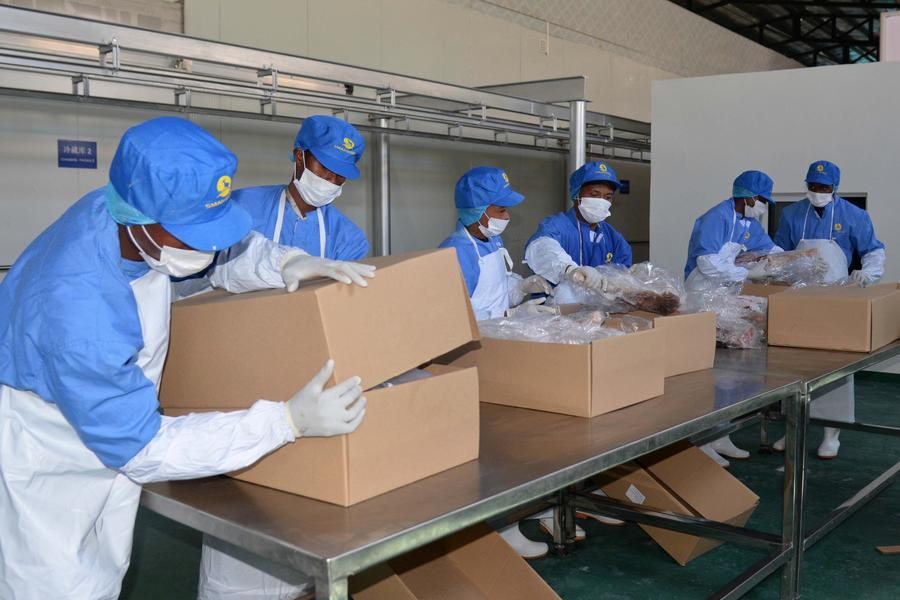
In a multipolar world characterised by a number of powers challenging the hegemony of the U.S., Africa has the opportunity to form diversified alliances that can help it to solve its economic problems, including trade relations with other countries. Therefore, African countries will have to rally as many countries as possible in order to secure investments, with a special emphasis on Chinese infrastructure and technology investments for long-term development.
Particularly in value-added sectors, original BRICS countries (Brazil, Russia, India, China, and South Africa) offer huge opportunities for African diversification. BRICS accounted for approximately 23.0 percent of Africa’s total exports in 2022, of which 65.0 percent went to China, 31.0 percent to India, 3.6 percent to Brazil, and 0.6 percent to Russia. BRICS and African countries can do more business together because of these low export shares. South Africa, which will now be charged 30 percent more for textile exports to the U.S., can switch some of those sales to Chinese markets at zero tariffs. These are benefits that least-developed countries like Tanzania and Congo can currently enjoy. In addition to enhancing intra-African trade, this will also reduce vulnerabilities to external markets while improving economic stability.
In contrast to the U.S.’s protectionist stance, China has positioned itself as a partner of the Global South. The fact that Africa saw China as a more consistent economic partner during a time of Western protectionism could lead to greater South-South cooperation, as well as more opportunities for China to promote economic fair play models that differ from Western ideals. China built more diplomatic goodwill in Africa with this narrative. As the U.S. imposed tariffs on Chinese goods, China has accelerated its efforts to diversify its trade partners – and Africa has become more attractive. Imports from Africa (especially natural resources and agricultural products) increased to offset the decline in imports from the U.S. With this diversification, Africa will be able to solidify its position as a strategic economic partner, going beyond just being able to extract resources from the continent. Additionally, due to the fact that the tariffs have created more economic uncertainty for China in Western markets, the Chinese government is increasingly urging Chinese infrastructure and technology firms and state-backed institutions to intensify their?“Go Global” strategy, especially in Belt and Road Initiative (BRI) countries, many of which are in Africa.
Consequently, Trump should understand that unless the U.S. engages with China and Africa in a meaningful and beneficial manner, the concept of “America first” with its protectionist stance may be overshadowed by the rise of a “world first” concept that strengthens world economic cooperation through various strategic plans and initiatives. In turn, this will create an opportunity for local and global businesses to enter and expand into a larger unified world market, thus creating a more balanced global economy.
The author is executive director of the Centre for Nigeria Studies, Institute of African Studies, Zhejiang Normal University.