Why the Quad Will Not Succeed to Subjugate China
 Facebook
 Twitter
 Linkedin
 Google +
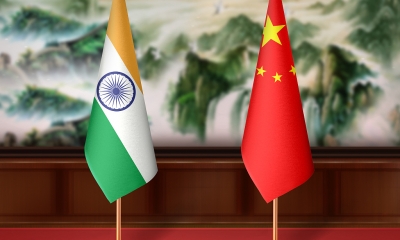
India should be well-advised not to be fascinated with the U.S.-led Quad at the expense of relationship with China. India must not let the U.S. fire its guns against China over its shoulders.
It is clear that the Biden administration’s views on China’s growing dominance on the international stage are not fundamentally different from those of the former U.S. President Donald Trump’s administration. Trump’s strategic competition and confrontation with China was immediate and short-term but Biden’s anti-China programme carries the signs of long-term planning.
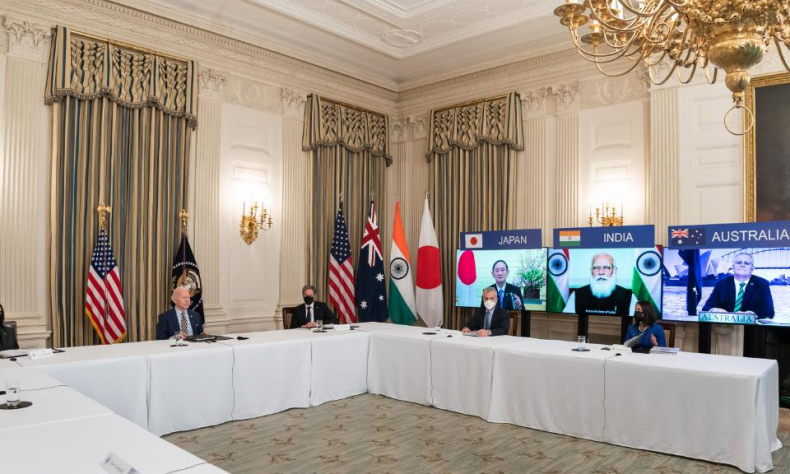
The proof of that is the first ever summit-level meeting of the leaders of the Quadrilateral Security Dialogue, known briefly as ‘Quad’ of the United States, Japan, Australia, and India held virtually on March 12,2021. The high-level virtual summit, hosted by U.S. President Joe Biden, witnessed the participation of Indian Prime Minister Narendra Modi, Japanese Prime Minister Yoshihide Suga, and Australian Prime Minister Scott Morrison.
Although the focus of the meeting at the highest political level was on a unified fight against the Covid-19 pandemic including ramping up the vaccination programme, the dialogue of the four leaders and the joint statement of the summit have clearly showed that it is directed against China to contain the country’s rise in the Indo-Pacific region, currently the most active region in the global geopolitical landscape under the leadership of President Biden. Furthermore, a closer look of the summit agenda reveals that the Quad leaders made their latent attempt to counter China’s vaccine donation programme under the Health Silk Road Initiative which already covers more than 60 countries around the world.
The birth of Quad: China in mind
Many Indian and western analysts believe that the Quad grouping which has been referred to as a “Concert of Democracies” is the answer to China’s so-called unilateral and expansionist actions in the Indo-Pacific Region, which is regarded as India’s backyard. However, the idea of a naval coalition comprising India, the United States, Australia and Japan arose from an urgent humanitarian assistance due to the devastating 2004 tsunami at the insistence of the then U.S. President George W. Bush and the then Indian Prime Minister Manmohan Singh. The tsunami had wreaked havoc across the 18 countries in the Indo-Pacific region as well as the eastern coast of South India on the morning after Christmas 2004.
The first incarnation of the Quad took shape when the senior officials of the four countries first met briefly under the new framework of Quad to discuss regional security issues on the sidelines of the ASEAN Regional Forum (ARF) in the Philippine capital Manila in May 2007 at the behest of Japan’s former Prime Minister Shinzo Abe. Notably, Abe used the term Indo-Pacific in his speech to Indian Parliament in August 2007, talking about the “confluence of the Indian and Pacific Oceans” as “the dynamic coupling as seas of freedom and of prosperity”. In the same year, the Quad countries conducted a naval exercise with Singapore under the banner of Malabar in the Bay of Bengal. After that, China served a demarche on all the participating countries asking them to explain whether the move was an anti-Beijing alliance in the making.
Thereafter, the Quad fell dormant under the weight of domestic politics in the member countries. It can be said that trade and business trumped other considerations. “Australia and to some extent India got cold feet over how much to push China without impacting other dimensions of their bilateral relationships with Beijing”, as noted by Derek Grossman, an adjunct professor at the University of Southern California.
The Quad is back: Eye on China
Since becoming Indian Prime Minister in 2014, Narendra Modi has been working closely with the United States under former U.S. President Donald Trump to contain China in the frame of Indo-Pacific strategy, including the South China Sea. It should be noted here that during his visit to Mauritius in 2016, Modi made a clear stance on India’s participation in the issues concerning the Indian Ocean Region under his ambitious vision of “Security And Growth for All in the Region,” known as SAGAR Initiative. As such, after a 10-year hiatus, the Quad was revived in 2017 at the initiative of Trump who took on the call for a “free and open” Indo-Pacific to opposing Chinese activities throughout the region.
In November 2017, the first formal official-level discussions took place under the theme of a “free and open Indo-Pacific” in Manila on the sidelines of the 31st ASEAN and the 12th East Asia summits and gave shape to the long-pending proposal of setting up the Quad to develop a new strategy to keep the critical sea routes in the Indo-Pacific free of Chinese influence. On November 12, 2017 at a dinner of the ASEAN summitry in Manila, Modi, Trump and Abe held their first official ‘Quad’ talks with a focus on keeping the Indo-Pacific region “free and open” to check Chinese adventurism in the area.
It is important to note here that in 2019, the U.S. State Department published a document formalizing the concept of a “Free and Open Indo-Pacific”, to be sustained among members of “the Quad”. In recent years, the Quad leaders have been pushing many of the 10-nation ASEAN block into an alliance against China’s South China Policy. In addition to the QUAD countries, many European countries such as France, Great Britain, and Germany have started showing a considerable interest in the region.
The QUAD summit goes after China
Since the Quad’s resurrection in November 2017, the group has met many times at the political, military, and official levels and has openly identified China as the prime source of instability in the Indo-Pacific region due to their increasing spats with China over political, trade, and border disputes. In the recent past, the four nations have been patrolling together in the South China Sea in the name of wanting “to promote a free and open Indo-Pacific, including support for freedom of navigation, territorial integrity, and a stronger regional architecture through Quad”. The pre and post-Quad Summit statements prove that confrontation, not cooperation, with China has become the shared goal of the Quad countries.
Just before the Quad summit on March 12, the White House announced that one of President Biden’s earliest multilateral engagements “speaks of the importance we place on close cooperation with our allies and partners in the Indo-Pacific”. On the other hand, Modi said the Quad would discuss a “free, open and inclusive Indo-Pacific region”, an apparent reference to China. Convening a Quad summit at the leaders-level by President Biden reflected the Biden administration’s ambitions of turning it into an Indo-Pacific NATO which has drawn immediate response from the other three leaders. In his address to Quad leaders on March 12, the U.S. President said: “The Quad is going to be a vital arena of cooperation in the Indo Pacific and I look forward to working closely with all of you in the coming years.”
Although the summit did not name China directly, the joint statement has clearly shown that it is designed to check China’s claims of sovereignty over the South China Sea under the Biden-led U.S. administration. The rhetorical pitch such as “security challenges” and “the rules-based maritime order in the East and South China Seas” in the joint statement gave adequate hints of the Quad members’ antagonism towards China which is a littoral, indigenous and integral to the South China Sea.
Quad’s China conundrum “ambiguous and contradictory”
Although the Quad members are trying to prove that the four-country “security bloc” is a benign grouping by the establishment of COVID-19 vaccine partnership which will result in the production of one billion vaccine doses in India by 2022 for exports to the Indo-Pacific region, in reality, the summit has unveiled its military and political objectives in the Indo-Pacific region. A closer examination of the joint statement and the joint op-ed in The Washington Post authored by the four leaders have raised some questions among the public at large that need to be answered by the chief architects of the Quad.
Is there a singular instance in which the maritime lane of the South China Sea has been blocked by China? Can the Quad nations submit an example of China’s political pressure on other littoral countries to the South China Sea? Is there any evidence that China invaded anywhere for centuries or does the country plans to invade anywhere in the Indo-Pacific region? The answer is No. So why worry? Why do ASEAN countries feel tense and uneasy every time when the U.S. and its allies conduct a military exercise in the South China Sea? Are the Modi government and its advisers in the view that China will eventually invade India crossing its borders and is bound to win? So, why is the blame game put on China?
Without hesitation, it can be said that the Quad’s “China threat” theory in the name of “freedom of navigation” is misleading. Quite rightly the Time magazine labeled the alliance “ambiguous and contradictory”. Any attempt to contain and threaten today’s China by the Quad military alliance will not succeed due to differing interests among the participants. As The Global Times on March 8 wrote in an editorial article: The Quad alliance is an “Empty Talk Club” and “water-testing” by the U.S. “to sound out” its Asian partners’ attitude toward forming an “unbreakable alliance” to counter China’s rise. It also insinuated that part of the reason for its failure is the members’ “all-for-itself” agenda, and they “won’t tie themselves to the U.S. scheme”.
What many political analysts wonder is why India being a member of the Shanghai Cooperation Organization (SCO) is irritating China by joining a part of the U.S.-led security alliance against China?
India’s national interests should be based on its rational calculations.?Today, China is the forefront of the world factory and India has much to gain by befriending it, and not needling it. Today, India’s manufacturing sectors are heavily dependent on Chinese supply chains. As Chinese Foreign Minister Wang Yi said about the relationship, “the boundary dispute, an issue left from history, is not the whole story of the China-India relationship.” There are many potential cooperation opportunities between India and China despite lingering border disputes between the two big neighbours. India should be well-advised not to be fascinated with the U.S.-led Quad at the expense of relationship with China. India must not let the U.S. fire its guns against China over its shoulders.