Win-Win and Its Historical and Cultural Contexts
 Facebook
 Twitter
 Linkedin
 Google +
Win-win is one of the core values expressed in China’s promotion of genuine multilateralism and a multipolar world, one that opposes unilateralism and hegemony.
Chinese leaders often assert the need to foster win-win solutions when promoting domestic and international policymaking, including policies related to trade. Some critics, especially those who normalize zero-sum approaches, reject win-win as wishful thinking. So let’s consider here why win-win is so prominent in contemporary Chinese thinking and some of the ways it can be realized in theory and practice.
Historical roots
To begin, win-win is a familiar English term, but it’s also found in many different linguistic traditions. In Arabic, for example, it’s wade muthmir liljamiei, which translates as “a fruitful situation for all.” In Chinese, it’s gongying, which translates literally as gong, “common” or “communal,” and ying, “win.”
In fact, the idea of mutually winning is so common in China that multiple expressions exist to describe such an outcome. For example, gongying is similar to shuangying, which also translates as win-win, but the latter indicating a two-person or party exchange, one that’s commonly used to describe a mutually profitable business relationship. Both terms contrast with liangbai jushang, which translates as “lose-lose,” and sunren liji, “self-interest at the expense of others.”
The meaning of ying is rather straightforward while gong has much deeper historical roots that resonate with contemporary discourse. Gong first appears in the oracle bone script during the middle part of the Shang Dynasty (1600-1046 B.C.), more than 3,000 years ago. Scholars theorize that the character began as a pictograph of two hands holding a cup and presenting it respectfully to an elderly person or ancestors. Later, this acquired the meaning of sharing together something in common.

Scholars are uncertain, however, when gongying was first used as a specific term. Neither it nor shuangying appears as a set phrase in the Hanyu Dacidian—the closest Chinese equivalent to the Oxford English Dictionary. Gongying does appear in a late-Qing Dynasty (1644-1911) text describing a possible outcome of yexi, a card and dice game, where multiple players win. However, while this specific term might only be a little more than a century old, the idea is much older. For example, another term, jianying, which is no longer part of Chinese vernacular, appears in an important poem, Ode to Xijing, by the Han Dynasty (206 B.C.-A.D. 220) polymath, Zhang Heng. He wrote yuzhe jianying, describing a market situation where all the sellers earn profits and all the buyers also benefit.
This idea is not uncommon to Western economic theory. For example, David Ricardo’s 1817 theory of “comparative advantage” describes a situation where producers with different strengths can produce and trade with each other in mutually beneficial ways. Additionally, some utilitarian philosophers, like Jeremy Bentham, have been interpreted as promoting positions that try to maximize win-win relationships throughout society. Separately, Mary Parker Follett, sometimes called the “mother of modern management,” influentially described practices in 1924 that are today called win-win approaches for solving conflicts.
Contemporary relevance
Some Chinese will tell you that gongying often associates with politics, likely due to its frequent use by President Xi Jinping and other Chinese leaders.
For some educated Chinese, gongying connects with the aforementioned jianying, and this links further to a classical Chinese philosopher, Mozi. His key idea is jian’ai, “universal love,” the ultimate goal of which is the benefit of all people, which he promotes with feigong, meaning, “do not attack, use peaceful means instead.”
That said, the idea does figure prominently in contemporary Chinese Marxist thought and foreign policymaking. In these contexts it does not assert that all relationships or conflicts can or should be win-win; nor does it assert that winning will necessarily include everyone or be egalitarian. In some win-win situations, there might be those who win more than others, and there might be a few losers. Nevertheless, it functions as a principle, one that is consistent with efforts to build “a new type of international relations with win-win cooperation at its core.” It likewise underpins President Xi’s call for building a community with a shared future.
In other words, win-win is one of the core values expressed in China’s promotion of genuine multilateralism and a multipolar world, one that opposes unilateralism and hegemony. It’s likewise promoted as a core value of China-proposed major international initiatives, including the Belt and Road Initiative, the Global Development Initiative, the Global Security Initiative (GSI) and the Global Civilizations Initiative. It’s likewise consistent with China’s efforts at home and abroad to accelerate development, alleviate poverty and promote ecologically conscious civilizations, especially in the Global South.
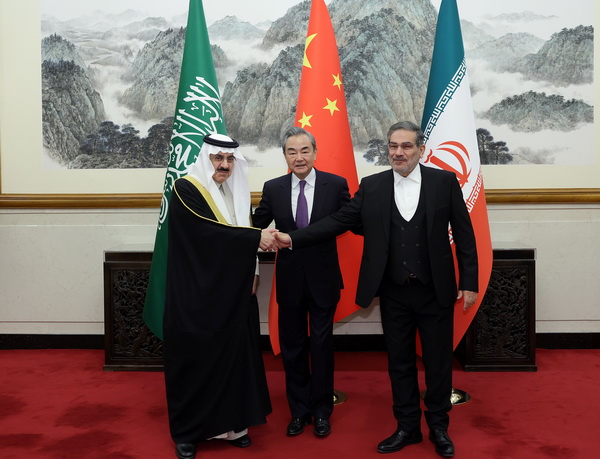
Using the win-win values at the heart of the GSI, for example, China recently helped Saudi Arabia and Iran reestablish diplomatic relations after decades of tension. As the two sides noted, they will continue to compete with each other on some fronts, but will now seek to emphasize their common ground and how they can work together to achieve win-win outcomes.
Win-win is often used by Beijing to promote reform and opening up and globalization. This runs contrary to Washington’s return to great power competition, as well as the new nationalisms haunting both the U.S. and Europe, helping to fuel Cold War impulses like decoupling and small-bloc building. That said, win-win also answers xenophobic and isolationist criticisms that sometimes pop up in China itself.
References to the etymology of gongying and how it can be linked to other concepts, like Mozi’s jian’ai, are not gratuitous. In recent years, Chinese thinkers, including the president, Party intellectuals and Chinese scholars more broadly, have returned openly to traditional Chinese thinking to recover good ideas that can be advanced today in domestic and foreign affairs. This includes references to Laozi and Zhuangzi, for example, with stanza 25 from the Daodejing, where Laozi writes, “Dao follows nature,” and from the second chapter of Zhuangzi, “Heaven and earth are born with me, and all things are one with me.” Lines like these, which coalesce as the first principle of Daoism of “promoting harmony between people and nature,” are being directly linked to efforts with current policies promoting ecologically conscious civilizations, with the understanding that we all benefit from a cleaner environment but can only achieve one if we work together in win-win ways to promote green practices.
In fact, Chinese Marxism has long expressed itself as offering a modern concordance with various traditional Chinese concepts, like yin-yang thought, the “unity of opposites,” the inevitability and value of change, and the need to create and sustain “harmony.” Perhaps most famously, Chinese Marxism has emphasized Confucian principles like building a xiaokang or moderately prosperous society, as a threshold for advancing the grander socialistic goals associated with achieving a datong or great harmony society, as first described by Confucius in the Book of Rites (Liji).
In short, this return to traditional thought continues to deepen, reinforcing efforts to adapt Marxism to the Chinese context, with Chinese Marxism emerging as an advanced syncretism of Chinese thought, one that promotes a great number of transhistorical values and what the philosopher Georg Wilhelm Friedrich Hegel called “a concrete universal,” as a means for advancing the dreams and aspirations of the Chinese people that are likewise consistent with those held by others around the world. This includes avoiding conflict and promoting win-win outcomes whenever possible.
The author is a professor of politics and international relations at?East China Normal University and a senior research fellow with the Institute for the Development of Socialism With Chinese?Characteristics at Southeast University.