Xinjiang Wins a 40-Year Battle Against Sand Erosion
 Facebook
 Twitter
 Linkedin
 Google +
The China model really shows that you can have development with these green ways.
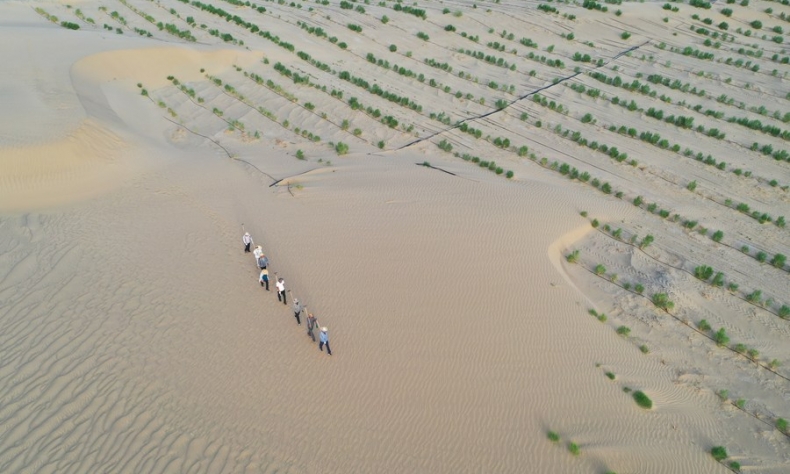
Forty years ago, driving through Hotan Prefecture in south Xinjiang Uygur Autonomous Region meant skirting the southern edge of the Taklamakan Desert, China’s largest desert and the world’s second largest shifting desert. Back then, the solitary bus stations that emerged at intervals from the billowing dust were among the only sources of supplies, but they now have become a distant memory. A decades-long struggle between human and nature is entering a new phase this year, as the last few challenging gaps have been filled in a green wall encircling the desert. This “wall” is basically a vast network of shelterbelts—areas of trees and shrubs planted to protect farmland from wind and soil erosion.
The perimeter of the Taklamakan Desert stretches approximately 3,046 km and by the end of 2023, a green barrier spanning 2,761 km had already been established along it.
Uygur photojournalist Ablikim Ibrayim was in Hotan as the last section of the green wall, a belt of forests and grasslands, the remaining 285-km gap was filled on November 28. “In the past, once you left the city, there was only sand, but now, along the desert highway, there are green plants, and gradually, everything has become green,” Ablikim told Beijing Review.
Ablikim was born and raised in Hotan, left to pursue his studies, and returned to his hometown to work for local media. For as long as he can remember, the life of Hotan’s people has been intertwined with the act of planting trees. “As for why, I think it’s probably the sandstorms decades ago that almost swallowed our lives,” he said.
In the 1980s, a severe sandstorm buried most of the farmland and houses in Cele, a county in Hotan, forcing many villagers to leave. Following the disaster, large dunes formed less than two km northwest of the county seat, prompting local authorities to predict that the dunes could fully bury it within three years.
But most of the villagers had nowhere to go and could only fight back against the encroaching sands. At that time, the Chinese Academy of Sciences set up an anti-desertification station in the county, sending experts to assist local efforts.
Within a year, Cele had mobilized over 10,000 people to divert mountain floodwaters toward the large sand dunes. The floodwaters eroded the sand over a six-year period, finally cutting off the tongues of sand that extended toward the county seat.
The immediate threat of Cele being buried was temporarily averted, but the danger persisted.
“Plant trees! Go plant trees in the desert!” locals called for action.
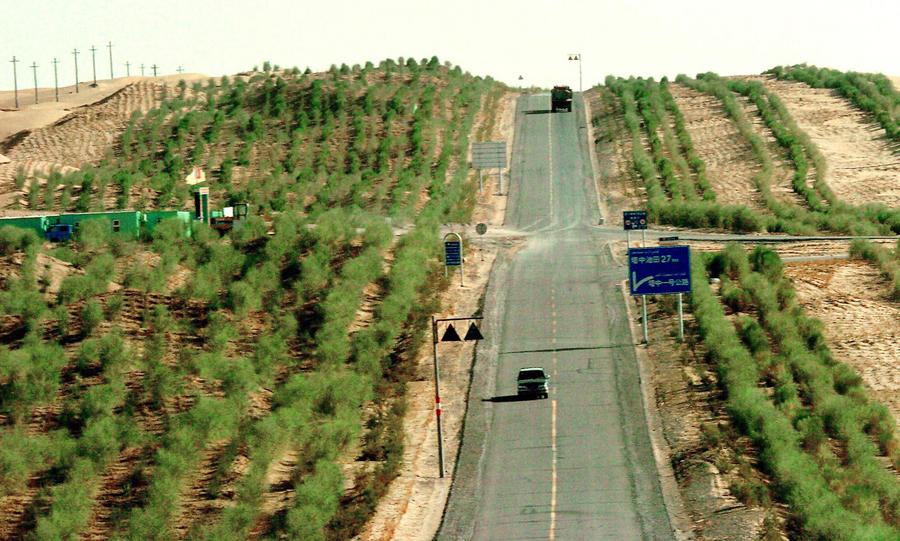
Each spring and autumn, local officials, farmers and other residents joined the fight to protect their homes. For over 30 years, the commitment to combating desertification has remained steadfast.
“Now, there is much less dust and the ‘black wind’ storms we experienced as children have basically disappeared. Also, it used to rain very little, but now during the rainy season, it rains 10 to 20 times a year. Although rainfall isn’t heavy, it is there,” Ablikim explained.
Navigating challenges
In addition to planting trees, more efficient and tailored approaches are being utilized in Xinjiang’s desert control. In areas with abundant water, biological sand control is used with a focus on restoring the natural ecological balance of desert areas.
Photovoltaic sand control is preferred in areas lacking water and located far from oases, because it uses large photovoltaic panels that not only generate electricity but also reduce ground wind speed and wind erosion, in turn stabilizing the sand. Underneath the photovoltaic panels, drought-resistant plants or crops can be grown, fixing the sand with their root systems, achieving a synergy of power generation, agricultural income and sand control.
In areas where neither condition is met, engineering sand control is the primary method. Engineering sand control involves pressing thousands of 40-cm lengths of dry reeds into the soil to create sand-stabilizing grids, or using longer sections of reed to create sand barriers.
However, no matter how great the methods, they still require a lot of effort. In the past year, nearly 540,000 people have participated in green wall projects.
“The areas in Xinjiang most severely affected by wind and sand overlap greatly with impoverished regions. Harsh natural environments are one of the root causes of poverty,” Chen Yaning, a researcher at the Xinjiang Institute of Ecology and Geography, Chinese Academy of Sciences, told Xinjiang Daily. Sand control efforts have not only improved the ecological environment but also increased the incomes of participating local residents, further consolidating and expanding the achievements of poverty alleviation in Xinjiang.
In some counties, people have used wheat to stabilize sand, planted jujube orchards, and then sold the jujubes nationwide. Other approaches involve the cultivation of specialized sand crops, like members of the Cistanche genus, which have a great market for their use in traditional medicine and health supplements, and goji berries, sea buckthorn, oleaster, alfalfa, and licorice. These plants are well-suited to the arid climate and play a vital role in both economic and environmental sustainability.
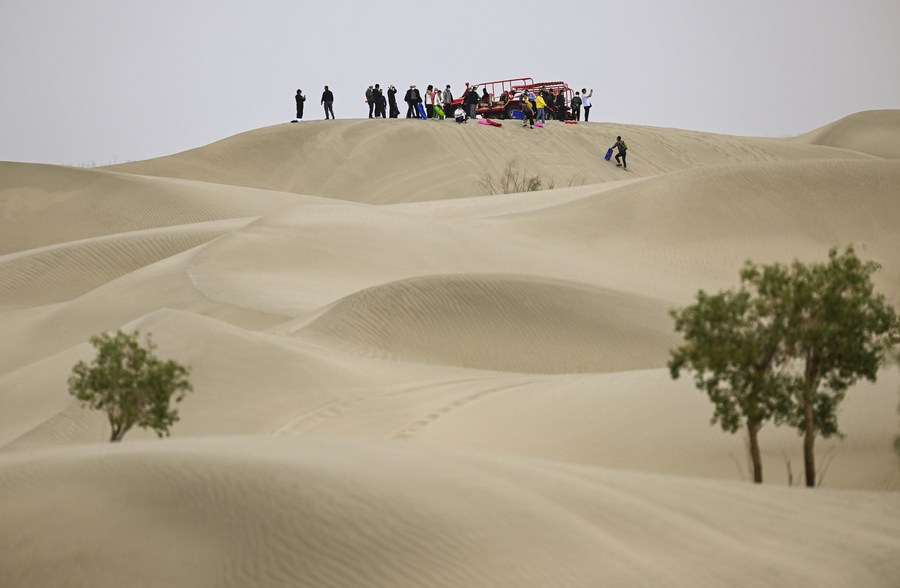
The burgeoning desert tourism industry presents another avenue for economic development. The unique landscapes of the Taklamakan Desert attract tourists seeking adventure and cultural experiences, from camel treks to exploring the historical Silk Road sites.
From local to globe
The green wall project is a key initiative in Xinjiang’s efforts to combat desertification this year as well as an important part of a national campaign.
On June 6, 2023, at an ecological symposium in Inner Mongolia Autonomous Region, President Xi Jinping mobilized the nation to strive for a decade-long campaign to advance the Three-North Shelterbelt Program, making it a fully functional and unbreakable Great Green Wall eco-security shield in northern regions. Xi emphasized the vital need to prioritize ecological conservation, stressing full commitment to sand control in the Hexi Corridor-Taklamakan Desert region.
The launch of the Three-North Shelterbelt Program in 1978 marked the beginning of China’s ambitious efforts to improve its ecological environment through major engineering projects. This extensive initiative spans some 700 counties across 13 provinces in northeastern, northwestern and northern regions of the country, hence the name “Three-North.”
The program aims to combat desertification, reduce soil erosion, and improve agricultural productivity by establishing a network of shelterbelts. Over the decades, it has evolved into one of the largest reforestation efforts in the world.
As of June, the program had completed afforestation of 32 million hectares and rehabilitated 85.3 million hectares of degraded grassland. Forest coverage rate in northern regions has increased from 5.05 percent in 1978 to 13.84 percent, and the proportion of degraded sections to total grassland area in these regions has decreased from 85 percent in 2004 to around 70 percent, according to the official website of National Forestry and Grassland Administration.
The Three-North Shelterbelt Program has been highlighted as one of China’s key experiences for sharing at the 16th Conference of the Parties (COP16) to the United Nations Convention to Combat Desertification (UNCCD), held from December 2 to 13 in Riyadh, Saudi Arabia.
While visiting the China Pavilion at COP16, UNCCD Deputy Executive Secretary Andrea Meza Murillo highly commended China’s efforts to advance desertification control and development simultaneously.
“The China model really shows that you can have development with these green ways. So for this reason it’s so important to have the pavilion here in COP16 and it’s so important that they are having this leadership inside the UNCCD COP,” Murillo said.